BuildCheckvsHoumify
Side-by-side battle & analysis. Compare features, pricing, real community ratings, and pros & cons in 2026.

BuildCheck
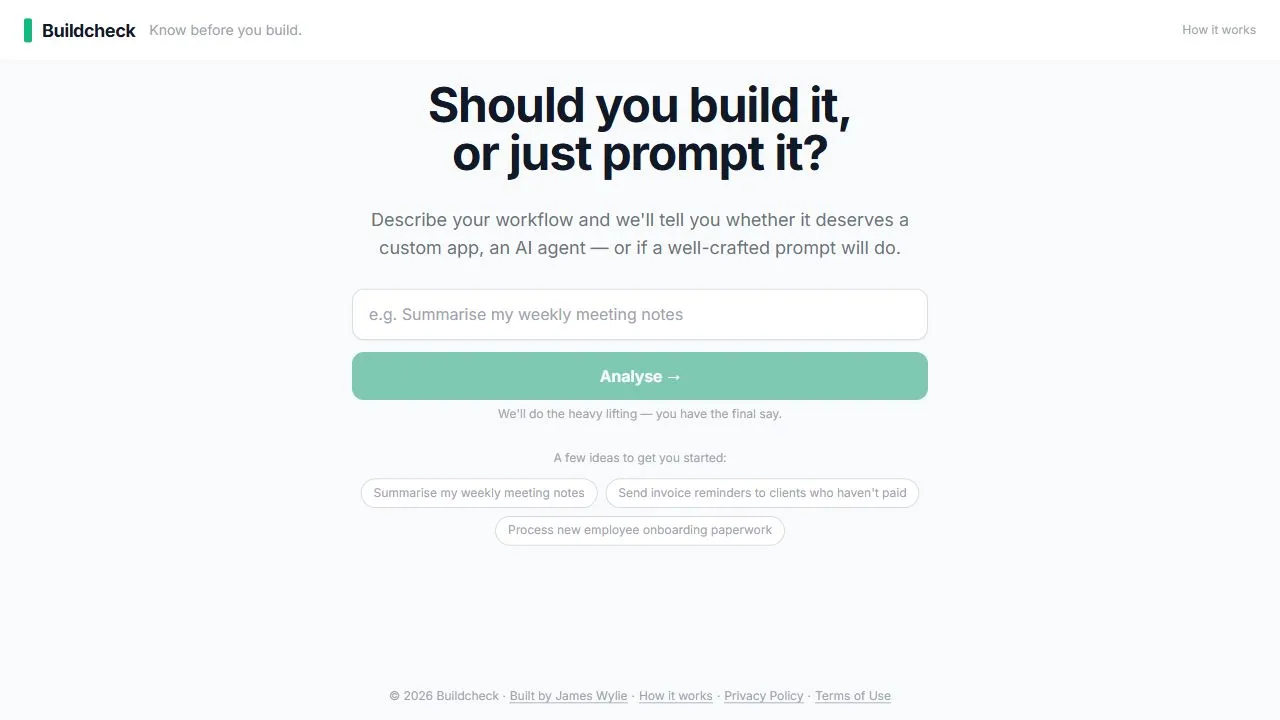
Know before you build. BuildCheck provides critical insights to avoid risks during construction and real estate projects.

Houmify
Houmify is an AI-powered property companion designed to help users discover personalized real estate solutions by leveraging artificial intelligence, machine learning, and data analytics .
Quick Verdict & Takeaway
Head-to-head summary recommendation
Both BuildCheck and Houmify provide high-performance solutions in the Real estate content ecosystem. Both platforms are top-rated in their respective categories.
Choose BuildCheck if:
You need a free tool optimized for Real Estate Services with TEXT input formats.
Choose Houmify if:
You prefer a free platform geared towards Real Estate Services with TEXT output options.
Specification & Feature Matrix
Direct technical comparison between BuildCheck and Houmify
| Feature / Spec | BuildCheck | Houmify |
|---|---|---|
| Pricing Model | FREE | FREE |
| Starting Price | Free / Not Listed | Free / Not Listed |
| Category | Real estate content | Real estate content |
| Subcategory | Real Estate Services | Real Estate Services |
| Supported Inputs | TEXT | TEXT |
| Generated Outputs | TEXT | TEXT |
| User Rating | ★ 4.0 / 5.0 (0) | ★ 4.0 / 5.0 (0) |
| Verified Status | Unverified | Unverified |
Interface & UI Showcase
Visual previews and interface screenshots
BuildCheck Interface
Houmify Interface


Pros & Cons Comparison
BuildCheck Pros & Cons
Strengths
- Free of charge
- Reduces project risks
Limitations
- Geographic limitations
- Requires data coverage in your area
Houmify Pros & Cons
About BuildCheck
BuildCheck is an innovative AI-powered pre-construction intelligence platform designed to provide developers, homeowners, and contractors with critical transparency and clarity before commencing any building project. By leveraging artificial intelligence and intelligent data aggregation, the tool streamlines the complex and often fragmented research phase of construction, ensuring that users are fully aware of the constraints and possibilities associated with a specific plot of land or existing structure. It addresses the pervasive problem of unforeseen construction obstacles by centralizing local regulations, site history, and environmental factors into an actionable, accessible format. The platform functions as a digital consultant, utilizing AI to sift through vast amounts of municipal and environmental data to help users "know before they build." This proactive approach is engineered to mitigate the high risks associated with real estate development, such as zoning violations, soil instability, or unexpected legal easements. By providing a consolidated view of a site's viability, BuildCheck empowers stakeholders to make data-driven decisions, significantly reducing the likelihood of costly project delays or total project failure during the execution phase. Designed for a diverse user base—ranging from first-time home renovators to professional commercial developers—BuildCheck transforms the traditionally manual process of due diligence into an automated, efficient workflow. Through the application of intelligent workflows, the tool eliminates the need for tedious manual searches through outdated government archives or expensive preliminary consultations. This makes it an essential component of the modern PropTech stack, optimizing the earliest stages of the construction lifecycle for maximum efficiency and risk reduction. Key Features of BuildCheck Consolidation of local building regulations and zoning ordinances into a simplified format. Comprehensive analysis of historical site data to identify previous land usage. Detection of environmental constraints and potential geographic hazards. Automated aggregation of site-specific information to reduce manual research time. Digital consulting interface for rapid pre-construction feasibility assessments. Integration of verified data streams to ensure information accuracy. Intelligent identification of potential building permit hurdles and regulatory roadblocks. Simplified reporting of site constraints for easier communication between stakeholders. Geographic-based data retrieval for targeted site analysis. Centralized dashboard for managing multiple project sites simultaneously. Why People Use BuildCheck The primary motivation for using BuildCheck lies in the avoidance of "hidden" costs that frequently plague the construction industry. Traditionally, the research phase of a building project required manual intervention: visiting city halls, hiring expensive land surveyors for preliminary checks, or spending dozens of hours scouring fragmented online PDF registries. These manual methods are not only time-consuming but are highly prone to human error, where a single missed regulation or an overlooked environmental easement can lead to thousands of dollars in fines or the requirement to demolish completed work. People transition to BuildCheck because it replaces this uncertainty with precision. The tool provides a scalable way to perform due diligence, allowing developers to screen multiple properties quickly before committing capital. By automating the gathering of regulatory and environmental data, users can identify "deal-breakers" in minutes rather than weeks. The shift from a reactive approach—discovering a problem during construction—to a proactive approach—identifying the problem during the planning phase—saves immense amounts of mental stress and financial resources. Furthermore, the platform is utilized to level the playing field for smaller contractors and individual homeowners. Historically, only large-scale developers had the budget to employ full-time consultants to navigate the complexities of municipal codes. BuildCheck democratizes access to this intelligence, providing professional-grade insights that ensure any project, regardless of size, is built on a foundation of verified information. Popular Use Cases Residential Home Extensions: Homeowners use the tool to verify setback requirements and height restrictions before designing an addition to their property. Land Acquisition: Real estate investors utilize BuildCheck to assess the viability of a vacant lot, ensuring there are no environmental hazards or zoning restrictions that would prevent their intended use. Commercial Development: Developers employ the platform to review mixed-use zoning laws to determine if a specific site can support both retail and residential units. Contractor Bidding: Construction firms use the gathered data to provide more accurate and competitive quotes by factoring in known site constraints from the outset. Environmental Compliance: Project managers check for protected wetlands, flood zones, or endangered species habitats to ensure the project meets all legal environmental standards. Urban Renewal Projects: Architects use the tool to understand heritage constraints and preservation laws when renovating buildings in historic city centers. Permit Application Pre-screening: Users identify potential regulatory conflicts before submitting formal permit applications to the city, increasing the rate of first-time approval. Benefits of BuildCheck Substantial Cost Avoidance: By identifying regulatory or environmental roadblocks early, users avoid expensive mid-project redesigns and legal penalties. Accelerated Project Timelines: The automation of the research phase reduces the time spent in the pre-planning stage, allowing projects to move to the construction phase faster. Enhanced Decision Confidence: Users can commit to land purchases or design plans with the certainty that their decisions are based on comprehensive, verified data. Reduced Operational Risk: The tool minimizes the chance of encountering unforeseen site conditions, leading to smoother project execution and fewer disputes with local authorities. Increased Productivity: Professional contractors can manage more leads and bids simultaneously by reducing the time spent on manual site due diligence. Improved Accuracy: AI-driven data aggregation reduces the likelihood of human error associated with interpreting complex municipal codes and site histories. Simplified Stakeholder Alignment: Providing a clear, consolidated report of site constraints allows owners, architects, and contractors to start the project with a shared understanding of the limitations.
About Houmify
Houmify is an AI-powered property companion designed to help users discover personalized real estate solutions by leveraging artificial intelligence, machine learning, and data analytics . Houmify addresses the challenges of navigating the complex real estate market by providing a platform that understands individual preferences and delivers highly relevant property recommendations. It solves the problem of information overload and inefficient searching, offering a streamlined experience for buyers, sellers, and investors. The tool utilizes AI to analyze market trends, property data, and user behavior, ultimately simplifying the process of finding the ideal property or making informed investment decisions. Houmify is intended for anyone involved in the real estate process, including prospective homebuyers, property sellers, and real estate investors seeking data-driven insights. It is a valuable resource for those looking to optimize their real estate journey and achieve their property goals. Key Features of Houmify Provides personalized property recommendations based on user preferences. Analyzes real estate market trends using AI algorithms. Offers detailed property information and insights. Facilitates neighborhood analysis and comparison. Enables users to save and organize preferred properties. Delivers data-driven insights for informed decision-making. Supports property searches based on various criteria. Offers a user-friendly interface for seamless navigation. Provides insights into property values and investment potential. Allows users to explore properties based on lifestyle preferences. Why People Use Houmify Individuals and organizations utilize Houmify to streamline and enhance their real estate experiences. Traditional property searches often involve sifting through countless listings, relying on limited information, and potentially making decisions based on incomplete data. Houmify differentiates itself by employing artificial intelligence to curate a personalized selection of properties that align with specific needs and preferences. This approach saves users significant time and effort, while also increasing the likelihood of finding a suitable property. The platform’s AI-driven analysis of market trends and property data provides a level of insight that is difficult to achieve through conventional methods. This empowers users to make more informed decisions, whether they are buying, selling, or investing in real estate. Houmify’s ability to analyze neighborhoods and provide comparative data further enhances its value, offering a comprehensive understanding of the surrounding environment. Ultimately, users choose Houmify for its efficiency, accuracy, and ability to simplify the complexities of the real estate market. Popular Use Cases First-time homebuyers: Discovering properties that match their budget, lifestyle, and location preferences. Real estate investors: Identifying promising investment opportunities based on market trends and property values. Property sellers: Gaining insights into comparable properties and optimizing listing strategies. Relocating individuals: Finding suitable housing in a new city or region based on specific criteria. Real estate agents: Enhancing client services by providing data-driven property recommendations. Property developers: Identifying potential development sites based on market demand and zoning regulations. Rental property seekers: Locating rental properties that meet their needs and budget. Neighborhood researchers: Analyzing neighborhood demographics, amenities, and property values. Downsizing seniors: Finding smaller, more manageable properties that suit their changing lifestyle. Vacation home buyers: Discovering properties in desirable vacation destinations. Benefits of Houmify Increased efficiency: Significantly reduces the time and effort required to find suitable properties. Improved decision-making: Provides data-driven insights that empower users to make informed choices. Personalized recommendations: Delivers property suggestions tailored to individual preferences and needs. Enhanced market understanding: Offers comprehensive analysis of real estate market trends and property values. Streamlined property search: Simplifies the process of navigating the complex real estate landscape. Greater accuracy: Leverages AI algorithms to ensure the relevance and reliability of property information. Expanded property options: Uncovers hidden gems and potential opportunities that might be missed through traditional searches. Reduced risk: Minimizes the potential for making costly mistakes by providing thorough property analysis. Empowered negotiation: Equips users with the knowledge and insights needed to negotiate effectively. Simplified real estate journey: Creates a seamless and user-friendly experience for all stakeholders.
More AI Competitors to Compare
ImagineX | Image to Video
Real estate content

QuickData.ai
Real estate content

Agentfuel
Real estate content

Bentley Systems
Real estate content

Backlinker.AI
Real estate content

Outpost CRM
Real estate content
Frequently Asked Questions
Most questions answered in under 30 seconds — but if you still have one, write to us at contactgetaitool@gmail.com and we reply within a few hours.
Which is better in 2026, BuildCheck or Houmify?
How does the pricing compare between BuildCheck and Houmify?
Can I use BuildCheck and Houmify for free?
What input and output formats do BuildCheck and Houmify support?
What are the key advantages of BuildCheck?
What are the key advantages of Houmify?
What are top alternative competitors to BuildCheck and Houmify?
Ready to Choose Your AI Tool?
Try both platforms or explore thousands of other curated artificial intelligence tools on GetAiTools.
Tags & Core Competencies
Specific tags and feature capabilities