Cloudir | LLM OpsvsEUrouter
Side-by-side battle & analysis. Compare features, pricing, real community ratings, and pros & cons in 2026.

Cloudir | LLM Ops
AI-driven LLM operations platform that helps businesses cut AI API costs by up to 90%.
EUrouter
Access AI models without leaving Europe.
Quick Verdict & Takeaway
Head-to-head summary recommendation
Both Cloudir | LLM Ops and EUrouter provide high-performance solutions in the APIs ecosystem. Both platforms are top-rated in their respective categories.
Choose Cloudir | LLM Ops if:
You need a mixed tool optimized for API management with TEXT input formats.
Choose EUrouter if:
You prefer a mixed platform geared towards API management with TEXT, IMAGE, VIDEO, AUDIO, OTHERS output options.
Specification & Feature Matrix
Direct technical comparison between Cloudir | LLM Ops and EUrouter
| Feature / Spec | Cloudir | LLM Ops | EUrouter |
|---|---|---|
| Pricing Model | MIXED | MIXED |
| Starting Price | $43.44/mo | $39/mo |
| Category | APIs | APIs |
| Subcategory | API management | API management |
| Supported Inputs | TEXT | TEXT, IMAGE, VIDEO, AUDIO, OTHERS |
| Generated Outputs | TEXT | TEXT, IMAGE, VIDEO, AUDIO, OTHERS |
| User Rating | ★ 4.0 / 5.0 (0) | ★ 4.0 / 5.0 (0) |
| Verified Status | Unverified | Unverified |
Interface & UI Showcase
Visual previews and interface screenshots
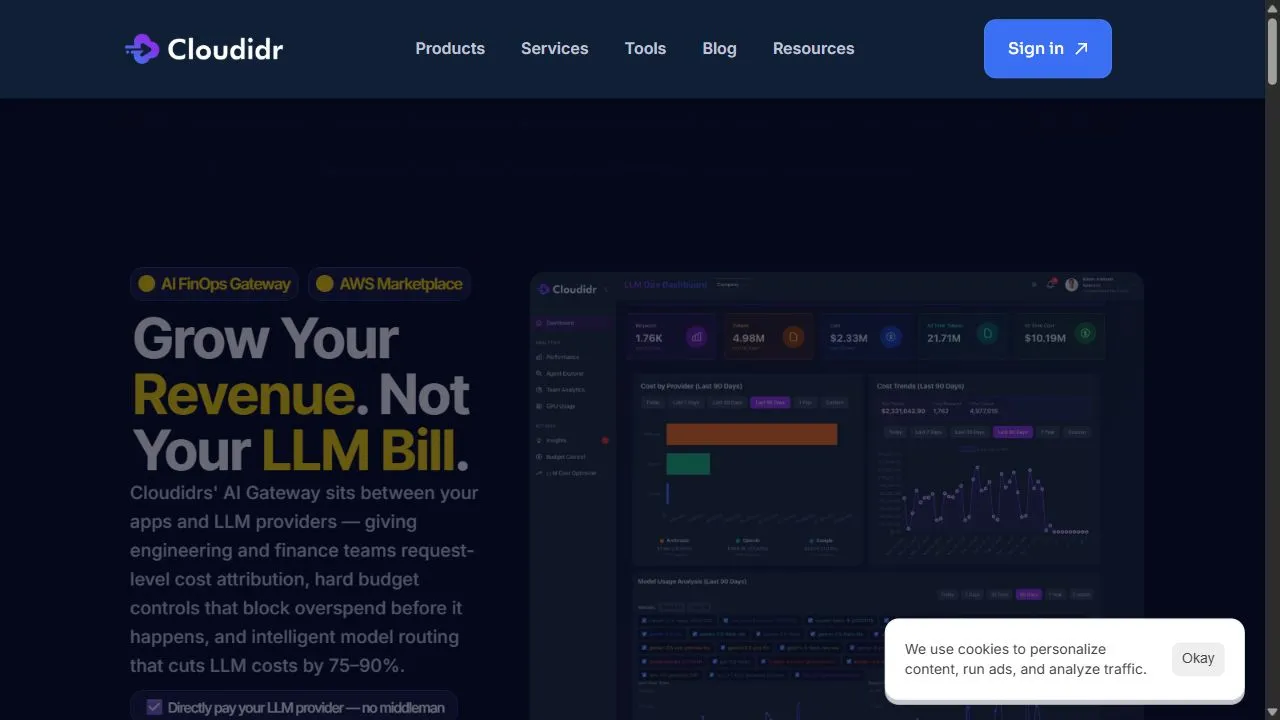
Cloudir | LLM Ops Interface
EUrouter Interface

Pros & Cons Comparison
Cloudir | LLM Ops Pros & Cons
Strengths
- Massive cost savings
- Simple implementation
Limitations
- Relatively high starting price
- Designed for technical users
EUrouter Pros & Cons
Strengths
- Ensures EU data residency for AI model access
- Complies with GDPR and other EU privacy regulations
- Offers a free tier for initial exploration
- Mitigates legal and reputational risks for businesses
Limitations
- Subscription required for full access and data volume
- May have limited access to non-EU specific AI models
About Cloudir | LLM Ops
Cloudir | LLM Ops is a professional AI-powered LLM operations (LLMOps) platform designed to help businesses optimize their AI API usage and drastically reduce operational costs by leveraging artificial intelligence, automated monitoring, and deep infrastructure visibility . In the current landscape of rapid AI adoption, companies often struggle with the unpredictable and escalating costs associated with scaling large language models (LLMs). Cloudir solves this critical problem by providing granular insights into how AI resources are consumed, allowing organizations to identify waste and optimize their token expenditure without compromising the performance of their applications. The platform is specifically engineered for developers, DevOps engineers, AI architects, and enterprise businesses who are deploying large-scale AI applications. By utilizing an intelligent monitoring layer, Cloudir analyzes API calls and resource utilization patterns to pinpoint exactly where budget leakage occurs. This enables technical teams to move from a reactive state of managing "bill shock" to a proactive strategy of cost optimization. Through its sophisticated LLMOps framework, the tool helps users achieve significant reductions in operational overhead, often saving between 75% and 90% on AI API costs. By integrating a high-visibility layer into the AI stack, Cloudir | LLM Ops transforms the way companies approach AI infrastructure management . Rather than relying on generic cloud billing dashboards that offer little context regarding specific model prompts or user behaviors, this platform provides a detailed breakdown of API interactions. This level of precision allows businesses to prune redundant processes, negotiate better usage patterns with providers, and ensure that their AI-driven products remain financially sustainable as they scale to thousands or millions of users. Key Features of Cloudir | LLM Ops One-line-of-code integration for rapid deployment across existing AI infrastructures. Real-time visibility into AI API consumption and spending patterns. Granular tracking of token usage across different large language model providers. Intelligent identification of redundant API calls and inefficient prompting patterns. Comprehensive resource utilization monitoring to prevent over-provisioning. Automated cost attribution to specific features, users, or departments. Actionable optimization insights to reduce monthly AI operational expenditures. Deep-dive infrastructure analytics to monitor the health and efficiency of LLM deployments. Scalable monitoring architecture designed to handle high-volume API traffic. Automated alerts and reporting on budget thresholds and usage spikes. Why People Use Cloudir | LLM Ops The primary motivation for adopting Cloudir | LLM Ops is the need for financial predictability in an environment where AI costs are notoriously volatile. Traditionally, managing LLM expenses involved manual auditing of API logs or relying on the basic billing dashboards provided by model vendors. These manual methods are often insufficient because they lack the granularity required to understand why costs are increasing. For example, a developer might notice a spike in spending but cannot easily determine if the increase is due to a specific inefficient prompt, a surge in a particular user segment, or a redundant loop in the application logic. Cloudir eliminates this guesswork by providing a transparent, data-driven view of the entire AI pipeline. Users shift from manual spreadsheet tracking to an automated system that highlights inefficiencies in real time. This transition is critical for companies moving from the prototyping phase to full-scale production. During prototyping, costs are negligible; however, during production, a minor inefficiency in a prompt can lead to thousands of dollars in wasted expenditure. Furthermore, the platform addresses the complexity of managing multi-model environments. Many modern enterprises use a mix of models—such as GPT-4 for complex reasoning and smaller, cheaper models for simpler tasks. Without a dedicated LLMOps tool, tracking the cost-benefit ratio of these different models is a cumbersome process. Cloudir | LLM Ops simplifies this by aggregating all usage data into a single pane of glass, allowing teams to optimize their model routing strategies for maximum efficiency and minimum cost. Popular Use Cases Enterprise SaaS Scaling: Software companies integrating AI features into their platforms use Cloudir to monitor per-customer AI costs, ensuring that the cost of serving the AI feature does not exceed the subscription revenue generated from the user. AI Agent Orchestration: Developers building complex autonomous agents that make hundreds of recursive API calls use the platform to identify "infinite loops" or redundant calls that drive up costs without adding value to the output. Cost-Effective Model Routing: Organizations deploying hybrid LLM strategies use the tool to analyze which tasks are being over-served by expensive high-parameter models and can be shifted to more economical, specialized models. FinOps for AI Teams: Financial operations teams in large corporations utilize the platform to create strict AI budgets and allocate spending across different product teams, ensuring accountability for AI resource consumption. Performance Tuning and Prompt Optimization: Prompt engineers use the visibility provided by the tool to test different prompt versions and measure the direct impact of those changes on token consumption and overall cost. Infrastructure Auditing: DevOps teams use the platform to conduct comprehensive audits of their AI stack, removing unused API keys and optimizing the frequency of calls to external AI services. Benefits of Cloudir | LLM Ops Substantial Cost Reduction: The most immediate outcome is the ability to reduce AI API expenditures by 75% to 90% through the elimination of waste and optimization of usage. Rapid Implementation: The one-line-of-code setup removes the friction typically associated with deploying monitoring tools, allowing teams to gain visibility almost instantly. Enhanced Financial Predictability: Businesses can move away from volatile monthly bills and establish stable, predictable budgets for their AI operations. Improved Operational Efficiency: By identifying and pruning redundant processes, developers can streamline their AI workflows, leading to leaner and more efficient applications. Data-Driven Decision Making: Leadership teams gain the empirical data necessary to decide when to scale infrastructure, when to switch model providers, or when to invest in fine-tuning their own models. Sustainable Scaling: The tool enables companies to grow their user base exponentially without a linear increase in AI costs, ensuring that the business remains profitable as it expands. Reduced Technical Overhead: Automation of the monitoring process frees up expensive engineering talent from manually auditing logs and managing billing disputes.
About EUrouter
Opening Overview EUrouter is a specialized AI model routing platform designed to provide businesses and developers with a secure gateway to advanced artificial intelligence models while ensuring that all data processing remains strictly within the European Union. By leveraging a sophisticated routing infrastructure, the platform solves the critical challenge of data residency, preventing sensitive information from leaving European borders when interacting with AI services. This allows organizations to integrate cutting-edge AI capabilities into their workflows without compromising their legal obligations or the privacy of their users. The platform utilizes intelligent routing and secure gateway technology to act as an intermediary between the end-user and various AI models. Instead of establishing direct connections to providers that may process data in non-EU jurisdictions, users route their requests through EUrouter, which guarantees that the data residency remains compliant with regional laws. This architecture is specifically built for organizations that operate under the strict mandates of the General Data Protection Regulation (GDPR) and other European privacy frameworks, making it an essential tool for the adoption of sovereign AI . Designed for a wide array of users—from independent software developers to large-scale enterprises and government agencies— EUrouter eliminates the friction between AI innovation and regulatory compliance. By focusing on EU data residency , the platform mitigates the significant legal and reputational risks associated with cross-border data transfers. It empowers privacy-conscious organizations to leverage the power of generative AI, including text, image, audio, and video processing, while maintaining absolute control over their data governance strategies. Key Features of EUrouter Guaranteed EU data residency for all AI model interactions. Strict adherence to GDPR and regional European data protection regulations. Secure gateway routing to prevent unauthorized cross-border data transfers. Support for multi-modal inputs including text, images, video, and audio. Unified API access to a variety of artificial intelligence models. Comprehensive data governance tools for monitoring information flow. Seamless integration capabilities for developers and enterprise software. Scalable infrastructure designed to handle varying volumes of AI requests. Dedicated routing protocols to ensure low latency while maintaining compliance. Flexible access tiers to accommodate both initial testing and full-scale production. Why People Use EUrouter The primary motivation for utilizing EUrouter stems from the increasingly complex legal landscape surrounding data privacy in the European Union. Traditionally, accessing the most powerful AI models required sending data to servers located in the United States or other non-EU countries. For many organizations, this creates a direct conflict with GDPR mandates, which place strict limits on how personal data can be transferred outside the European Economic Area (EEA). Manual compliance audits and the attempt to build proprietary, localized AI infrastructure are often prohibitively expensive and technically exhausting for most businesses. EUrouter replaces these manual, high-risk methods with an automated, compliant routing layer. Instead of risking massive regulatory fines or turning away from AI adoption entirely, companies use this tool to bridge the gap. By shifting the responsibility of data residency to a dedicated routing service, organizations can move from a position of risk to a position of security. This allows them to deploy AI features in a fraction of the time it would take to build a fully sovereign internal environment. Furthermore, the shift toward "Sovereign AI" has made data localization a competitive advantage. Users choose EUrouter because it allows them to market their own products as "privacy-first" and "EU-compliant," which is a significant selling point for B2B SaaS companies operating within Europe. The platform provides the scalability of global AI models with the legal safety of a local data center, ensuring that productivity gains do not come at the cost of legal vulnerability. Popular Use Cases Legal and Law Firms : Processing highly confidential client documents and case files through AI for summarization or research while ensuring that sensitive legal data never leaves the EU jurisdiction. Healthcare Providers : Utilizing AI to analyze patient records, medical imaging, or diagnostic notes while remaining compliant with stringent healthcare privacy laws and GDPR. Financial Institutions : Implementing AI-driven fraud detection or automated customer support for banking clients, where financial regulations mandate strict data localization and residency. Governmental Agencies : Deploying AI tools for public administration and civic services where national security and data sovereignty are non-negotiable requirements. EU-Based SaaS Developers : Integrating AI capabilities into their own software offerings to provide "compliant AI" features to their end-users without having to build their own routing infrastructure. Corporate HR Departments : Using AI to screen resumes and manage employee data while ensuring that personal identity information is handled according to European labor and privacy laws. Educational Institutions : Implementing AI tutors or grading assistants for students while protecting the privacy of minors and adhering to regional educational data standards. Benefits of EUrouter Elimination of Regulatory Risk : Users significantly reduce the likelihood of GDPR violations and the associated heavy financial penalties by guaranteeing data residency. Accelerated AI Adoption : Organizations can integrate AI into their operations immediately without waiting for months of legal review or the construction of private server farms. Enhanced Client Trust : By utilizing a compliant gateway, businesses can provide transparent guarantees to their customers that their data is handled with the highest level of privacy. Operational Simplicity : The tool simplifies the technical overhead of managing multiple AI model connections while maintaining a single point of compliance. Versatile Data Processing : The ability to handle text, audio, video, and images ensures that a wide variety of business needs can be met through a single compliant interface. Improved Data Sovereignty : Organizations maintain greater control over their intellectual property and sensitive corporate data by preventing it from being stored or processed in foreign jurisdictions. Cost-Effective Compliance : It provides a more affordable alternative to building a fully localized AI stack from scratch, offering a scalable path from free exploration to enterprise-grade usage. Future-Proofing : As AI regulations in the EU continue to evolve (such as the EU AI Act), using a dedicated routing platform allows for easier adjustments to compliance protocols.
More AI Competitors to Compare




Frequently Asked Questions
Most questions answered in under 30 seconds — but if you still have one, write to us at contactgetaitool@gmail.com and we reply within a few hours.
Which is better in 2026, Cloudir | LLM Ops or EUrouter?
How does the pricing compare between Cloudir | LLM Ops and EUrouter?
Can I use Cloudir | LLM Ops and EUrouter for free?
What input and output formats do Cloudir | LLM Ops and EUrouter support?
What are the key advantages of Cloudir | LLM Ops?
What are the key advantages of EUrouter?
What are top alternative competitors to Cloudir | LLM Ops and EUrouter?
Ready to Choose Your AI Tool?
Try both platforms or explore thousands of other curated artificial intelligence tools on GetAiTools.
Tags & Core Competencies
Specific tags and feature capabilities