HatchablevsFabricate
Side-by-side battle & analysis. Compare features, pricing, real community ratings, and pros & cons in 2026.

Hatchable
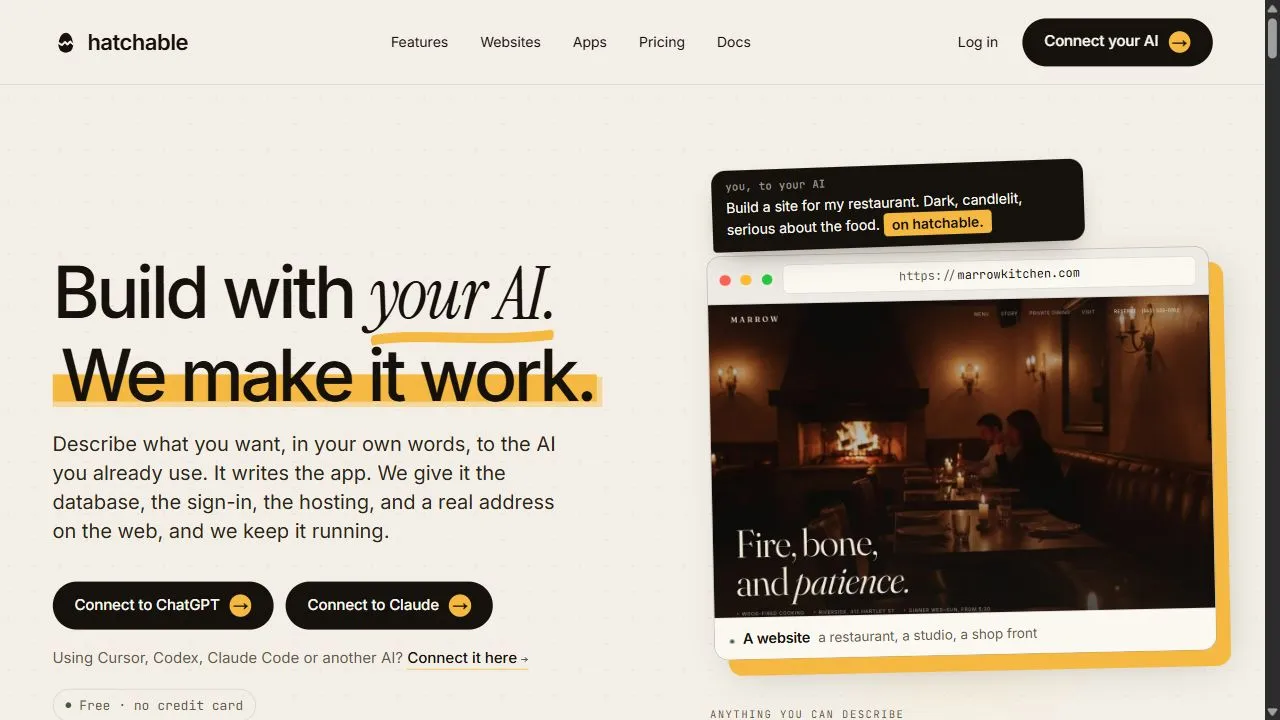
Build and host functional applications using AI without writing code. Ideal for fast prototyping and launching ideas.

Fabricate
Build complete web applications with AI.
Quick Verdict & Takeaway
Head-to-head summary recommendation
Both Hatchable and Fabricate provide high-performance solutions in the Ai App Builder ecosystem. Both platforms are top-rated in their respective categories.
Choose Hatchable if:
You need a mixed tool optimized for App Builder Website with TEXT input formats.
Choose Fabricate if:
You prefer a subscription platform geared towards App Builder Website with OTHERS, TEXT output options.
Specification & Feature Matrix
Direct technical comparison between Hatchable and Fabricate
| Feature / Spec | Hatchable | Fabricate |
|---|---|---|
| Pricing Model | MIXED | SUBSCRIPTION |
| Starting Price | $12/mo | Free / Not Listed |
| Category | Ai App Builder | Ai App Builder |
| Subcategory | App Builder Website | App Builder Website |
| Supported Inputs | TEXT | TEXT, OTHERS |
| Generated Outputs | OTHERS | OTHERS, TEXT |
| User Rating | ★ 4.0 / 5.0 (0) | ★ 4.0 / 5.0 (0) |
| Verified Status | Unverified | Unverified |
Interface & UI Showcase
Visual previews and interface screenshots
Hatchable Interface

Fabricate Interface

Pros & Cons Comparison
Hatchable Pros & Cons
Strengths
- No coding knowledge required
- Integrated hosting
Limitations
- May have limitations for highly complex apps
- Dependent on the platform's proprietary coding engine
Fabricate Pros & Cons
Strengths
- Builds complete full-stack web applications with AI.
- Accelerates development time and effort.
- Democratizes full-stack development.
- Ideal for prototyping and MVPs.
Real Community Feedback
Verified user reviews from GetAiTools community
Hatchable Reviews0
No community reviews yet for Hatchable.
Fabricate Reviews1
"Really nice."
About Hatchable
Opening Overview Hatchable is a powerful AI-powered application development and hosting platform designed to help users build and deploy fully functional software applications by leveraging artificial intelligence, automated coding agents, and integrated cloud infrastructure . By bridging the gap between conceptual ideas and live digital products, the platform eliminates the traditional requirement for manual coding, allowing users to transform text-based requirements into operational software without needing a deep technical background in computer science or software engineering. The primary problem Hatchable solves is the high barrier to entry associated with software creation. Traditionally, launching a functional application required either extensive coding knowledge, the hiring of expensive development teams, or the use of rigid no-code tools that often lack the flexibility of actual code. Hatchable utilizes a sophisticated AI coding agent that interprets natural language instructions and translates them into a working application. This automation streamlines the entire software development lifecycle, from the initial design phase to the final deployment, making it an essential tool for those looking to digitize their workflows or launch new products rapidly. Designed specifically for entrepreneurs, startup founders, and non-technical visionaries, Hatchable serves as an end-to-end ecosystem. Beyond the generation of code, the platform provides integrated hosting services, ensuring that applications are not just built, but are immediately accessible to the global market. By consolidating development and deployment into a single AI-driven workflow, Hatchable enables users to focus on product-market fit and user experience rather than the complexities of server management, environment configuration, or API integrations. Key Features of Hatchable AI Coding Agent : An intelligent engine that interprets natural language descriptions to generate functional application logic. Automated Code Generation : Transforms user requirements into actual software code without requiring manual input from the user. Integrated Cloud Hosting : Provides immediate deployment capabilities, ensuring applications are live and accessible online instantly. Text-to-App Workflow : Allows users to define their application's purpose and functionality through simple text prompts. Automated Environment Configuration : Handles the technical setup of servers and dependencies required to run the application. Rapid Prototyping Engine : Enables the quick creation of minimum viable products (MVPs) to test hypotheses in real-time. End-to-End Deployment Pipeline : Manages the transition from a conceptual prompt to a hosted production environment. Frictionless Scaling Infrastructure : Supports the growth of the application as the user base increases without needing manual server migrations. Why People Use Hatchable The core motivation for using Hatchable lies in the desire to bypass the traditional, often grueling, process of software development. In a standard development cycle, an entrepreneur must write detailed technical specifications, hire developers, manage version control, and coordinate with hosting providers to get a product online. This process is not only time-consuming but also prohibitively expensive for many early-stage founders. Hatchable replaces this fragmented process with a streamlined, AI-driven approach where the AI acts as both the lead developer and the DevOps engineer. Many users turn to Hatchable because it provides a level of agility that manual coding cannot match. When a business need changes or a new feature is required, the user can simply update their requirements via the AI agent rather than rewriting hundreds of lines of code. This allows for an iterative approach to development where the product evolves based on real user feedback in near real-time. Furthermore, the integration of hosting is a critical driver for adoption. Most no-code or low-code tools require the user to find a separate hosting provider, configure DNS settings, and manage SSL certificates. By incorporating these elements directly into the platform, Hatchable removes the "deployment anxiety" that often plagues non-technical creators. The shift from a conceptual idea to a URL accessible by the public is reduced from weeks or months to a matter of minutes, drastically increasing the speed of innovation. Popular Use Cases Startup MVP Development : Founders can build a functional version of their product to secure seed funding or validate a business idea without investing in a full engineering team. Internal Business Tooling : Companies can create custom internal applications to automate repetitive tasks, manage data, or streamline employee workflows without taxing their IT department. Proof-of-Concept (PoC) Creation : Product managers can quickly generate a working model of a feature to demonstrate its feasibility to stakeholders or clients. Niche SaaS Launching : Solo entrepreneurs can build and host specialized software-as-a-service tools for specific industry problems, enabling them to enter micro-markets quickly. Personal Productivity Apps : Individuals can create tailored applications to manage personal data, tracking, or organization based on their specific logic and preferences. Rapid Market Testing : Marketers can deploy functional landing pages with integrated app logic to test conversion rates for a theoretical product before committing to full-scale development. Benefits of Hatchable Accelerated Time-to-Market : Drastically reduces the duration between the initial ideation phase and the public launch of a functional application. Significant Cost Reduction : Eliminates the need for high upfront investments in professional software development agencies or full-time engineers during the prototyping phase. Democratization of Software Creation : Empowers individuals without technical degrees to compete in the digital economy by removing the coding knowledge barrier. Operational Simplicity : Consolidates the build and host process into one platform, removing the need to manage multiple third-party subscriptions and technical hand-offs. Enhanced Iteration Speed : Allows for rapid pivoting and feature updates through natural language prompts, ensuring the product stays aligned with user needs. Elimination of Technical Overhead : Removes the burden of server maintenance, environment patching, and infrastructure management, allowing users to focus on business growth. Reduced Risk of Human Error : By utilizing a standardized AI coding agent for the initial build, the platform minimizes common syntax errors and configuration mistakes found in manual coding.
About Fabricate
Opening Overview Fabricate is a powerful AI-powered app builder designed to help users construct complete full-stack web applications by leveraging artificial intelligence, automation, and intelligent workflows . By bridging the gap between a conceptual idea and a deployed product, the platform eliminates the traditional barriers associated with software engineering, allowing users to generate functional software without manually writing every line of code. It addresses the primary pain point of modern digital creation: the high cost, steep learning curve, and significant time investment required to build a scalable web application from scratch. The platform utilizes advanced artificial intelligence to handle the entire development lifecycle. From the initial design of the user interface (UI) to the creation of complex backend logic and the integration of secure databases, Fabricate automates the heavy lifting of full-stack development. By converting high-level textual descriptions and requirements into executable code and infrastructure, the tool leverages generative AI to ensure that the resulting applications are not only functional but also architecturally sound. Fabricate is engineered for a diverse range of users, including experienced software developers seeking to accelerate their workflow, entrepreneurs looking to launch a Minimum Viable Product (MVP), and aspiring creators who lack formal coding education but possess a strong product vision. By democratizing access to full-stack development, it enables rapid digital transformation and allows for an iterative approach to software creation, where ideas can be tested and refined in a fraction of the time typically required by traditional development teams. Key Features of Fabricate Automated generation of full-stack web application architectures. AI-driven user interface (UI) and user experience (UX) design. Intelligent backend logic generation based on high-level descriptions. Seamless integrated database setup and management. End-to-end automation of the application deployment process. Text-to-app conversion capabilities for rapid project initiation. Abstraction of complex infrastructure and server management. Rapid prototyping tools for iterative design and testing. Intelligent orchestration of frontend and backend connectivity. Scalable codebase generation suitable for business-grade applications. Why People Use Fabricate The primary motivation for using Fabricate is the drastic reduction in the time-to-market for new digital products. In traditional software development, building a full-stack application requires a multidisciplinary team consisting of frontend developers, backend engineers, and database administrators. This manual process is often fraught with bottlenecks, communication gaps, and lengthy development cycles. Fabricate replaces this fragmented approach with a unified AI-driven workflow, allowing a single individual to perform the work that previously required an entire engineering department. Many users turn to Fabricate to bypass the "technical wall" that often halts innovation. For non-technical founders, the inability to code often means relying on expensive agencies or searching for a technical co-founder, both of which introduce significant risk and cost. By using an AI app builder, these creators can maintain full control over their vision and iterate on their product in real-time. The ability to transform a written prompt into a functioning application allows for a level of agility that manual coding cannot match. Furthermore, professional developers use the platform to eliminate the repetitive and tedious aspects of software construction. Writing boilerplate code, configuring environment variables, and setting up basic database schemas are time-consuming tasks that do not add direct value to the unique logic of an application. Fabricate automates these foundational elements, enabling developers to focus their energy on high-level architecture and unique feature sets rather than the mundane aspects of infrastructure setup. The shift toward AI-assisted development also minimizes the likelihood of early-stage human error in configuration. By relying on intelligent workflows to integrate the frontend and backend, users avoid the common integration bugs that plague manual full-stack projects. This leads to a more stable initial build, providing a reliable foundation for further scaling and customization. Popular Use Cases Startup MVP Development : Entrepreneurs use the platform to build fully functional Minimum Viable Products to demonstrate their concept to investors and early adopters without spending months in development. Rapid Prototyping for Agencies : Design and development agencies utilize the tool to quickly create high-fidelity, working prototypes for clients, moving beyond static mockups to actual functional software. Internal Business Tools : Corporations build custom internal applications, such as specialized CRM systems, inventory trackers, or employee portals, tailored specifically to their unique operational workflows. SaaS Experimentation : Product managers and innovators launch "micro-SaaS" tools to test market demand for a specific feature or service before committing to a full-scale engineering project. Educational Project Building : Students and aspiring developers use the platform to visualize how full-stack architectures work by seeing how their high-level requirements translate into integrated frontend and backend systems. Automation of Client Portals : Service-based businesses create dedicated client dashboards and portals that integrate database functionality for secure data sharing and project tracking. Benefits of Fabricate Accelerated Development Speed : Reduces the transition time from ideation to deployment from months to days or even hours. Lowered Financial Barriers : Eliminates the need for large upfront investments in development teams during the early stages of product creation. Increased Accessibility : Empowers non-coders to build sophisticated, data-driven web applications, effectively democratizing software creation. Enhanced Iteration Cycles : Allows users to modify features and pivot product direction instantly by updating descriptions rather than rewriting thousands of lines of code. Reduced Technical Complexity : Simplifies the management of servers, databases, and API integrations through an intuitive AI abstraction layer. Improved Resource Allocation : Enables technical teams to focus on complex business logic and optimization while the AI handles the foundational full-stack scaffolding. Consistency in Architecture : Ensures that the generated applications follow standard structural patterns, reducing technical debt in the early phases of the project. Higher Innovation Rate : Encourages more experimentation by lowering the risk and effort associated with building and testing new software ideas.
More AI Competitors to Compare

Emergentlabs
Ai App Builder

Blink - Ai App Builder
Ai App Builder

OnSpace.AI - AI Mobile App Builder
Ai App Builder

LampBuilder
Ai App Builder
Rocket
Ai App Builder
Mobirise
Ai App Builder
Frequently Asked Questions
Most questions answered in under 30 seconds — but if you still have one, write to us at contactgetaitool@gmail.com and we reply within a few hours.
Which is better in 2026, Hatchable or Fabricate?
How does the pricing compare between Hatchable and Fabricate?
Can I use Hatchable and Fabricate for free?
What input and output formats do Hatchable and Fabricate support?
What are the key advantages of Hatchable?
What are the key advantages of Fabricate?
What are top alternative competitors to Hatchable and Fabricate?
Ready to Choose Your AI Tool?
Try both platforms or explore thousands of other curated artificial intelligence tools on GetAiTools.
Tags & Core Competencies
Specific tags and feature capabilities