KhromavsGalileo AI
Side-by-side battle & analysis. Compare features, pricing, real community ratings, and pros & cons in 2026.

Khroma
Khroma is an AI-powered color palette generator that assists designers and creatives in discovering and utilizing harmonious color schemes tailored to their individual preferences.

Galileo AI
Galileo AI is an innovative AI design tool that empowers users to generate stunning user interface (UI) designs from simple text prompts.
Quick Verdict & Takeaway
Head-to-head summary recommendation
Both Khroma and Galileo AI provide high-performance solutions in the UnCategorized ecosystem. Khroma holds the rating edge with an average community score of ★ 4.6/5.0 (0 verified reviews).
Choose Khroma if:
You need a free tool optimized for UnCategorized with TEXT input formats.
Choose Galileo AI if:
You prefer a subscription platform geared towards UnCategorized with TEXT, IMAGE output options.
Specification & Feature Matrix
Direct technical comparison between Khroma and Galileo AI
| Feature / Spec | Khroma | Galileo AI |
|---|---|---|
| Pricing Model | FREE | SUBSCRIPTION |
| Starting Price | Free / Not Listed | Free / Not Listed |
| Category | UnCategorized | UnCategorized |
| Subcategory | UnCategorized | UnCategorized |
| Supported Inputs | TEXT | TEXT |
| Generated Outputs | TEXT | TEXT, IMAGE |
| User Rating | ★ 4.6 / 5.0 (0) | ★ 4.5 / 5.0 (0) |
| Verified Status | Unverified | Verified |
Interface & UI Showcase
Visual previews and interface screenshots
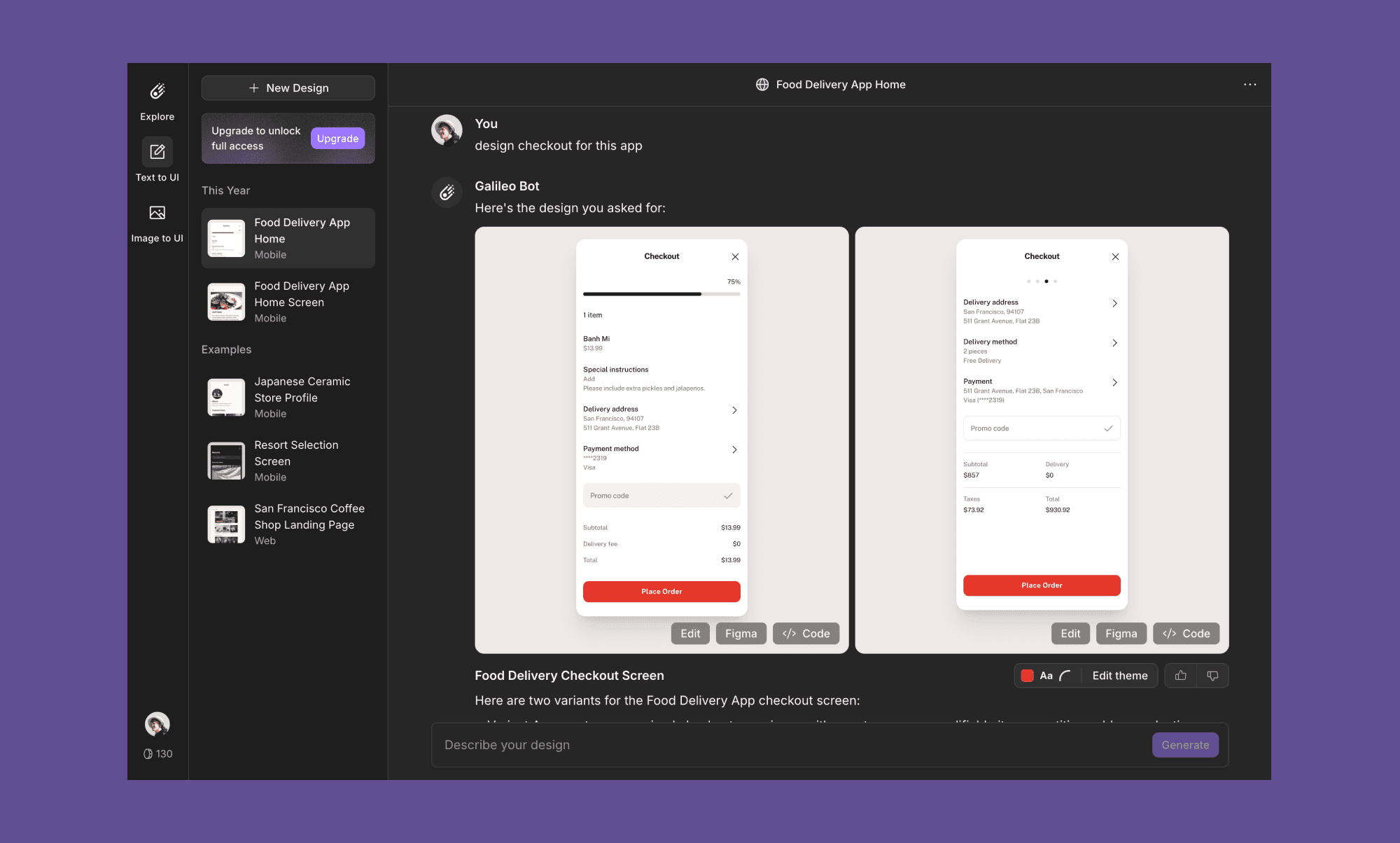
Galileo AI Interface

Video Walkthroughs & Demos
Watch official video demos and workflow tutorials
Galileo AI Demo
Real Community Feedback
Verified user reviews from GetAiTools community
Khroma Reviews0
No community reviews yet for Khroma.
Galileo AI Reviews2
"It’s helpful for small businesses."
"I wish they had a live chat support option."
About Khroma
Khroma is an AI-powered color palette generator that assists designers and creatives in discovering and utilizing harmonious color schemes tailored to their individual preferences. It addresses the challenge of initial creative block when starting a design project, specifically the difficulty of selecting a suitable color palette. Khroma leverages machine learning and neural networks to learn a user’s aesthetic tastes and generate an endless supply of unique and personalized color combinations. This tool is designed for graphic designers, web developers, interior designers, artists, and anyone seeking inspiration for color schemes in their projects. Key Features of Khroma Generates infinite, personalized color palettes based on user preferences. Utilizes a neural network trained on a vast database of colors. Allows users to rate color combinations to refine the AI’s understanding of their taste. Offers palette previews in various contexts, including typography and gradients. Enables users to test palettes with custom images to visualize real-world applications. Provides a simple and intuitive interface for exploring and saving color schemes. Allows users to lock specific colors within a palette to maintain consistency. Offers the ability to export palettes in multiple formats for use in design software. Facilitates the discovery of unexpected and inspiring color combinations. Stores user preferences for consistent palette generation over time. Why People Use Khroma Individuals and professionals often struggle with the initial stages of design, particularly when it comes to color selection. Traditionally, designers rely on pre-made palettes, color theory principles, or extensive trial and error to find suitable color combinations. These methods can be time-consuming, limiting, and may not always align with a specific project’s aesthetic goals. Khroma streamlines this process by employing artificial intelligence to learn a user’s individual color preferences. By training a neural network on colors a user likes, Khroma eliminates the guesswork and provides a continuous stream of harmonious palettes. This results in significant time savings, reduces creative frustration, and expands the possibilities for unique and personalized designs. Unlike generic palette generators, Khroma adapts to the user, becoming more accurate and insightful with each interaction. The tool’s ability to preview palettes in realistic contexts further enhances its value, allowing users to confidently apply color schemes to their projects. Popular Use Cases Graphic Design: Generating color palettes for logos, branding materials, marketing collateral, and illustrations. Web Development: Creating color schemes for websites, user interfaces, and digital products. Interior Design: Discovering harmonious color combinations for room decor, furniture selection, and architectural projects. Fashion Design: Inspiring color palettes for clothing lines, accessories, and textile patterns. Art & Illustration: Providing a starting point for paintings, drawings, and digital artwork. Marketing & Advertising: Developing visually appealing color schemes for campaigns and promotional materials. User Interface (UI) Design: Creating accessible and aesthetically pleasing color palettes for mobile and web applications. Brand Identity Development: Establishing a consistent and memorable color palette for a brand’s visual identity. Content Creation: Selecting color schemes for social media graphics, presentations, and blog posts. Personal Projects: Assisting individuals with color selection for home decor, DIY projects, and personal artwork. Benefits of Khroma Enhanced Creativity: Khroma inspires new ideas and expands the possibilities for color exploration. Time Savings: The AI-powered palette generation significantly reduces the time spent on color selection. Personalized Results: Palettes are tailored to individual preferences, ensuring aesthetic alignment. Improved Design Quality: Harmonious color combinations enhance the visual appeal and effectiveness of designs. Reduced Creative Block: Khroma overcomes the “blank page” problem by providing a constant source of inspiration. Increased Efficiency: Streamlined workflow allows designers to focus on other aspects of their projects. Consistent Branding: Facilitates the creation of a cohesive and recognizable brand identity through consistent color usage. Accessibility: The tool is free to use, making it accessible to a wide range of users. Versatility: Applicable to a diverse range of design disciplines and creative projects. Continuous Learning: The AI adapts and improves its palette generation based on user feedback.
About Galileo AI
Galileo AI is an innovative AI design tool that empowers users to generate stunning user interface (UI) designs from simple text prompts. It addresses the challenge of rapid prototyping and design iteration by automating the initial design phases, significantly reducing the time and resources required to create visually appealing and functional interfaces. Utilizing advanced artificial intelligence and natural language processing , Galileo AI translates user ideas into high-fidelity UI mockups, catering to designers, founders, and product teams seeking to accelerate their design workflows. This tool is particularly valuable for those exploring multiple design concepts or needing to quickly visualize their product ideas. Key Features of Galileo AI Generates UI designs from text descriptions. Offers a variety of design styles and themes. Allows users to refine designs through iterative prompting. Provides customizable design components and elements. Supports the creation of designs for web and mobile applications. Enables users to export designs in multiple formats. Facilitates rapid prototyping and concept exploration. Offers a user-friendly interface for easy navigation. Allows for the specification of desired platform (iOS, Android, Web). Provides options to define specific UI elements like buttons, forms, and navigation bars. Supports the generation of complete screen designs or individual components. Enables users to adjust the level of detail and complexity in generated designs. Why People Use Galileo AI Individuals and teams utilize Galileo AI to overcome the initial hurdles of the design process. Traditionally, creating UI designs requires significant time and expertise in design software. Galileo AI streamlines this process by allowing users to articulate their vision in natural language, which the AI then translates into a visual representation. This is particularly beneficial for startups and entrepreneurs who may not have dedicated design resources, or for established teams looking to accelerate their design cycles. The tool’s ability to quickly generate multiple design variations fosters exploration and allows for faster iteration based on feedback. By automating the foundational aspects of UI design, Galileo AI frees up designers to focus on more complex tasks like user research, usability testing, and refining the overall user experience. It democratizes the design process, making it accessible to a wider range of users, regardless of their design background. Popular Use Cases Startup Prototyping: Quickly generate mockups for pitch decks and investor presentations. Web Application Design: Create initial designs for web-based software and platforms. Mobile App Design: Develop UI concepts for iOS and Android applications. UX/UI Exploration: Rapidly iterate on design ideas and explore different visual approaches. Design System Creation: Generate consistent UI components for building design systems. A/B Testing Mockups: Create variations of UI elements for A/B testing purposes. User Flow Visualization: Design screens representing different stages of a user flow. Concept Validation: Quickly visualize and validate product ideas with potential users. Educational Purposes: Students learning UI/UX design can use it to experiment with different concepts. Rapid Wireframing: Generate basic wireframes to outline the structure of an application. Generating Design Inspiration: Overcome creative blocks by exploring AI-generated design options. Creating Mockups for User Research: Quickly produce visuals for user interviews and testing. Benefits of Galileo AI Accelerated Design Workflow: Significantly reduces the time spent on initial design creation. Increased Design Iteration: Enables rapid exploration of multiple design concepts. Reduced Design Costs: Minimizes the need for extensive design resources. Enhanced Creativity: Inspires new design ideas and approaches. Improved Collaboration: Facilitates communication between designers, developers, and stakeholders. Democratized Design Access: Empowers non-designers to create professional-looking UI designs. Streamlined Prototyping: Simplifies the process of creating interactive prototypes. Faster Time to Market: Accelerates the product development lifecycle. Consistent Design Language: Helps maintain a consistent visual style across applications. Efficient Resource Allocation: Frees up designers to focus on higher-level tasks. Simplified Concept Validation: Allows for quick and easy validation of product ideas. Reduced Risk of Design Errors: AI-powered generation can minimize common design mistakes.
More AI Competitors to Compare
Visily
UnCategorized
Relume
UnCategorized

Visual Electric
UnCategorized

Musho
UnCategorized

Motiff
UnCategorized
Fontjoy
UnCategorized
Frequently Asked Questions
Most questions answered in under 30 seconds — but if you still have one, write to us at contactgetaitool@gmail.com and we reply within a few hours.
Which is better in 2026, Khroma or Galileo AI?
How does the pricing compare between Khroma and Galileo AI?
Can I use Khroma and Galileo AI for free?
What input and output formats do Khroma and Galileo AI support?
What are the key advantages of Khroma?
What are the key advantages of Galileo AI?
What are top alternative competitors to Khroma and Galileo AI?
Ready to Choose Your AI Tool?
Try both platforms or explore thousands of other curated artificial intelligence tools on GetAiTools.
Tags & Core Competencies
Specific tags and feature capabilities