MyravsVexa
Side-by-side battle & analysis. Compare features, pricing, real community ratings, and pros & cons in 2026.

Myra
Your AI front-office assistant that handles support and onboarding for your SaaS.
Vexa
Vexa is a real-time meeting transcription API and assistant that empowers businesses to capture and analyze every detail of their conversations, eliminating the need for manual note-taking and improving meeting productivity.
Quick Verdict & Takeaway
Head-to-head summary recommendation
Both Myra and Vexa provide high-performance solutions in the Productivity ecosystem. Both platforms are top-rated in their respective categories.
Choose Myra if:
You need a mixed tool optimized for Personal Assistant with TEXT input formats.
Choose Vexa if:
You prefer a mixed platform geared towards Time Management with TEXT output options.
Specification & Feature Matrix
Direct technical comparison between Myra and Vexa
| Feature / Spec | Myra | Vexa |
|---|---|---|
| Pricing Model | MIXED | MIXED |
| Starting Price | Free / Not Listed | $20/mo |
| Category | Productivity | Productivity |
| Subcategory | Personal Assistant | Time Management |
| Supported Inputs | TEXT | TEXT |
| Generated Outputs | TEXT | TEXT |
| User Rating | ★ 4.0 / 5.0 (0) | ★ 4.0 / 5.0 (0) |
| Verified Status | Unverified | Unverified |
Interface & UI Showcase
Visual previews and interface screenshots
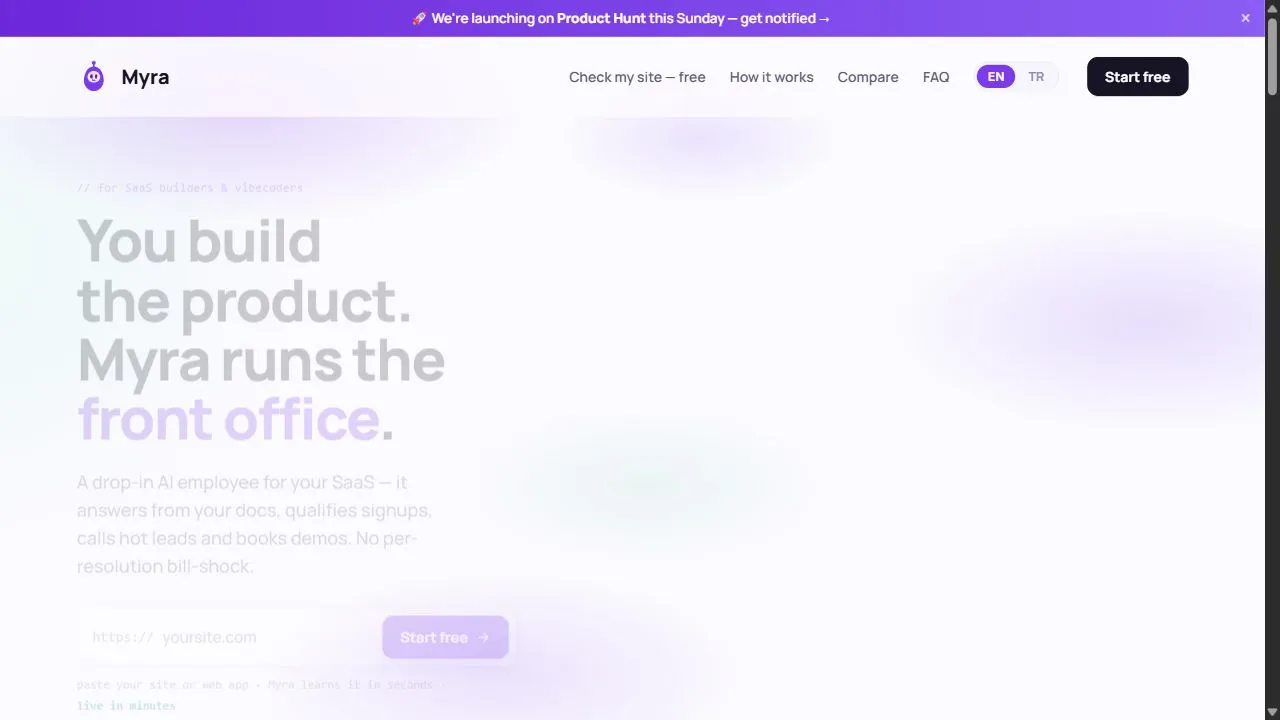
Myra Interface
Vexa Interface

Pros & Cons Comparison
Myra Pros & Cons
Strengths
- Reduces staffing needs
- Specialized for SaaS
Limitations
- Initial integration effort
- Limited to text-based interactions
Vexa Pros & Cons
Real Community Feedback
Verified user reviews from GetAiTools community
Myra Reviews0
No community reviews yet for Myra.
Vexa Reviews1
"免费版本也还不错。"
About Myra
Myra is a powerful AI-powered front-office assistant designed to help SaaS companies automate customer communication, scheduling, and onboarding processes by leveraging artificial intelligence, automation, and intelligent workflows . By acting as a digital employee rather than a simple chatbot, it manages the critical intersection between a software product and its users, ensuring that administrative and operational burdens do not hinder technical progress. The tool solves the primary challenge faced by early-stage startup founders and small product teams: the operational drain of managing the "front office." In many SaaS environments, founders often find themselves trapped in a cycle of answering repetitive support queries and manually guiding new users through onboarding, which diverts essential time and energy away from product development and core business growth. Myra mitigates this by utilizing advanced natural language processing and context-aware AI to handle these interactions autonomously and efficiently. Designed specifically for the SaaS ecosystem, Myra is for founders, product managers, and customer success leads who require a scalable way to maintain high-quality user interactions without linearly increasing headcount. By integrating deep knowledge of a company's specific product context, the AI provides human-like interactions that guide users toward their "aha moment" faster, thereby reducing churn and increasing the overall lifetime value of the customer. Key Features of Myra Automated customer communication management for handling repetitive inquiries. Intelligent user onboarding workflows to guide new sign-ups through product setup. Automated scheduling capabilities to streamline meetings and demonstrations. Product-contextual understanding to provide accurate answers based on specific software documentation. Scalable interaction handling to manage increasing user volumes without performance degradation. API integration capabilities to perform specific actions within a company's dashboard. Human-like conversational interface for natural and engaging user experiences. Real-time response delivery to eliminate wait times for customer support. Front-office operational automation to synchronize communication across different user touchpoints. Context-driven guidance to help users navigate complex software features. Why People Use Myra The primary motivation for implementing Myra is the desire to decouple company growth from operational overhead. In traditional SaaS management, scaling the user base typically requires a proportional increase in customer support staff and onboarding specialists. This manual approach is not only expensive but often leads to inconsistencies in how information is delivered to users, potentially resulting in a fragmented user experience and higher churn rates. People use Myra to move away from reactive support models—where users wait for a human to respond to a ticket—toward a proactive, instantaneous engagement model. By automating the front-office, companies can ensure that every user receives the same high standard of guidance and support, regardless of the time of day or the volume of concurrent users. Furthermore, the tool is adopted by teams who recognize that the first few minutes of a user's experience with a product are the most critical. Manual onboarding is often slow and prone to human error; Myra ensures a seamless, automated transition from registration to active usage. This transition from manual labor to AI-driven operations allows technical teams to focus exclusively on shipping features and improving the codebase, while the AI ensures the business side of the user relationship remains healthy and efficient. Popular Use Cases Early-Stage SaaS Startups: Founders use Myra to act as their first "employee," handling all initial user queries and onboarding so the team can focus entirely on reaching product-market fit. B2B Software Platforms: Companies with complex setup processes utilize Myra to guide enterprise clients through technical configurations and integration steps without needing a dedicated account manager for every small account. Product-Led Growth (PLG) Companies: Businesses that rely on a self-serve model use Myra to nudge users toward key features, ensuring that the self-serve journey is supported by an intelligent guide. Subscription-Based Tools: Service providers use the tool to manage scheduling for demo calls and trial walkthroughs, converting free users to paid plans through timely and automated interaction. Developer Tools: Technical products use Myra to provide instant answers to API questions and documentation queries, reducing the number of technical support tickets submitted by developers. Scaling Mid-Sized SaaS: Companies experiencing rapid growth implement Myra to maintain a consistent customer experience while avoiding the logistical challenge of rapidly hiring and training a large support team. Benefits of Myra Increased Operational Efficiency: By automating the front-office, companies eliminate the manual repetition of answering common questions and scheduling appointments. Reduced Personnel Costs: The tool reduces the immediate need for a large customer success or support team, significantly lowering the monthly burn rate for startups. Accelerated User Activation: Automated, context-aware onboarding ensures users reach the core value of the product faster, which directly correlates with higher retention rates. 24/7 Availability: Unlike human staff, Myra provides instantaneous support across all time zones, ensuring that international users are never left waiting for assistance. Improved Consistency: Every user receives the most up-to-date and accurate information based on the provided product context, eliminating the risk of human error or contradictory instructions. Enhanced Founder Productivity: By removing the burden of daily operational management, product creators can spend more time on strategic planning and high-level development. Scalability on Demand: The AI can handle ten or ten thousand conversations simultaneously without a dip in quality or an increase in response time. Higher User Satisfaction: Users benefit from immediate resolutions to their problems and a guided introduction to the software, leading to a more positive overall brand perception.
About Vexa
Vexa is a real-time meeting transcription API and assistant that empowers businesses to capture and analyze every detail of their conversations, eliminating the need for manual note-taking and improving meeting productivity. Vexa addresses the common problem of information loss and inefficient follow-up actions that often plague business meetings. It leverages artificial intelligence , specifically automatic speech recognition (ASR) and natural language processing (NLP) , to deliver highly accurate transcriptions with minimal latency. This tool is designed for businesses of all sizes, particularly those reliant on frequent meetings for project management, legal proceedings, sales calls, and internal communication. Professionals seeking to improve meeting efficiency, enhance record-keeping, and streamline post-meeting workflows will find Vexa to be an invaluable asset. It’s a powerful solution for anyone looking for accurate meeting transcripts , real-time transcription services , or an AI meeting assistant . Key Features of Vexa Provides real-time transcription for various platforms including Microsoft Teams, Google Meet, and custom WebSocket integrations. Offers high-accuracy speech-to-text conversion with low latency. Includes speaker identification to differentiate between participants. Automatically extracts action items from meeting conversations. Supports multiple languages for global teams. Delivers transcriptions in various formats for easy integration. Offers a robust API for developers to build custom applications. Provides secure and reliable data processing. Enables searchable transcripts for quick information retrieval. Facilitates automated documentation of meeting proceedings. Why People Use Vexa Individuals and organizations adopt Vexa to overcome the limitations of traditional meeting documentation methods. Manually taking notes during meetings is often disruptive, incomplete, and time-consuming. Vexa automates this process, allowing participants to fully engage in the conversation without the cognitive load of simultaneous note-taking. The resulting transcripts are not only more comprehensive but also readily searchable and shareable, fostering better collaboration and accountability. Unlike relying on memory or hastily scribbled notes, Vexa provides a verifiable record of discussions, decisions, and action items. This leads to significant time savings , improved accuracy , and enhanced productivity for teams. The API-first approach allows for seamless integration into existing workflows and custom applications, offering a scalable solution for growing businesses. Popular Use Cases Sales Teams: Transcribing sales calls for coaching, performance evaluation, and identifying key customer insights. Legal Professionals: Creating accurate records of client meetings, depositions, and court proceedings. Project Management: Documenting project meetings, tracking action items, and ensuring alignment among team members. Executive Teams: Capturing board meetings, strategic planning sessions, and leadership discussions. Customer Support: Analyzing customer support calls to identify trends, improve agent performance, and enhance customer satisfaction. Human Resources: Recording employee interviews, performance reviews, and training sessions. Research & Academia: Transcribing interviews, focus groups, and lectures for analysis and documentation. Healthcare: Documenting patient consultations (with appropriate privacy safeguards and compliance). Remote Teams: Facilitating clear communication and documentation for distributed workforces. Podcast Production: Generating transcripts for podcast episodes to improve accessibility and SEO. Benefits of Vexa Increased Productivity: Participants can focus on the conversation, not note-taking, leading to more productive meetings. Improved Accuracy: AI-powered transcription minimizes errors and ensures a comprehensive record of discussions. Enhanced Accountability: Clear documentation of decisions and action items promotes accountability and follow-through. Streamlined Workflows: Automated transcription and action item extraction save time and effort on post-meeting tasks. Better Collaboration: Easily shareable transcripts facilitate collaboration and knowledge sharing among team members. Reduced Costs: Eliminating the need for manual transcription services reduces operational expenses. Scalable Solution: The API-first approach allows businesses to scale their transcription needs as they grow. Improved Compliance: Accurate records of meetings can help organizations meet regulatory requirements. Actionable Insights: Extracted action items provide a clear roadmap for follow-up and project execution. Enhanced Accessibility: Transcripts make meetings accessible to individuals with hearing impairments or those who prefer to read content.
More AI Competitors to Compare

Manyreach
Productivity

Saufter
Productivity

Notedly
Productivity

Moltbot- Personal AI Assistant
Productivity

TeamsMaestro - Free AI Meeting Note Taker
Productivity

PDF to Video AI
Productivity
Frequently Asked Questions
Most questions answered in under 30 seconds — but if you still have one, write to us at contactgetaitool@gmail.com and we reply within a few hours.
Which is better in 2026, Myra or Vexa?
How does the pricing compare between Myra and Vexa?
Can I use Myra and Vexa for free?
What input and output formats do Myra and Vexa support?
What are the key advantages of Myra?
What are the key advantages of Vexa?
What are top alternative competitors to Myra and Vexa?
Ready to Choose Your AI Tool?
Try both platforms or explore thousands of other curated artificial intelligence tools on GetAiTools.
Tags & Core Competencies
Specific tags and feature capabilities