OptiHedgevsAllMind AI
Side-by-side battle & analysis. Compare features, pricing, real community ratings, and pros & cons in 2026.

OptiHedge
AI-driven stock forecasting for S&P 500 investors, focusing on buy/sell signals and risk management.
AllMind AI
AI-powered investment research platform for making smarter financial decisions with confidence.
Quick Verdict & Takeaway
Head-to-head summary recommendation
Both OptiHedge and AllMind AI provide high-performance solutions in the Finance ecosystem. Both platforms are top-rated in their respective categories.
Choose OptiHedge if:
You need a mixed tool optimized for Stock Market Tools with TEXT, OTHERS input formats.
Choose AllMind AI if:
You prefer a mixed platform geared towards Investment Analysis with TEXT output options.
Specification & Feature Matrix
Direct technical comparison between OptiHedge and AllMind AI
| Feature / Spec | OptiHedge | AllMind AI |
|---|---|---|
| Pricing Model | MIXED | MIXED |
| Starting Price | $99/mo | $19.99/mo |
| Category | Finance | Finance |
| Subcategory | Stock Market Tools | Investment Analysis |
| Supported Inputs | TEXT, OTHERS | TEXT |
| Generated Outputs | TEXT | TEXT |
| User Rating | ★ 4.0 / 5.0 (0) | ★ 4.0 / 5.0 (0) |
| Verified Status | Unverified | Unverified |
Interface & UI Showcase
Visual previews and interface screenshots
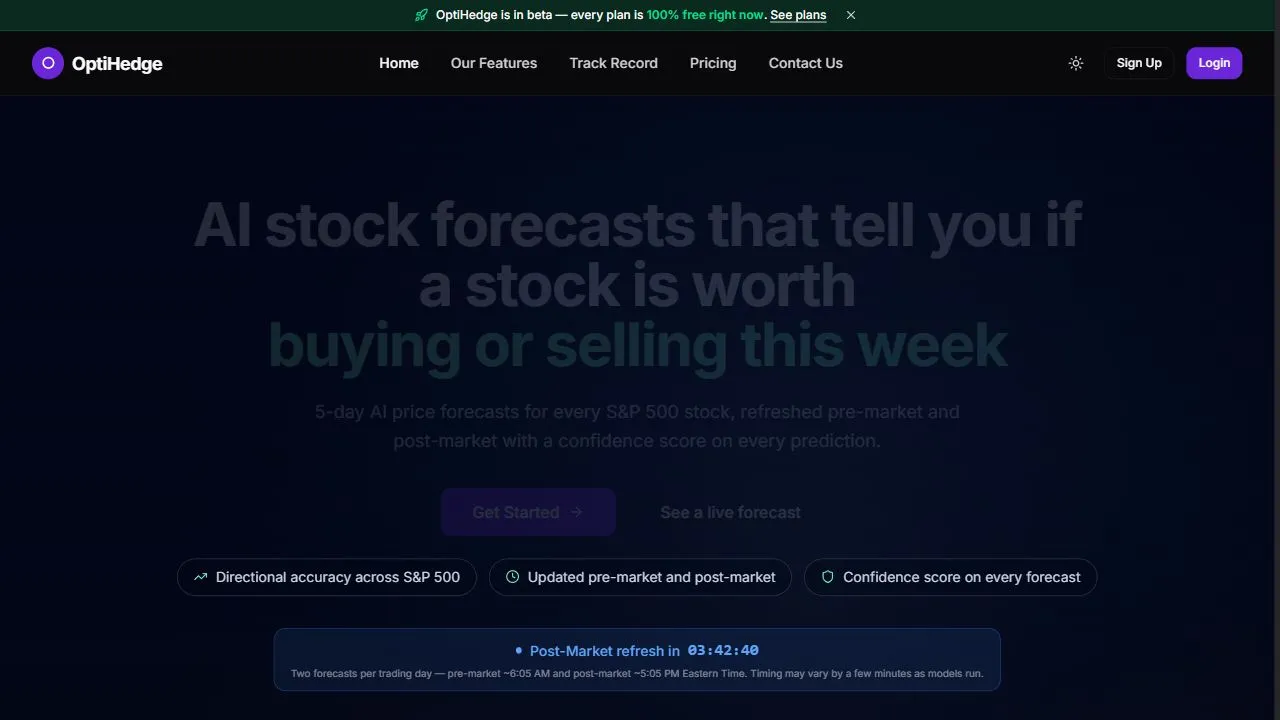
OptiHedge Interface
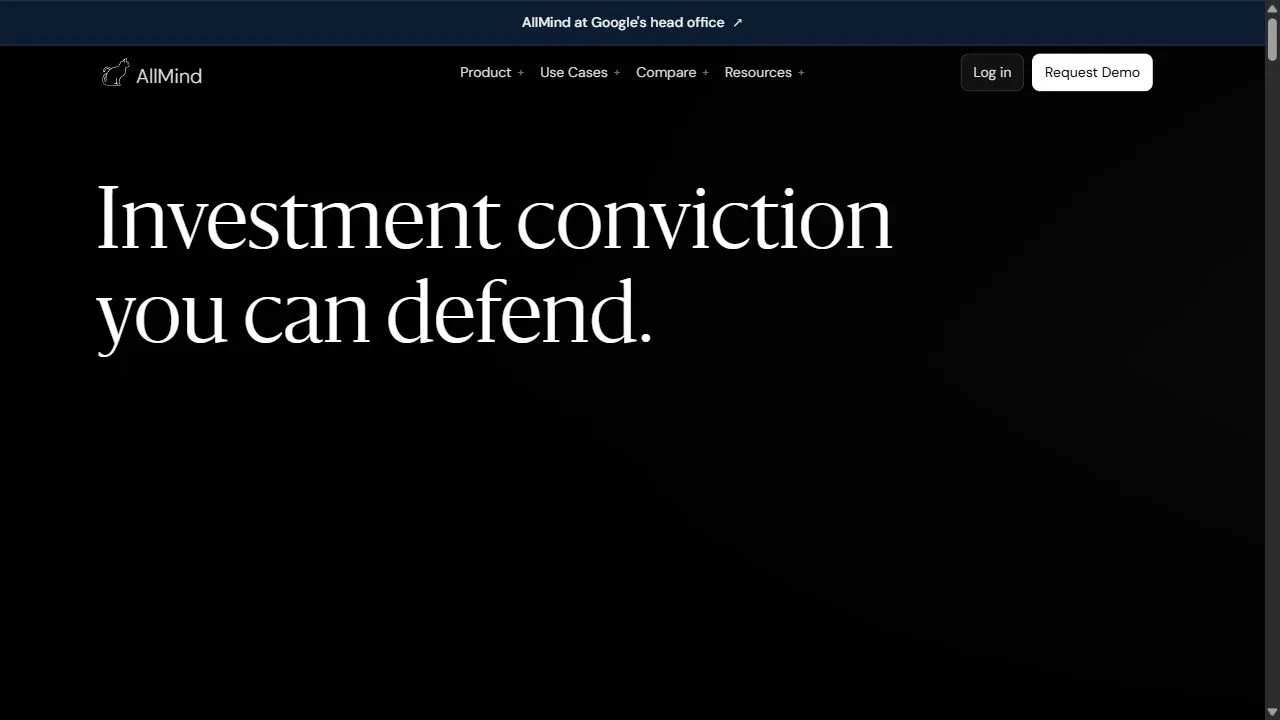
AllMind AI Interface

Pros & Cons Comparison
OptiHedge Pros & Cons
Strengths
- Advanced forecasting models
- Clear signals for traders
Limitations
- High entry price
AllMind AI Pros & Cons
Strengths
- Deep analytical capabilities
- Confidence building tools
Limitations
- Requires fundamental knowledge to use effectively
About OptiHedge
OptiHedge is a professional AI-powered stock forecasting platform designed to help S&P 500 investors optimize their portfolios by providing high-level predictive insights and actionable buy and sell signals. By leveraging advanced artificial intelligence, complex financial modeling, and automated data synthesis, the platform transforms vast amounts of volatile market data into clear, strategic direction for equity traders and long-term investors. The primary problem OptiHedge solves is the overwhelming complexity and volatility inherent in the S&P 500. For most investors, tracking five hundred of the largest publicly traded companies in the United States is a monumental task that often leads to analysis paralysis or emotional decision-making. OptiHedge utilizes AI to filter through market noise, identifying patterns and trends that are often invisible to the human eye. By applying machine learning algorithms to historical and real-time data, the tool provides a quantitative foundation for critical investment decisions, reducing the reliance on guesswork. This tool is specifically engineered for serious investors, quantitative traders, and portfolio managers who require a more analytical, data-driven approach to the stock market. Whether the goal is risk mitigation, capital growth, or precise timing of entries and exits, OptiHedge provides the technical precision necessary to navigate the equity markets with greater confidence. By integrating AI stock forecasting , predictive equity modeling , and automated trading signals , the platform serves as a sophisticated layer of intelligence between the raw market feed and the investor's final execution. Key Features of OptiHedge AI-driven price forecasting specifically tailored for S&P 500 equities. Automated generation of high-probability buy and sell signals. Advanced financial modeling to identify emerging market trends. Comprehensive risk management tools to protect capital during volatility. Real-time processing of complex market data streams. Predictive analytics designed to anticipate short-term and long-term price movements. Data-backed forecasting models that synthesize historical performance with current market indicators. Specialized intelligence for navigating the volatility of large-cap US stocks. Why People Use OptiHedge The core motivation for using OptiHedge lies in the pursuit of an objective, quantitative edge in an environment often driven by sentiment and irrationality. Traditional investment methods typically rely on manual technical analysis—such as studying candlesticks, moving averages, and RSI indicators—or fundamental analysis, which involves hours of reading earnings reports and macroeconomic news. While these methods are valuable, they are time-consuming and subject to human cognitive biases. Investors often fall victim to "confirmation bias," where they seek out information that supports a trade they already want to make, rather than looking at the data objectively. OptiHedge eliminates this subjectivity by replacing manual intuition with artificial intelligence. Users migrate to this platform because it can process millions of data points across the entire S&P 500 simultaneously, a feat impossible for a human analyst. The ability to receive a clear "buy" or "sell" signal based on complex modeling allows traders to act with speed and precision. In the fast-paced world of equity trading, the difference between a profitable trade and a loss often comes down to a matter of hours or even minutes; the automation provided by OptiHedge ensures that users do not miss critical windows of opportunity. Furthermore, the scalability of AI is a major draw. Monitoring a single stock is manageable, but monitoring a diversified portfolio of S&P 500 companies requires a level of oversight that typically only institutional hedge funds can afford. OptiHedge democratizes this level of analysis, providing retail investors with institutional-grade forecasting tools. By shifting the burden of data processing to the AI, users can focus on high-level strategy and risk allocation rather than the tedious task of manual data entry and chart scrubbing. Popular Use Cases S&P 500 Swing Trading: Traders use the platform to identify medium-term trends, utilizing AI signals to enter positions at the bottom of a cycle and exit at the peak. Portfolio Risk Mitigation: Investors employ the tool's forecasting capabilities to identify potential downturns in specific sectors, allowing them to hedge their positions or move to cash before a market correction. Strategic Entry Timing: Long-term investors use the tool to find the most mathematically advantageous time to add to their positions in blue-chip stocks, avoiding buying at historical peaks. Quantitative Validation: Professional traders use OptiHedge as a "second opinion" to validate their own manual analysis, ensuring that their trade thesis is supported by AI-driven data. Diversification Analysis: Investors use the platform to scan the S&P 500 for undervalued opportunities that meet specific AI-predicted growth criteria across different industry sectors. Volatility Management: Traders focusing on high-volatility periods use the tool to navigate rapid price swings with data-backed confidence rather than emotional reactions. Benefits of OptiHedge Enhanced Decision-Making Speed: By automating the analysis process, users can move from data to execution in a fraction of the time required by manual research. Elimination of Emotional Bias: The AI provides objective signals, helping investors avoid common psychological pitfalls such as fear, greed, and revenge trading. Increased Technical Precision: The use of complex financial modeling leads to more accurate entry and exit points, which directly impacts the overall profitability of a portfolio. Reduced Cognitive Load: Investors no longer need to manually track hundreds of variables; the AI synthesizes the noise into a simplified, actionable format. Improved Risk-Adjusted Returns: By focusing on high-probability signals and integrated risk management, users can potentially increase their returns while lowering their exposure to unnecessary risk. Institutional-Grade Intelligence: Users gain access to predictive capabilities and data processing power that were previously reserved for high-frequency trading firms and large hedge funds. Consistency in Strategy: The platform ensures that the same rigorous analytical standards are applied to every stock in the S&P 500, ensuring a disciplined approach to investing.
About AllMind AI
Opening Overview AllMind AI is a powerful AI-powered investment research platform designed to help users build conviction in their financial decisions by leveraging artificial intelligence, automation, and intelligent data workflows . In an era where financial markets are flooded with an overwhelming amount of fragmented information, this tool serves as a sophisticated filter that separates meaningful market signals from irrelevant noise. By aggregating and analyzing vast datasets from across the global market, it provides users with the clarity needed to navigate complex investment opportunities and execute trades with a high degree of confidence. The primary problem AllMind AI solves is the "information overload" that often leads to analysis paralysis or emotional decision-making for investors. Instead of manually scanning thousands of news articles, financial statements, and market indicators, users can rely on the platform to synthesize this data into defensible evidence. The AI is utilized to simulate market behaviors, predict potential trends based on historical patterns, and process real-time data inputs to ensure that the user's investment thesis is grounded in reality rather than speculation. This platform is engineered for a diverse range of users, from casual retail investors looking to professionalize their approach to full-time financial analysts requiring a scalable way to validate their hypotheses. By acting as a digital investment partner that operates continuously, AllMind AI allows its users to maintain a competitive edge, ensuring that no critical risk or opportunity is overlooked. It transforms the research process from a tedious manual task into a streamlined, AI-driven operation, focusing on the ultimate goal of building a robust, long-term financial portfolio. Key Features of AllMind AI Massive aggregation of diverse financial datasets from global market sources. AI-driven signal distillation to isolate actionable insights from market noise. Predictive market behavior simulation using integrated historical data. Real-time data processing to identify immediate shifts in market sentiment. Rigorous thesis testing modules to validate investment hypotheses. Automated continuous scanning for emerging financial risks and opportunities. Intelligent trend identification across various asset classes and sectors. Advanced data synthesis for the creation of defensible investment evidence. High-capacity analytical processing for large-scale portfolio oversight. Sophisticated pattern recognition to detect cyclical market movements. Why People Use AllMind AI The core motivation for utilizing AllMind AI stems from the inherent difficulty of modern investment research. Traditionally, building a strong investment thesis required hundreds of hours of manual labor, involving the scrutiny of SEC filings, macroeconomic reports, and technical charts. For most individuals, this manual process is not only time-consuming but also prone to cognitive biases, where an investor might subconsciously seek out information that confirms their existing beliefs while ignoring contradictory evidence. AllMind AI eliminates these pitfalls by providing an objective, data-driven layer of analysis that forces the user to confront the actual evidence. Furthermore, the scalability of the tool is a significant draw. A human analyst can only track a limited number of assets with high precision before the quality of their oversight diminishes. AllMind AI can monitor thousands of data points simultaneously across multiple markets without fatigue. This allows users to scale their investment horizons, moving from a handful of stocks to a diversified global portfolio without a proportional increase in workload. Accuracy and confidence are the ultimate drivers of adoption. In the financial world, the difference between a profitable trade and a significant loss often comes down to the quality of the intelligence used to make the decision. By providing simulations and predictive modeling, the platform allows users to "stress test" their ideas in a virtual environment before risking actual capital. This transition from guessing to knowing is why professionals and enthusiasts alike integrate this AI into their financial workflows, seeking a level of precision that was previously reserved for institutional hedge funds. Popular Use Cases Equity Research and Stock Selection : Investors use the platform to analyze individual companies, distilling complex financial data into clear indicators of value or growth potential. Risk Management and Mitigation : Portfolio managers employ the tool to identify early warning signs of market downturns or sector-specific crashes, allowing them to hedge their positions proactively. Investment Thesis Validation : Analysts input a specific theory regarding a market trend and use the AI to find historical precedents and real-time data that either support or refute the claim. Macroeconomic Trend Analysis : Users monitor global economic indicators to determine how shifts in interest rates or geopolitical events might impact various asset classes. Diversification Strategy : Investors use the AI to find non-correlated assets, ensuring their portfolio is balanced and less susceptible to a single point of failure. Active Portfolio Monitoring : Users set the platform to constantly scan for specific triggers or anomalies in their holdings, receiving intelligence the moment a significant change occurs. Competitive Benchmarking : Comparing the performance and data metrics of multiple companies within the same industry to identify the most efficient operator. Benefits of AllMind AI Enhanced Decision Confidence : Users move away from speculative trading and toward evidence-based investing, significantly reducing the anxiety associated with high-stakes financial moves. Massive Time Efficiency : The time required to conduct comprehensive due diligence is reduced from days or weeks to a fraction of that time through AI automation. Elimination of Cognitive Bias : By relying on objective data aggregation, users can avoid the emotional traps and confirmation biases that often lead to poor investment choices. Institutional-Grade Intelligence : Retail investors gain access to the type of data synthesis and predictive power typically only available to large-scale financial institutions. Increased Portfolio Resilience : The ability to simulate risks and detect anomalies early leads to more stable portfolios that can withstand market volatility. Improved Scalability : Users can oversee a significantly larger number of assets and markets without needing to increase their research staff or manual effort. Higher Quality Insights : The process of distilling noise into signals ensures that the user focuses only on the most impactful information, leading to higher quality strategic decisions. Consistent Market Oversight : Because the AI operates continuously, users benefit from 24/7 market surveillance, ensuring they are never blindsided by overnight global shifts.
More AI Competitors to Compare

Gorilla Terminal
Finance

OtterQuant
Finance



Intellectia
Finance
Alfie Invest
Finance
Frequently Asked Questions
Most questions answered in under 30 seconds — but if you still have one, write to us at contactgetaitool@gmail.com and we reply within a few hours.
Which is better in 2026, OptiHedge or AllMind AI?
How does the pricing compare between OptiHedge and AllMind AI?
Can I use OptiHedge and AllMind AI for free?
What input and output formats do OptiHedge and AllMind AI support?
What are the key advantages of OptiHedge?
What are the key advantages of AllMind AI?
What are top alternative competitors to OptiHedge and AllMind AI?
Ready to Choose Your AI Tool?
Try both platforms or explore thousands of other curated artificial intelligence tools on GetAiTools.
Tags & Core Competencies
Specific tags and feature capabilities