PitchgradevsBeemer
Side-by-side battle & analysis. Compare features, pricing, real community ratings, and pros & cons in 2026.
Pitchgrade
Pitchgrade gives you instant, AI-powered feedback and research to refine your pitch deck.

Beemer
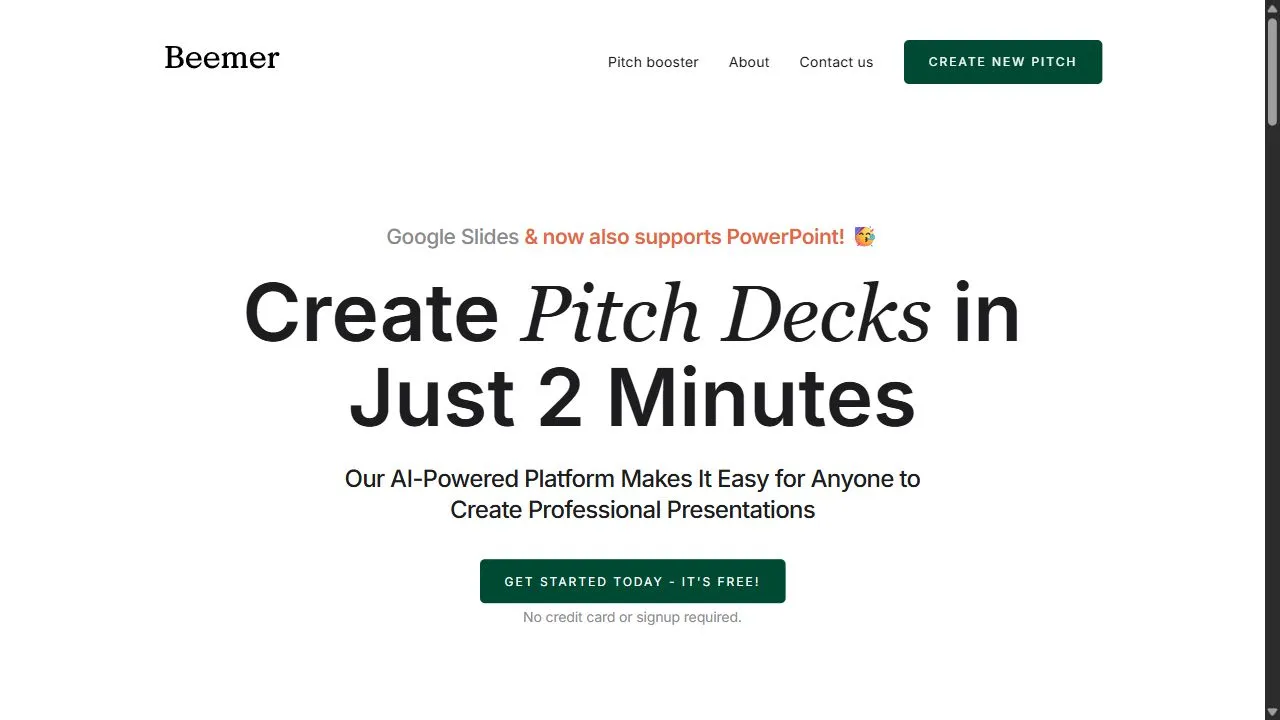
Create a fully structured pitch deck in under two minutes with AI-powered automation from Beemer.
Quick Verdict & Takeaway
Head-to-head summary recommendation
Both Pitchgrade and Beemer provide high-performance solutions in the Ai Presentation ecosystem. Both platforms are top-rated in their respective categories.
Choose Pitchgrade if:
You need a mixed tool optimized for Pitch Deck Generator with TEXT, IMAGE input formats.
Choose Beemer if:
You prefer a subscription platform geared towards Pitch Deck Generator with TEXT output options.
Specification & Feature Matrix
Direct technical comparison between Pitchgrade and Beemer
| Feature / Spec | Pitchgrade | Beemer |
|---|---|---|
| Pricing Model | MIXED | SUBSCRIPTION |
| Starting Price | $4.99/mo | $10/mo |
| Category | Ai Presentation | Ai Presentation |
| Subcategory | Pitch Deck Generator | Pitch Deck Generator |
| Supported Inputs | TEXT, IMAGE | TEXT |
| Generated Outputs | TEXT | TEXT |
| User Rating | ★ 4.0 / 5.0 (0) | ★ 4.0 / 5.0 (0) |
| Verified Status | Unverified | Unverified |
Interface & UI Showcase
Visual previews and interface screenshots
Pitchgrade Interface

Beemer Interface
Pros & Cons Comparison
Pitchgrade Pros & Cons
Strengths
- Constructive slide-by-slide feedback
- Very affordable entry tier
Limitations
- Depends on clarity of input text
- Feedback is algorithmic
Beemer Pros & Cons
Strengths
- Incredibly fast
- Easy to get started
Limitations
- Generic design options
- Limited advanced narrative control
About Pitchgrade
Pitchgrade is a powerful AI-powered pitch deck analysis tool designed to help entrepreneurs and startup founders refine their investor presentations by leveraging artificial intelligence, automated storytelling analysis, and intelligent feedback loops . The platform solves the critical problem of "founder bias," where creators are often too close to their own project to identify gaps in logic, narrative weaknesses, or confusing slide structures. By providing an objective, AI-driven critique, it ensures that a pitch is polished and persuasive before it ever reaches the eyes of a venture capitalist or angel investor. The tool utilizes advanced AI to evaluate both the individual components of a slide and the overarching flow of the presentation. By analyzing text and visual inputs, the AI identifies areas where the value proposition is unclear, where the market data lacks impact, or where the storytelling sequence fails to build momentum. This process transforms the traditionally slow and expensive cycle of seeking mentor feedback into an instant, iterative process. It is specifically engineered for early-stage founders, seasoned entrepreneurs scaling their ventures, and business developers who need to communicate complex ideas with maximum clarity and impact. By integrating research on startup ecosystem trends and investor expectations, Pitchgrade acts as a digital private coach. It does more than just check for errors; it aligns the user's content with the standards of successful fundraising campaigns. This enables users to optimize their messaging for high-intent investors, increasing the likelihood of securing meetings and successfully closing funding rounds. Through the application of machine learning, the platform helps users transition from a basic set of slides to a professional, cohesive business narrative. Key Features of Pitchgrade Automated slide-by-slide analysis to identify specific areas for improvement. Comprehensive storytelling flow evaluation to ensure a logical narrative progression. AI-generated constructive critiques focusing on clarity and persuasion. Research-backed insights into current startup ecosystem best practices. Support for both text and image inputs to analyze visual and written content. Trend tracking to keep users updated on emerging investor preferences. Instant feedback loops allowing for rapid iteration of presentation materials. Narrative alignment tools to ensure the value proposition is consistently communicated. Objective scoring and feedback to remove emotional bias from the editing process. Scalable analysis capable of handling various deck lengths and complexities. Why People Use Pitchgrade The primary motivation for using Pitchgrade is the need for an objective, unbiased perspective on a business pitch. Traditionally, founders rely on a small circle of mentors, peers, or expensive consultants to review their decks. This manual method is often slow, subjective, and limited by the availability of the reviewer. Many founders find themselves in a "feedback vacuum" where they receive conflicting advice or, worse, no critical feedback at all, leading to preventable failures during actual investor meetings. Pitchgrade replaces this inefficient process with an algorithmic approach that provides immediate results. Instead of waiting days for a mentor to reply to an email, a user can upload their materials and receive a detailed critique in seconds. This scalability allows founders to experiment with different narrative angles and messaging strategies in real-time, refining their pitch through multiple iterations before the first high-stakes presentation. Furthermore, the tool addresses the psychological challenge of presenting. The anxiety associated with fundraising often stems from uncertainty regarding how a deck will be perceived. By using an AI coach to identify weaknesses—such as a confusing revenue model slide or a weak competitive analysis—founders can enter meetings with a higher degree of confidence, knowing that their materials have been vetted against professional standards. Popular Use Cases Seed-Stage Fundraising: First-time founders use the tool to build their very first deck, ensuring they include all essential sections required by seed investors. Series A and B Scaling: Experienced entrepreneurs use the platform to refine complex data presentations and ensure their growth narrative is compelling for institutional venture capital. Startup Accelerators: Participants in accelerator programs utilize the tool to rapidly iterate their pitches during intensive "demo day" preparation periods. Corporate Innovation Labs: Internal corporate teams use the AI to pitch new product ideas to executive stakeholders using a startup-style framework. Pitch Competition Entries: Entrepreneurs entering business plan competitions use the tool to ensure their storytelling is punchy and fits within strict time and slide constraints. Biotech and Deep Tech Founders: Specialists in complex fields use the AI to simplify highly technical information into a format that is accessible to generalist investors. Freelance Pitch Consultants: Professional deck designers use the tool as a preliminary check to ensure the structural integrity of the narrative before applying visual design. Benefits of Pitchgrade Increased Funding Probability: By eliminating narrative gaps and clarifying the value proposition, users create more persuasive decks that resonate with investors. Rapid Iteration Cycles: The speed of AI feedback allows users to move from a rough draft to a polished final version in a fraction of the time required by manual reviews. Removal of Subjective Bias: Users receive objective, data-driven critiques that highlight genuine weaknesses rather than opinions based on a single mentor's preference. Enhanced Professionalism: The tool ensures that presentations adhere to industry standards, making the founding team appear more prepared and professional. Reduced Cost of Preparation: By providing an affordable alternative to high-priced pitch consultants, the tool democratizes access to professional-grade presentation coaching. Improved Communication Clarity: The focus on storytelling flow helps founders distill complex business models into clear, concise, and impactful messages. Higher Confidence Levels: Founders can present with greater certainty, knowing that the most common pitfalls of pitch decks have been addressed. Continuous Learning: Through the research aspects of the platform, users become more educated on the mechanics of successful fundraising and business storytelling.
About Beemer
Beemer is a powerful AI-powered pitch deck generator designed to help entrepreneurs and startup founders accelerate the fundraising process by leveraging artificial intelligence, automation, and intelligent content structuring . The tool specifically addresses the common bottleneck faced by founders: the exhaustive amount of time and effort required to transform a raw business idea into a professional, investor-ready presentation. By automating the heavy lifting of slide creation, Beemer allows users to move from a conceptual stage to a structured pitch in a matter of minutes. The platform utilizes advanced AI to analyze basic startup information and automatically distribute that data across a series of strategically sequenced slides. This ensures that the resulting presentation adheres to the logical flow that venture capitalists and angel investors expect. Rather than starting with a blank canvas, users provide essential text inputs, and the AI handles the narrative architecture, layout, and content placement. This approach minimizes the friction associated with slide design and copywriting, enabling founders to focus more on their core product and less on the logistics of presentation software. Designed primarily for early-stage founders, serial entrepreneurs, and business development professionals , Beemer streamlines the transition from idea to execution. By integrating AI-driven automation, the tool eliminates the need for expensive design agencies or hours of manual formatting in traditional presentation software. It is an essential utility for anyone operating in fast-paced environments where the ability to iterate quickly on a pitch is a competitive advantage. Key Features of Beemer Rapid AI generation of complete pitch decks in under two minutes. Automated creation of problem-solution fit slides to establish market need. Intelligent generation of market size slides to demonstrate scalability. Automated business model slide creation to outline revenue streams. Text-to-presentation conversion based on basic startup descriptions. Exportable slide formats compatible with various presentation environments. Structured narrative sequencing based on investor expectations. Simplified input interface for rapid data entry. Iterative design capabilities for refining pitch content. Automated layout distribution to ensure visual consistency across slides. Why People Use Beemer The primary motivation for using Beemer is the drastic reduction in the time required to produce a high-quality first draft of a pitch deck. In traditional workflows, creating a pitch deck is a grueling process involving multiple iterations of copywriting, layout adjustments, and visual formatting. Founders often spend days or even weeks toggling between documents and slide software, often getting bogged down in aesthetic details before the core narrative is even finalized. Beemer shifts this paradigm by prioritizing the structure and speed of the initial output. Many users turn to Beemer to overcome the "blank page syndrome," where the sheer scale of creating a comprehensive investor presentation leads to procrastination. By providing a fully structured deck almost instantaneously, the tool gives users a tangible foundation that can be tweaked and polished, rather than forcing them to build from scratch. This allows for a much faster iteration cycle; a founder can test different value propositions or business models by generating several versions of a deck to see which narrative feels most compelling. Furthermore, Beemer is used to ensure professional standardization. Many founders possess great ideas but lack the design skills or the knowledge of "investor psychology"—the specific sequence of information that investors look for when evaluating a startup. Beemer implicitly encodes these industry standards into its AI, ensuring that critical components like market opportunity and the business model are not overlooked. This shift from manual creation to AI-assisted generation results in a higher level of consistency and a professional appearance that builds credibility with potential stakeholders. Popular Use Cases Pre-Seed and Seed Funding Rounds: Founders use the tool to quickly generate a professional deck to secure their first round of external investment without hiring a design firm. Pitch Competitions and Demo Days: Entrepreneurs participating in time-sensitive competitions use Beemer to create a concise, high-impact presentation that fits strict time limits. Internal Stakeholder Alignment: Business leads use the tool to visualize a new project or internal venture for executive approval, ensuring the logic is sound and the presentation is polished. Rapid Prototyping of Business Ideas: Serial entrepreneurs use Beemer to quickly map out the logic of multiple business concepts, using the generated decks as a way to "stress test" the viability of a startup idea. Updating Decks for Different Investor Personas: Users generate variations of their pitch to emphasize different strengths—such as focusing more on the technical innovation for a VC or the market growth for an angel investor. Bootstrapped Startup Documentation: Small teams use the tool to maintain a professional outward-facing presentation for potential partners or early adopters without diverting engineering resources to design. Benefits of Beemer Dramatic Increase in Speed: The most immediate outcome is the reduction of production time from days to minutes, allowing founders to reach the "pitch-ready" stage significantly faster. Enhanced Professionalism: Users achieve a polished, cohesive look that conveys competence and seriousness to investors, regardless of their personal design skills. Focus on Strategy over Formatting: By automating the layout and slide creation, the tool frees the user to spend their cognitive energy on refining the business strategy and value proposition. Reduced Cognitive Load: The AI-driven structure removes the stress of deciding what information goes on which slide, providing a proven framework for success. Higher Iteration Velocity: The ability to generate decks quickly means users can experiment with different narratives and pivot their messaging in real-time based on feedback. Improved Investor Readiness: By ensuring that all essential slides—such as the problem, solution, and market size—are included, the tool reduces the risk of a deck being rejected for missing critical information. Lower Entry Barriers for Non-Designers: Beemer democratizes the ability to create high-quality presentations, ensuring that great ideas are not ignored simply because they were presented in an unappealing format.
More AI Competitors to Compare

Kimi Slides
Ai Presentation

Grist
Ai Presentation
CopySlides
Ai Presentation

Raccoon AI
Ai Presentation
Plus AI for PowerPoint
Ai Presentation

Tenorshare AI Diagrimo
Ai Presentation
Frequently Asked Questions
Most questions answered in under 30 seconds — but if you still have one, write to us at contactgetaitool@gmail.com and we reply within a few hours.
Which is better in 2026, Pitchgrade or Beemer?
How does the pricing compare between Pitchgrade and Beemer?
Can I use Pitchgrade and Beemer for free?
What input and output formats do Pitchgrade and Beemer support?
What are the key advantages of Pitchgrade?
What are the key advantages of Beemer?
What are top alternative competitors to Pitchgrade and Beemer?
Ready to Choose Your AI Tool?
Try both platforms or explore thousands of other curated artificial intelligence tools on GetAiTools.
Tags & Core Competencies
Specific tags and feature capabilities