RelumevsLovart
Side-by-side battle & analysis. Compare features, pricing, real community ratings, and pros & cons in 2026.

Relume
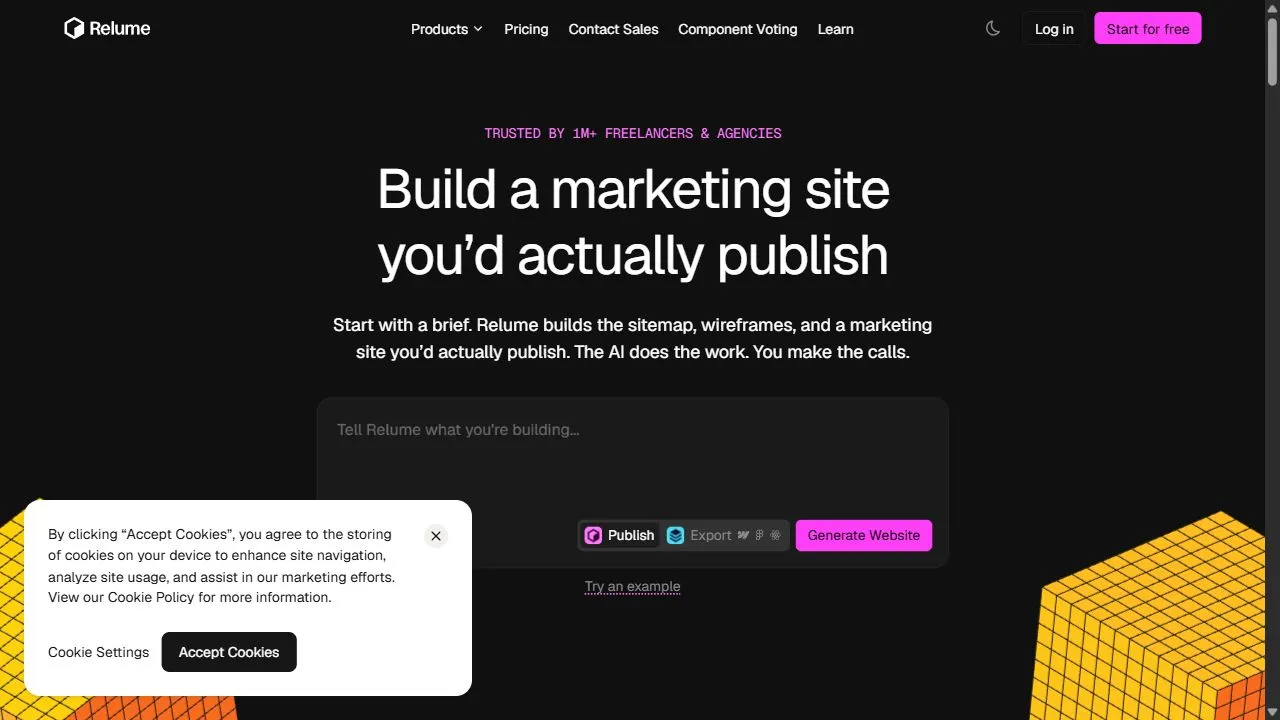
Relume is a comprehensive AI-powered tool for rapidly designing and building high-quality, publishable marketing websites.
Lovart
Opening Overview Lovart is a powerful AI-powered design agent designed to help users transform textual prompts into professional-grade visual assets by leveraging artificial intelligence, automation, and intelligent generative workflows .
Quick Verdict & Takeaway
Head-to-head summary recommendation
Both Relume and Lovart provide high-performance solutions in the Design ecosystem. Both platforms are top-rated in their respective categories.
Choose Relume if:
You need a mixed tool optimized for UX Design with TEXT input formats.
Choose Lovart if:
You prefer a mixed platform geared towards Graphic Design with IMAGE output options.
Specification & Feature Matrix
Direct technical comparison between Relume and Lovart
| Feature / Spec | Relume | Lovart |
|---|---|---|
| Pricing Model | MIXED | MIXED |
| Starting Price | $12/mo | $15/mo |
| Category | Design | Design |
| Subcategory | UX Design | Graphic Design |
| Supported Inputs | TEXT | TEXT |
| Generated Outputs | TEXT, OTHERS | IMAGE |
| User Rating | ★ 4.0 / 5.0 (0) | ★ 4.0 / 5.0 (0) |
| Verified Status | Unverified | Unverified |
Interface & UI Showcase
Visual previews and interface screenshots
Relume Interface
Lovart Interface

Pros & Cons Comparison
Relume Pros & Cons
Strengths
- Seamless integration with Webflow and Figma
- Drastically reduces design-to-development time
Limitations
- Requires learning curve for best integration
- Advanced features locked behind subscription
Lovart Pros & Cons
Strengths
- Transforms text prompts into high-quality design masterpieces.
- Acts as an intelligent AI design assistant.
- Redefines creative workflow for speed and precision.
- Accessible for designers, marketers, artists, and businesses.
- Empowers users to push creative boundaries.
Limitations
- Free tier might have significant limitations or watermarks.
- Subscription required for full functionality and commercial use.
- The AI's interpretation might sometimes deviate from highly nuanced or subjective artistic visions.
Real Community Feedback
Verified user reviews from GetAiTools community
Relume Reviews0
No community reviews yet for Relume.
Lovart Reviews1
"My favorite AI tool."
About Relume
Opening Overview Relume is a powerful AI-powered design and development platform designed to help users rapidly prototype, build, and deploy high-quality marketing websites by leveraging artificial intelligence, automation, and intelligent workflows . The platform serves as a critical bridge between the initial conceptualization phase of a website and the final development stage, eliminating the friction typically found when moving from a design tool to a live environment. By automating the structural elements of web design, the tool allows professionals to bypass the repetitive, manual tasks of layout creation and focus instead on high-level strategy, brand identity, and conversion optimization. The core problem Relume solves is the time-intensive nature of traditional web design. In a standard workflow, designers often spend days or weeks manually drafting sitemaps and wireframes before a single line of code is written or a visual element is placed. Relume utilizes artificial intelligence to generate comprehensive site maps and wireframes based on simple text prompts, effectively reducing the project timeline from weeks to a matter of days. This automation ensures that the foundational architecture of a website is logically structured and optimized for user experience before the aesthetic layer is applied. This tool is specifically engineered for web designers, marketing agencies, solo founders, and enterprise marketing teams who need to produce professional, responsive, and SEO-friendly websites at scale. By integrating deeply with industry-standard tools such as Figma and Webflow , Relume ensures that the AI-generated blueprints can be seamlessly transitioned into fully functional, publishable websites. It transforms the way marketing sites are constructed by shifting the focus from manual pixel-pushing to strategic content orchestration. Key Features of Relume AI-driven sitemap generation based on descriptive project prompts. Automated wireframe creation using a vast library of pre-built components. Seamless direct integration with Figma for visual design refinements. One-click export capabilities to Webflow for rapid site deployment. Intelligent content strategy drafting to align page structure with marketing goals. Extensive component library that ensures responsive layout consistency. Real-time editing of AI-generated site structures to allow for human oversight. Automated layout suggestions tailored to specific industry standards. Collaborative workspace tools for team-based project planning. High-fidelity wireframing that eliminates the need for manual sketching. Why People Use Relume The primary motivation for adopting Relume is the drastic reduction in the time required to move from an idea to a functional website. In traditional web development, the "blank page" problem is a significant hurdle; designers often struggle to determine the optimal page hierarchy and component placement for various industries. Relume eliminates this struggle by providing an AI-generated starting point that is grounded in proven conversion patterns and user experience best practices. Instead of building every section from scratch, users start with a professional framework that can be tweaked and refined. Furthermore, the platform addresses the common disconnect between the design and development phases. Many agencies experience a "loss in translation" when a static design in a tool like Figma is handed over to a developer for implementation in Webflow. Relume mitigates this by using a standardized component system that exists in both the wireframing stage and the development stage. This ensures that what is planned in the AI sitemap is exactly what is built in the final product, reducing the need for costly revisions and back-and-forth communication. Scalability is another driving factor. For agencies managing dozens of client projects simultaneously, the ability to generate a professional sitemap and wireframe in minutes rather than days allows them to increase their project capacity without increasing their headcount. The shift from manual labor to AI-assisted architecture allows these professionals to focus on the creative and strategic aspects of the project—such as copywriting and visual branding—rather than the tedious technical assembly of page sections. Popular Use Cases Marketing Agencies: Scaling the production of client landing pages and corporate websites by using AI to generate initial blueprints and structures. SaaS Founders: Rapidly building MVP (Minimum Viable Product) landing pages to test market hypotheses and gather user feedback without investing weeks in design. Freelance Web Designers: Increasing hourly profitability by reducing the time spent on the wireframing phase and focusing on high-value visual customization. Enterprise Marketing Teams: Standardizing the structure of multi-page corporate sites across different regional domains to ensure brand and UX consistency. E-commerce Brand Launches: Planning the user journey and page architecture for new online stores to ensure a frictionless path from landing page to checkout. UX/UI Designers: Using the AI sitemap tool to brainstorm complex site architectures and user flows before moving into high-fidelity prototyping. Benefits of Relume Accelerated Time-to-Market: Drastically reduces the duration of the design-to-development lifecycle, allowing websites to go live in a fraction of the usual time. Increased Design Consistency: Leverages a structured component library that ensures every page is responsive, balanced, and follows a cohesive logic. Higher Productivity: Frees designers and marketers from repetitive manual tasks, enabling them to spend more time on conversion rate optimization (CRO) and strategy. Improved Client Alignment: Allows agencies to present professional sitemaps and wireframes to clients early in the process, ensuring agreement on structure before visual design begins. Seamless Workflow Integration: Eliminates the technical gap between planning, designing in Figma, and developing in Webflow through a unified ecosystem. Enhanced SEO Foundation: AI-generated structures are built with logical hierarchies that provide a strong foundation for search engine optimization and crawlability. Reduced Resource Waste: Minimizes the need for extensive redesigns by validating the site architecture through AI-driven blueprints before the heavy development phase begins.
About Lovart
Opening Overview Lovart is a powerful AI-powered design agent designed to help users transform textual prompts into professional-grade visual assets by leveraging artificial intelligence, automation, and intelligent generative workflows . By positioning itself as a design agent rather than a simple tool, Lovart acts as an intuitive partner that interprets complex creative directions and executes them with high precision. It solves the critical problem of the "creative gap"—the space between a conceptual idea in a user's mind and the technical skill required to produce a polished, high-quality design. The platform utilizes advanced AI models to analyze natural language inputs and translate them into diverse visual styles and formats. This automation eliminates the need for extensive manual labor in the initial stages of design, allowing users to generate intricate illustrations, marketing visuals, and conceptual art in a fraction of the time required by traditional methods. By integrating an intelligent agent architecture, Lovart can handle nuanced requests, making it an essential asset for those who need to produce high-volume, high-quality imagery without the overhead of traditional design software. Lovart is specifically engineered for a broad spectrum of users, including professional graphic designers, digital marketers, concept artists, and business owners . Whether the objective is to create compelling visuals for a global marketing campaign, detailed illustrations for a professional publication, or unique artistic assets for personal projects, the platform provides the scalability and speed necessary to maintain a competitive edge in a fast-paced digital economy. Through the application of generative AI, Lovart democratizes high-end design, making sophisticated visual production accessible to anyone with a clear vision. Key Features of Lovart Text-to-design generation that converts simple prompts into complex visual masterpieces. Intelligent design agent capabilities that interpret and execute detailed creative directions. Support for a wide array of visual styles and artistic formats to suit different brand identities. High-speed rendering of professional-grade assets to accelerate production timelines. Automated workflow integration that bridges the gap between ideation and final execution. Advanced prompt interpretation to handle intricate and specific design requirements. Scalable image generation suitable for both small-scale personal use and large-scale corporate needs. Intuitive interface designed to streamline the collaborative process between human and AI. Why People Use Lovart The primary motivation for adopting Lovart is the desire to overcome the technical and temporal bottlenecks associated with traditional design processes. In a conventional workflow, creating a high-quality visual asset often requires a combination of expensive software, years of technical training, and hours of manual execution. Even for experienced designers, the process of sketching, drafting, and refining a concept can be time-consuming. Lovart replaces this linear, manual process with an iterative, AI-driven approach that provides near-instant results. Users turn to Lovart to achieve a level of scalability that is impossible with human labor alone. For businesses that require a constant stream of fresh content for social media, advertisements, or internal presentations, the ability to generate a variety of high-fidelity options in seconds is a significant operational advantage. This allows creative teams to spend less time on the repetitive aspects of production and more time on high-level strategic thinking and creative direction. Furthermore, Lovart provides a solution for non-designers who possess strong ideas but lack the technical proficiency to use complex vector or raster graphics software. By utilizing a text-based interface, these users can manifest their visions without needing to learn intricate toolsets. The shift from "manual creation" to "creative curation" allows users to focus on the outcome and the message of the design, while the AI handles the technical execution, ensuring a professional finish every time. Popular Use Cases Digital Marketing Agencies: Creating rapid prototypes for ad campaigns, social media graphics, and eye-catching banners that align with specific client brand guidelines. Content Creators and Bloggers: Generating unique, high-resolution featured images and custom illustrations that enhance storytelling and increase user engagement. Book Publishers and Authors: Developing concept art for characters, detailed world-building visuals, and professional-grade book cover designs. Corporate Branding Teams: Producing mood boards and conceptual visual directions for new product launches or company rebranding initiatives. Game Developers: Creating early-stage concept art for environments, characters, and assets to visualize game worlds before moving into 3D production. E-commerce Store Owners: Generating stylized lifestyle imagery or artistic product backgrounds to make online listings more visually appealing. Independent Artists: Using the AI agent to brainstorm compositions and explore new stylistic directions before executing a final hand-drawn piece. Benefits of Lovart Drastic Reduction in Production Time: Accelerates the transition from concept to final image, reducing project turnaround times from days to seconds. Increased Creative Output: Enables users to experiment with dozens of different styles and compositions rapidly, leading to more innovative final designs. Cost Efficiency: Lowers the financial barrier to professional design by reducing the need for outsourced assets or expensive software subscriptions for basic tasks. Enhanced Accessibility: Empowers individuals without formal design training to produce high-quality visual content, democratizing the creative process. Improved Consistency: Allows for the rapid generation of multiple assets that follow a consistent thematic or stylistic direction through precise prompt engineering. Reduced Cognitive Load: Removes the stress of the "blank canvas" by providing an immediate visual starting point that can be refined and perfected. Higher Scalability: Facilitates the production of massive libraries of visual assets without a proportional increase in human effort or resource expenditure.
More AI Competitors to Compare

Leonardo AI
Design

MockMe.ai
Design

Lexica AI.net
Design
PXZ AI | Video Generator
Design

VisualGPT
Design
AI Watermark Remover | Picsman AI
Design
Frequently Asked Questions
Most questions answered in under 30 seconds — but if you still have one, write to us at contactgetaitool@gmail.com and we reply within a few hours.
Which is better in 2026, Relume or Lovart?
How does the pricing compare between Relume and Lovart?
Can I use Relume and Lovart for free?
What input and output formats do Relume and Lovart support?
What are the key advantages of Relume?
What are the key advantages of Lovart?
What are top alternative competitors to Relume and Lovart?
Ready to Choose Your AI Tool?
Try both platforms or explore thousands of other curated artificial intelligence tools on GetAiTools.
Tags & Core Competencies
Specific tags and feature capabilities