Google Launches Antigravity 2.0 as Agent-First Rival to Claude Code and OpenAI Codex
Google just ripped the IDE out of Antigravity and rebuilt it from scratch as an agent-first desktop app — and it’s coming directly for Claude Code and *...
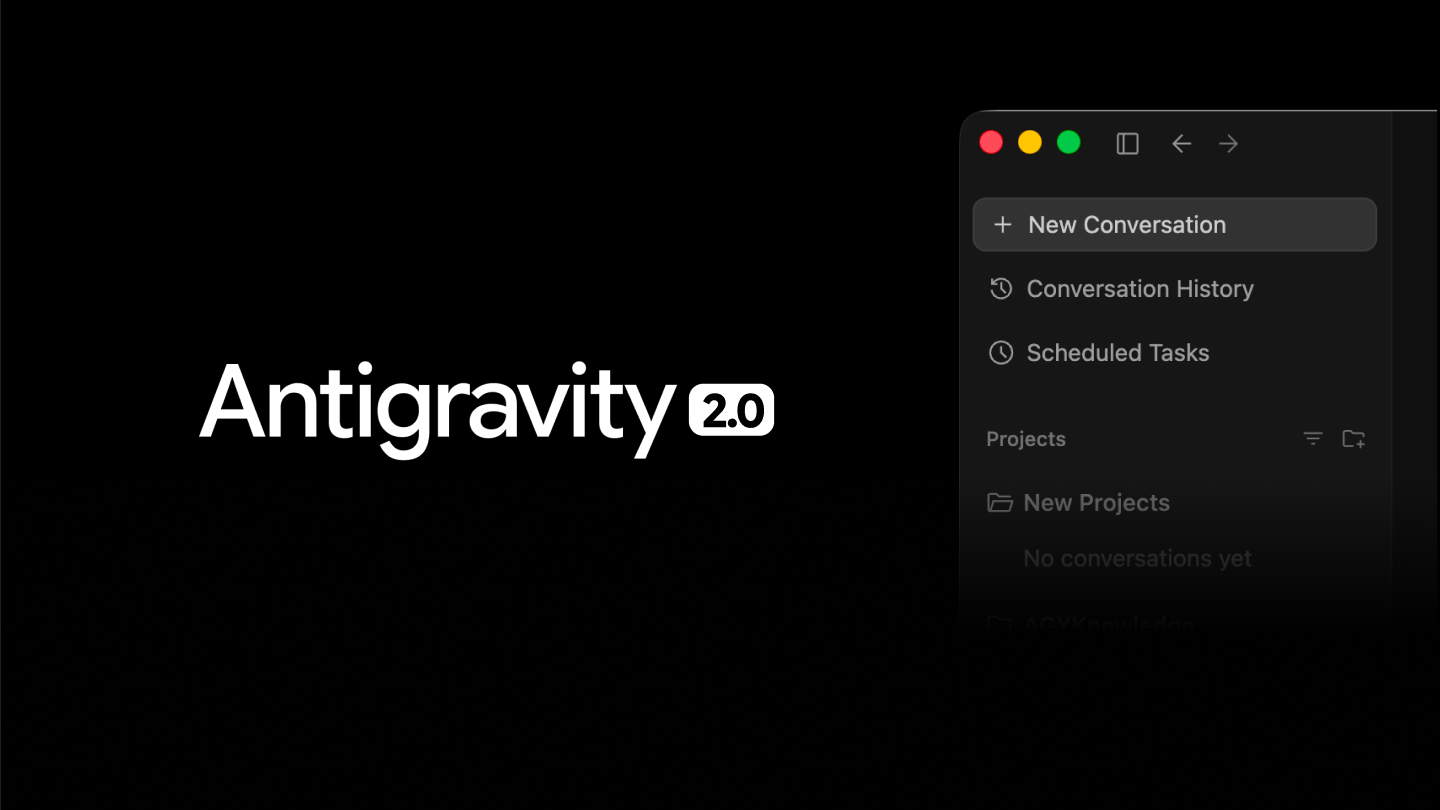
Google just ripped the IDE out of Antigravity and rebuilt it from scratch as an agent-first desktop app — and it’s coming directly for Claude Code and OpenAI Codex. Announced at I/O 2026, Antigravity 2.0 drops the code editor skin to become a standalone agent platform that runs on the new Gemini 3.5 Flash model, clocking 289 output tokens per second — more than 4x faster than Claude Opus 4.7 and 4x faster than GPT-5.5. If you build software for a living, this is the most consequential developer tool Google has shipped in years.

What Is Antigravity 2.0? The Background
Antigravity started life as Google’s AI-powered IDE — a code editor with Gemini baked in, similar to how GitHub Copilot works inside VS Code. The original version launched in 2024 and gained a modest following among Android and Firebase developers.
But over the past year, Claude Code (from Anthropic) and OpenAI Codex (now a standalone agent tool) redefined what developers expect: not just autocomplete, but autonomous agents that can plan, execute, and debug entire tasks without hand-holding. Google realised the IDE format was holding Antigravity back.
Version 2.0 is a full rebuild. It’s no longer a code editor with AI bolted on. It’s a desktop app (macOS, Linux, Windows) built entirely around agentic workflows. The model underneath is Gemini 3.5 Flash, which Google claims beats even its own Gemini 3.1 Pro on coding and agentic benchmarks.
The Core News: What Changed in Antigravity 2.0
The headline speed jump (289 tokens/sec) is only the beginning. The real shift is architectural:
- Main agent spawns sub-agents on the fly — it can define subtasks, run them in parallel, and keep its own context window uncluttered.
- Asynchronous execution — the agent doesn’t freeze while code compiles. Tasks run in the background.
- JSON hooks — developers can intercept and shape agent behaviour without writing wrapper scripts.
- Scheduled Tasks layer — built-in cron-style scheduling so agents fire on timers, not just manual invocations.
Varun Mohan, head of Antigravity, demonstrated the capability on stage by having the agents build an operating system from scratch for under $1,000 in tokens — and then code a Doom clone to run on top of it.
New slash commands clarify how Google expects users to interact:
| Command | What It Does |
|---|---|
/goal | Runs the agent to completion without asking for permission |
/grill-me | Agent asks clarifying questions before touching any file |
/browser | Explicitly enables web search (Google admits agents still can’t decide when to browse on their own) |
| Voice input | Transcribes live instead of sending raw audio to the model |
Agents are no longer tied to a single repo. Conversations now live inside “projects” that span multiple folders and carry their own permissions.
Why This Matters: The Stakes for the Developer Tools Market
This isn’t just a product update — it’s Google’s best shot at winning the agentic coding wars. Here’s how the major players stack up:
| Tool | Model | Tokens/sec | Agent Architecture | Pricing Starting |
|---|---|---|---|---|
| Antigravity 2.0 | Gemini 3.5 Flash | 289 | Full agent + subagents | $20/mo (Pro) |
| Claude Code | Claude Opus 4.7 | 67 | Agent-only | $20/mo (Pro) |
| OpenAI Codex | GPT-5.5 | 71 | Agent-only | $20/mo (Plus) |
Speed alone isn’t everything, but 4x faster inference changes the developer experience dramatically. When your agent can iterate four times faster, the entire feedback loop compresses. That’s the kind of productivity gain that makes teams switch tools.
Google is also bundling deeper integrations with AI Studio, Firebase, and Android — plus a new AI Studio Android app. If you’re already in the Google ecosystem, Antigravity 2.0 becomes the natural choice.
Key Details: Technical Breakdown and Features
New CLI and SDK
The old Gemini CLI is being replaced entirely. A new Antigravity CLI takes over, so existing terminal workflows will need migration. Google is also releasing an SDK that lets developers build custom agents on top of Antigravity’s infrastructure.
Pricing Reshuffle
| Tier | Price | Limits |
|---|---|---|
| Pro | $20/mo | Standard |
| AI Ultra (new) | $100/mo | 5x Pro limits |
| Ultra | $200/mo (down from $250) | 20x Pro limits |
New and existing Ultra subscribers get $100 bonus credits through May 25. The $100 middle tier is clearly aimed at power users who found Pro too limiting but couldn’t justify the old $250 Ultra.
Availability
- macOS, Linux, Windows — out today.
- Existing Antigravity IDE users will automatically update to 2.0 on their next update.
Competitive Landscape: Who Else Is in This Race?
- Anthropic’s Claude Code — strong agent capabilities, but slower inference and no subagent spawning. Pricing similar.
- OpenAI Codex — popularised the agentic coding trend. Fast, but still single-agent. Tightly integrated with OpenAI ecosystem.
- GitHub Copilot — still the king of autocomplete, but weak on full agent autonomy. Microsoft has been rumoured to be building a deeper agent layer.
- Cursor — indie standout with strong AI-assisted editing, but not an agent platform yet.
Antigravity 2.0’s advantage is subagent parallelism and speed. Its disadvantage: it’s tied to Google infrastructure, which may scare off developers who don’t want to go all-in on Google Cloud.
What This Means for AI-Tool and AI-News Publishers
For publishers covering AI tools in Delhi, this story is pure gold. Here are 5 content angles you can execute today:
-
Benchmark showdown: Test Antigravity 2.0, Claude Code, and OpenAI Codex on the same coding task (e.g., build a React component with API integration). Measure time, tokens used, and code quality. This is guaranteed clickbait for developer readers.
-
Pricing analysis: Break down the new $100 AI Ultra tier vs competitors. Is it worth it for Indian freelancers? Compare costs in INR and factor in token consumption for typical Indian startup projects.
-
How to migrate from Gemini CLI to Antigravity CLI: A step-by-step tutorial for Indian developers who’ve been using Gemini CLI. Include common gotchas.
-
The “build an OS under $1000” experiment: Reproduce Varun Mohan’s demo. Can you actually build an OS for under ₹85,000 in tokens? Document the process for a viral technical deep-dive.
-
SEO guide: “Antigravity 2.0 vs Claude Code”: Create a comprehensive comparison page targeting keywords like “best AI coding agent 2026”, “Antigravity 2.0 review”, “Gemini 3.5 Flash benchmark”. Indian developers search for these terms heavily.
Challenges Ahead: Risks and Limitations
- Vendor lock-in: Antigravity 2.0 is deeply tied to Google’s ecosystem. If you use AWS or Azure heavily, the integration friction is real.
- Agent reliability on web search: Google itself admits agents can’t reliably decide when to open a webpage. The
/browsertoggle is a workaround, not a solution. - Token cost for large projects: While the demo showed a $1,000 OS build, real-world projects with complex dependencies could burn through credits fast.
- Migration pain: Existing Gemini CLI users must migrate to the new Antigravity CLI — that’s a breaking change.
- Competitive moat: Claude Code and OpenAI Codex are also iterating rapidly. Google’s speed advantage may shrink as competitors adopt faster models.
Final Thoughts
Antigravity 2.0 is the first time Google has shipped a developer tool that genuinely rethinks how AI agents work, not just slaps AI onto an existing interface. The subagent spawning and async execution are architectural leaps that competitors will need to match. But the real test is adoption: will developers trust Google enough to let its agents manage their entire workflow? If they do, the coding agent race just got a new frontrunner.
FAQ
What is Antigravity 2.0 exactly?
It’s Google’s new standalone desktop app for AI-powered coding agents, replacing the older Antigravity IDE. It runs on the Gemini 3.5 Flash model and can spawn subagents that work in parallel.
How fast is Antigravity 2.0 compared to Claude Code and OpenAI Codex?
Google claims 289 output tokens per second on Artificial Analysis benchmarks, versus 67 for Claude Opus 4.7 and 71 for GPT-5.5 — roughly 4x faster than both.
Can I still use Antigravity 2.0 if I’m not on Google Cloud?
Yes, the desktop app works locally, but deeper integrations with AI Studio, Firebase, and Android require Google services. You can use it as a standalone agent without a cloud account.
When is Antigravity 2.0 available?
It’s out today on macOS, Linux, and Windows. Existing Antigravity IDE users will get the update automatically.
What are the main risks of switching to Antigravity 2.0?
Vendor lock-in to Google’s ecosystem, potential high token costs for large projects, and the need to migrate from the old Gemini CLI to the new Antigravity CLI.
How does Antigravity 2.0 handle complex multi-file projects?
Agents now work inside “projects” that span multiple folders with their own permissions. The main agent can delegate subagents to handle different files or modules in parallel.


