CubevsDatumFuse.AI
Side-by-side battle & analysis. Compare features, pricing, real community ratings, and pros & cons in 2026.

Cube
Cube is an agentic analytics platform that provides a single, trusted semantic layer for all your business data and team reporting.

DatumFuse.AI
DatumFuse.AI is an AI-powered data intelligence platform that transforms raw, unstructured data into actionable insights, automating the processes of data cleaning, harmonization, augmentation, and visualization.
Quick Verdict & Takeaway
Head-to-head summary recommendation
Both Cube and DatumFuse.AI provide high-performance solutions in the Analytics Ai ecosystem. Both platforms are top-rated in their respective categories.
Choose Cube if:
You need a mixed tool optimized for Analytics Ai with TEXT, OTHERS input formats.
Choose DatumFuse.AI if:
You prefer a mixed platform geared towards Analytics Ai with TEXT output options.
Specification & Feature Matrix
Direct technical comparison between Cube and DatumFuse.AI
| Feature / Spec | Cube | DatumFuse.AI |
|---|---|---|
| Pricing Model | MIXED | MIXED |
| Starting Price | $40/mo | $15/mo |
| Category | Analytics Ai | Analytics Ai |
| Subcategory | Analytics Ai | Analytics Ai |
| Supported Inputs | TEXT, OTHERS | TEXT |
| Generated Outputs | TEXT | TEXT |
| User Rating | ★ 4.0 / 5.0 (0) | ★ 4.0 / 5.0 (0) |
| Verified Status | Unverified | Unverified |
Interface & UI Showcase
Visual previews and interface screenshots
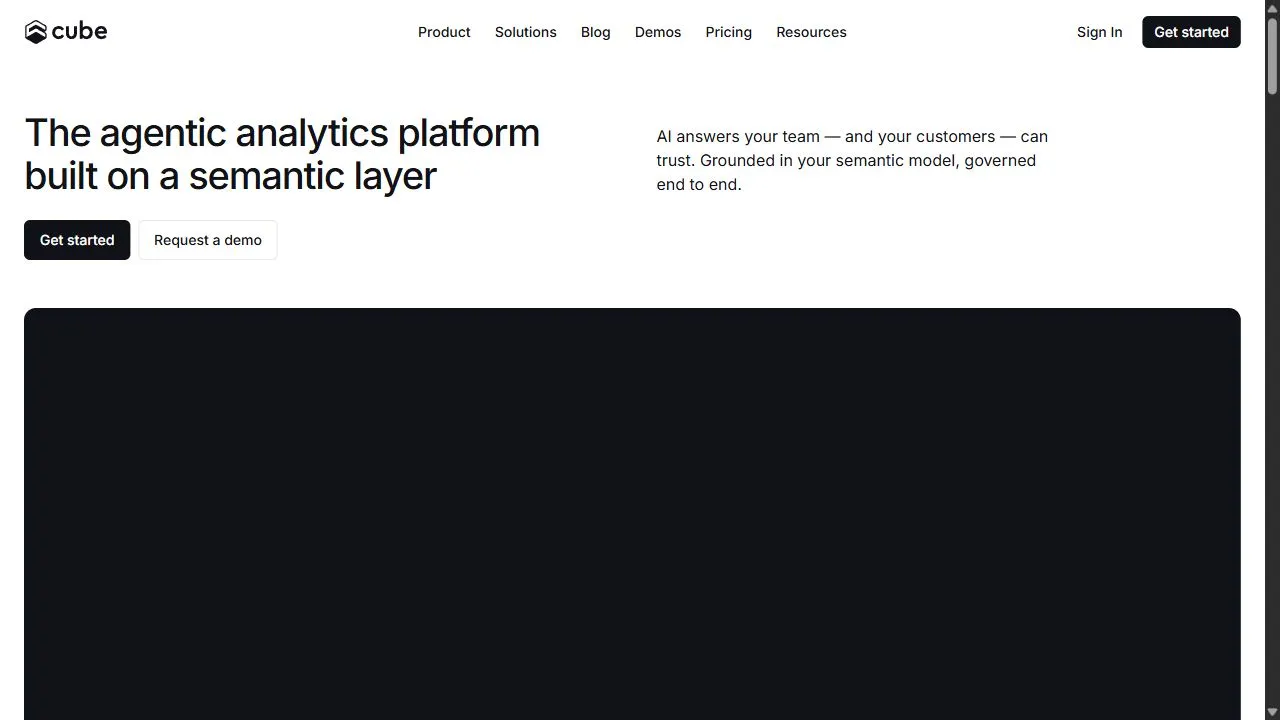
Cube Interface
DatumFuse.AI Interface


Pros & Cons Comparison
Cube Pros & Cons
Strengths
- Single source of truth for metrics
- Scalable infrastructure
- Seamless BI integration
Limitations
- Steep learning curve for non-technical users
- Requires significant initial setup
DatumFuse.AI Pros & Cons
Real Community Feedback
Verified user reviews from GetAiTools community
Cube Reviews0
No community reviews yet for Cube.
DatumFuse.AI Reviews1
"It keeps stripping my markdown headers when I export."
About Cube
Cube is a professional agentic analytics platform designed to bridge the gap between complex raw data sets and actionable business intelligence by leveraging a robust semantic layer. This platform solves the critical problem of data inconsistency—often referred to as metric drift—where different departments or tools report different numbers for the same business KPI. By introducing a centralized layer of intelligence between the data source and the visualization tool, Cube ensures that an organization maintains a single source of truth, providing consistent, governed metrics across all internal teams, external applications, and customer-facing dashboards. The platform utilizes artificial intelligence and automation to transform how organizations interact with their data, moving beyond static dashboards toward agentic analytics. This approach allows the system to not only present data but to understand the underlying business logic, enabling AI-driven applications to query data accurately without requiring a human to write complex SQL for every request. Cube is primarily built for data engineers, software developers, and BI professionals who need to scale their data infrastructure while maintaining strict security and reliability. By integrating seamlessly with the modern data stack, Cube empowers organizations to decouple their data definitions from their visualization tools. This means that if a business logic change occurs—such as how "Monthly Recurring Revenue" is calculated—the change is made once in the Cube semantic layer and is instantly updated across every connected BI tool or application. This architectural shift eliminates data silos and reduces the operational overhead associated with maintaining redundant reporting logic across multiple platforms. Key Features of Cube Universal Semantic Layer that centralizes business logic and metric definitions in one location. Agentic AI Integration allowing for the creation of intelligent data assistants and AI-powered analytics workflows. API-First Architecture that enables developers to embed analytics directly into custom SaaS applications via REST, GraphQL, or SQL APIs. Pre-aggregation and Caching capabilities to significantly accelerate query performance on massive datasets. Multi-Cloud and Hybrid Deployment options to ensure data residency and security compliance. Broad BI Tool Compatibility providing seamless connectivity with popular visualization software. Dynamic Data Security and access control layers to ensure users only see the data they are authorized to access. Real-time Data Synchronization to provide up-to-the-minute insights without overloading the underlying data warehouse. Version Control Integration allowing data teams to manage semantic definitions using standard software engineering practices. Why People Use Cube The primary motivation for adopting Cube is the elimination of the "SQL bottleneck" and the inconsistency inherent in traditional reporting methods. In a standard environment, every dashboard or report relies on its own set of SQL queries. When a business definition changes, data engineers must manually find and update every single query across dozens of dashboards, a process that is prone to human error and leads to conflicting reports. Cube replaces this manual, fragmented approach with a centralized semantic layer, ensuring that a metric defined once is used everywhere. Furthermore, organizations use Cube to solve the performance challenges associated with querying huge volumes of data in real-time. Traditional BI tools often struggle with latency when hitting a data warehouse directly. Cube’s intelligent caching and pre-aggregation layers act as a high-performance buffer, delivering results in milliseconds regardless of the underlying database's speed. This makes it an essential tool for companies providing customer-facing analytics where a slow loading screen is unacceptable. Lastly, the shift toward "agentic" analytics is a major driver. With the rise of Large Language Models (LLMs), companies want to enable natural language querying of their data. However, LLMs are notorious for hallucinating SQL queries or misunderstanding database schemas. Cube provides the necessary structural guardrails; the AI interacts with the semantic layer rather than the raw database, ensuring that the answers provided to users are based on governed business logic rather than AI guesswork. Popular Use Cases Embedded Analytics for SaaS Providers: Software companies use Cube to build sophisticated, white-labeled analytics dashboards directly into their products, allowing their customers to track their own usage and performance metrics. Enterprise-Wide Metric Standardization: Large corporations with multiple departments (Finance, Sales, Marketing) use Cube to ensure that everyone is looking at the same "North Star" metrics, eliminating disputes over data accuracy during executive meetings. AI-Powered Data Assistants: Developers build internal "Chat with your Data" bots that leverage Cube’s semantic layer to translate natural language questions into accurate data retrievals without needing a data analyst for every query. High-Scale Executive Reporting: Organizations with massive datasets use Cube’s pre-aggregation features to generate instant executive summaries and KPIs that would otherwise take minutes to load from a traditional warehouse. Customer-Facing Data Portals: Companies provide their clients with secure, self-service portals where users can filter and explore their own data in real-time without risking the exposure of other clients' information. Benefits of Cube Absolute Data Consistency: Guarantees that the same metric returns the same value regardless of the tool or user accessing it, fostering trust in organizational data. Dramatic Reduction in Engineering Overhead: Simplifies the maintenance of data pipelines by removing the need to update repetitive SQL queries across multiple platforms. Improved Application Performance: Accelerates data retrieval speeds through advanced caching, leading to a better end-user experience in embedded applications. Enhanced Data Governance: Centralizes security and access rules, making it easier to audit who is accessing what data and ensuring compliance with privacy regulations. Faster Time-to-Insight: Enables non-technical stakeholders to access accurate data through AI assistants and intuitive BI tools without waiting for a developer to build a new report. Increased Scalability: Allows data infrastructure to grow seamlessly as data volume increases, preventing the reporting layer from becoming a performance bottleneck. Decoupled Architecture: Provides the flexibility to switch BI tools or underlying databases without having to rewrite all the business logic from scratch.
About DatumFuse.AI
DatumFuse.AI is an AI-powered data intelligence platform that transforms raw, unstructured data into actionable insights, automating the processes of data cleaning, harmonization, augmentation, and visualization. DatumFuse.AI addresses the significant challenges businesses face when dealing with complex and often messy datasets. Traditional data analysis methods are time-consuming, prone to errors, and require specialized expertise. This platform leverages the power of artificial intelligence and machine learning to streamline data preparation, uncover hidden patterns, and deliver clear, concise narratives. It is designed for data analysts, business intelligence professionals, marketers, and anyone who needs to extract meaningful insights from data quickly and efficiently, offering a solution for data cleaning, data analysis, and data visualization . DatumFuse.AI empowers users to move beyond simply collecting data and towards truly understanding it, enabling data-driven decision-making and improved business outcomes. The platform’s core strength lies in its ability to automate tasks that previously required significant manual effort, accelerating the entire data analysis lifecycle. Key Features of DatumFuse.AI Automated data cleaning and standardization. Intelligent data harmonization across multiple sources. AI-powered data augmentation with external datasets. Automated data narration that translates complex findings into plain language. Interactive data visualization tools for clear insight communication. Support for various data formats, including spreadsheets and CSV files. Ability to identify and flag data anomalies and inconsistencies. Customizable data transformation workflows. Secure data processing and storage. User-friendly interface requiring minimal technical expertise. Why People Use DatumFuse.AI Users adopt DatumFuse.AI to overcome the limitations of traditional data analysis methods. Manually cleaning, harmonizing, and analyzing data is a notoriously slow and error-prone process. This platform automates these tasks, significantly reducing the time and resources required to derive valuable insights. Unlike conventional business intelligence tools that often require extensive coding or specialized skills, DatumFuse.AI is designed for accessibility, allowing users of all technical levels to unlock the power of their data. The platform’s ability to narrate findings in plain language further democratizes data access, making insights understandable to a wider audience within an organization. It provides a scalable solution for organizations of all sizes looking to improve their data analytics capabilities and make more informed decisions. Popular Use Cases Marketing Analytics: Analyzing customer data to identify trends, segment audiences, and optimize marketing campaigns. Sales Performance Analysis: Identifying top-performing products, regions, and sales representatives to improve sales strategies. Financial Reporting: Automating the preparation of financial reports and identifying key financial indicators. Customer Relationship Management (CRM): Cleaning and enriching customer data to improve CRM accuracy and effectiveness. Supply Chain Optimization: Analyzing supply chain data to identify bottlenecks and improve efficiency. Healthcare Data Analysis: Identifying patterns in patient data to improve healthcare outcomes and reduce costs. Market Research: Analyzing market data to identify opportunities and assess competitive landscapes. Academic Research: Cleaning and analyzing research data to support scientific discoveries. Data Migration: Harmonizing data during system migrations and integrations. Data Quality Assessment: Identifying and resolving data quality issues across an organization. Benefits of DatumFuse.AI Increased Efficiency: Automate data preparation tasks, saving significant time and resources. Improved Data Quality: Ensure data accuracy and consistency through automated cleaning and harmonization. Enhanced Insights: Uncover hidden patterns and trends through AI-powered data augmentation and analysis. Faster Decision-Making: Access clear, concise narratives and visualizations that facilitate informed decisions. Reduced Costs: Lower the cost of data analysis by automating manual tasks and reducing errors. Greater Accessibility: Empower users of all technical levels to unlock the power of their data. Scalable Solution: Adapt to growing data volumes and evolving business needs. Improved Collaboration: Share insights easily with colleagues through interactive visualizations and narratives. Data-Driven Culture: Foster a data-driven culture within the organization by making data more accessible and understandable. Competitive Advantage: Gain a competitive edge by leveraging data insights to optimize business strategies and improve performance.
More AI Competitors to Compare
Writesonic
Analytics Ai

Getgud.io
Analytics Ai

Formula Bot(for Data Analysis)
Analytics Ai

Julius ai
Analytics Ai
ComputerX
Analytics Ai

ChatFlow
Analytics Ai
Frequently Asked Questions
Most questions answered in under 30 seconds — but if you still have one, write to us at contactgetaitool@gmail.com and we reply within a few hours.
Which is better in 2026, Cube or DatumFuse.AI?
How does the pricing compare between Cube and DatumFuse.AI?
Can I use Cube and DatumFuse.AI for free?
What input and output formats do Cube and DatumFuse.AI support?
What are the key advantages of Cube?
What are the key advantages of DatumFuse.AI?
What are top alternative competitors to Cube and DatumFuse.AI?
Ready to Choose Your AI Tool?
Try both platforms or explore thousands of other curated artificial intelligence tools on GetAiTools.
Tags & Core Competencies
Specific tags and feature capabilities