CubevsWritesonic
Side-by-side battle & analysis. Compare features, pricing, real community ratings, and pros & cons in 2026.

Cube
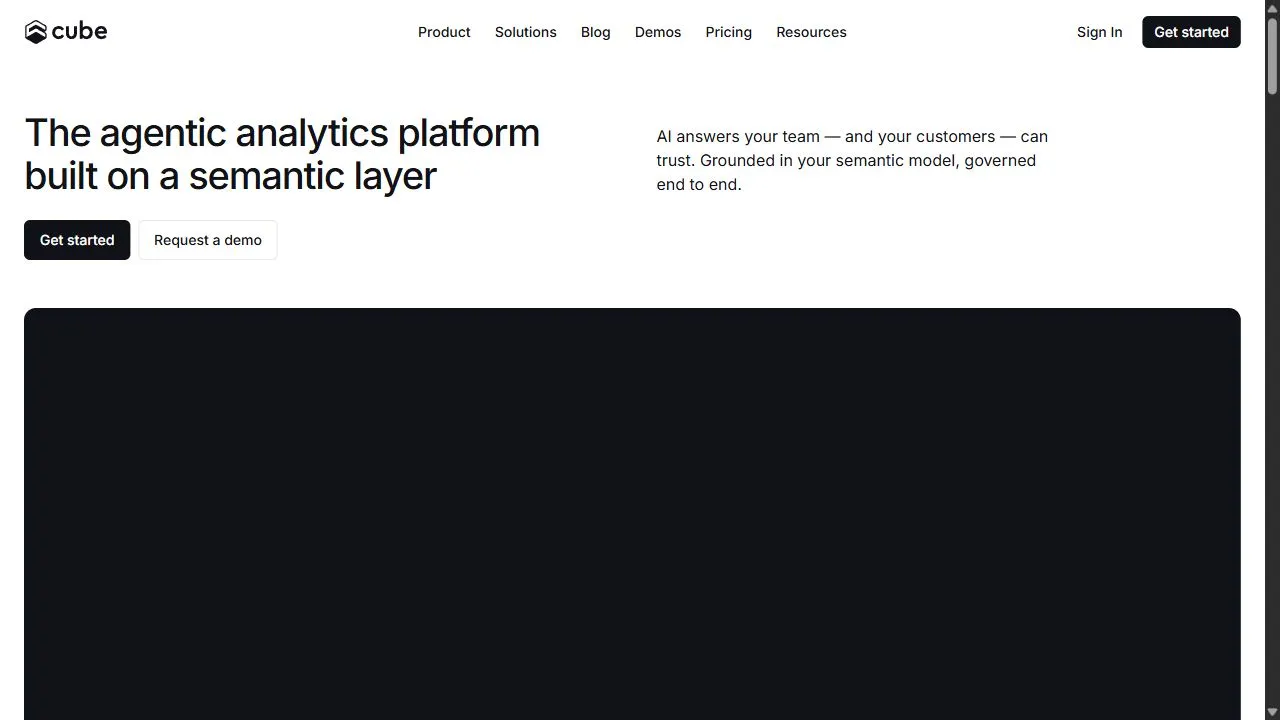
Cube is an agentic analytics platform that provides a single, trusted semantic layer for all your business data and team reporting.
Writesonic
Writesonic is an AI-powered SEO analytics platform designed to help businesses monitor, analyze, and improve their brand visibility in AI-driven search results .
Quick Verdict & Takeaway
Head-to-head summary recommendation
Both Cube and Writesonic provide high-performance solutions in the Analytics Ai ecosystem. Both platforms are top-rated in their respective categories.
Choose Cube if:
You need a mixed tool optimized for Analytics Ai with TEXT, OTHERS input formats.
Choose Writesonic if:
You prefer a free platform geared towards Analytics Ai with TEXT output options.
Specification & Feature Matrix
Direct technical comparison between Cube and Writesonic
| Feature / Spec | Cube | Writesonic |
|---|---|---|
| Pricing Model | MIXED | FREE |
| Starting Price | $40/mo | Free / Not Listed |
| Category | Analytics Ai | Analytics Ai |
| Subcategory | Analytics Ai | Analytics Ai |
| Supported Inputs | TEXT, OTHERS | TEXT |
| Generated Outputs | TEXT | TEXT |
| User Rating | ★ 4.0 / 5.0 (0) | ★ 4.0 / 5.0 (0) |
| Verified Status | Unverified | Unverified |
Interface & UI Showcase
Visual previews and interface screenshots
Cube Interface
Writesonic Interface

Pros & Cons Comparison
Cube Pros & Cons
Strengths
- Single source of truth for metrics
- Scalable infrastructure
- Seamless BI integration
Limitations
- Steep learning curve for non-technical users
- Requires significant initial setup
Writesonic Pros & Cons
Real Community Feedback
Verified user reviews from GetAiTools community
Cube Reviews0
No community reviews yet for Cube.
Writesonic Reviews2
"I’ve noticed Writesonic tends to use the same transition words over and over."
"Работает быстро и стабильно."
About Cube
Cube is a professional agentic analytics platform designed to bridge the gap between complex raw data sets and actionable business intelligence by leveraging a robust semantic layer. This platform solves the critical problem of data inconsistency—often referred to as metric drift—where different departments or tools report different numbers for the same business KPI. By introducing a centralized layer of intelligence between the data source and the visualization tool, Cube ensures that an organization maintains a single source of truth, providing consistent, governed metrics across all internal teams, external applications, and customer-facing dashboards. The platform utilizes artificial intelligence and automation to transform how organizations interact with their data, moving beyond static dashboards toward agentic analytics. This approach allows the system to not only present data but to understand the underlying business logic, enabling AI-driven applications to query data accurately without requiring a human to write complex SQL for every request. Cube is primarily built for data engineers, software developers, and BI professionals who need to scale their data infrastructure while maintaining strict security and reliability. By integrating seamlessly with the modern data stack, Cube empowers organizations to decouple their data definitions from their visualization tools. This means that if a business logic change occurs—such as how "Monthly Recurring Revenue" is calculated—the change is made once in the Cube semantic layer and is instantly updated across every connected BI tool or application. This architectural shift eliminates data silos and reduces the operational overhead associated with maintaining redundant reporting logic across multiple platforms. Key Features of Cube Universal Semantic Layer that centralizes business logic and metric definitions in one location. Agentic AI Integration allowing for the creation of intelligent data assistants and AI-powered analytics workflows. API-First Architecture that enables developers to embed analytics directly into custom SaaS applications via REST, GraphQL, or SQL APIs. Pre-aggregation and Caching capabilities to significantly accelerate query performance on massive datasets. Multi-Cloud and Hybrid Deployment options to ensure data residency and security compliance. Broad BI Tool Compatibility providing seamless connectivity with popular visualization software. Dynamic Data Security and access control layers to ensure users only see the data they are authorized to access. Real-time Data Synchronization to provide up-to-the-minute insights without overloading the underlying data warehouse. Version Control Integration allowing data teams to manage semantic definitions using standard software engineering practices. Why People Use Cube The primary motivation for adopting Cube is the elimination of the "SQL bottleneck" and the inconsistency inherent in traditional reporting methods. In a standard environment, every dashboard or report relies on its own set of SQL queries. When a business definition changes, data engineers must manually find and update every single query across dozens of dashboards, a process that is prone to human error and leads to conflicting reports. Cube replaces this manual, fragmented approach with a centralized semantic layer, ensuring that a metric defined once is used everywhere. Furthermore, organizations use Cube to solve the performance challenges associated with querying huge volumes of data in real-time. Traditional BI tools often struggle with latency when hitting a data warehouse directly. Cube’s intelligent caching and pre-aggregation layers act as a high-performance buffer, delivering results in milliseconds regardless of the underlying database's speed. This makes it an essential tool for companies providing customer-facing analytics where a slow loading screen is unacceptable. Lastly, the shift toward "agentic" analytics is a major driver. With the rise of Large Language Models (LLMs), companies want to enable natural language querying of their data. However, LLMs are notorious for hallucinating SQL queries or misunderstanding database schemas. Cube provides the necessary structural guardrails; the AI interacts with the semantic layer rather than the raw database, ensuring that the answers provided to users are based on governed business logic rather than AI guesswork. Popular Use Cases Embedded Analytics for SaaS Providers: Software companies use Cube to build sophisticated, white-labeled analytics dashboards directly into their products, allowing their customers to track their own usage and performance metrics. Enterprise-Wide Metric Standardization: Large corporations with multiple departments (Finance, Sales, Marketing) use Cube to ensure that everyone is looking at the same "North Star" metrics, eliminating disputes over data accuracy during executive meetings. AI-Powered Data Assistants: Developers build internal "Chat with your Data" bots that leverage Cube’s semantic layer to translate natural language questions into accurate data retrievals without needing a data analyst for every query. High-Scale Executive Reporting: Organizations with massive datasets use Cube’s pre-aggregation features to generate instant executive summaries and KPIs that would otherwise take minutes to load from a traditional warehouse. Customer-Facing Data Portals: Companies provide their clients with secure, self-service portals where users can filter and explore their own data in real-time without risking the exposure of other clients' information. Benefits of Cube Absolute Data Consistency: Guarantees that the same metric returns the same value regardless of the tool or user accessing it, fostering trust in organizational data. Dramatic Reduction in Engineering Overhead: Simplifies the maintenance of data pipelines by removing the need to update repetitive SQL queries across multiple platforms. Improved Application Performance: Accelerates data retrieval speeds through advanced caching, leading to a better end-user experience in embedded applications. Enhanced Data Governance: Centralizes security and access rules, making it easier to audit who is accessing what data and ensuring compliance with privacy regulations. Faster Time-to-Insight: Enables non-technical stakeholders to access accurate data through AI assistants and intuitive BI tools without waiting for a developer to build a new report. Increased Scalability: Allows data infrastructure to grow seamlessly as data volume increases, preventing the reporting layer from becoming a performance bottleneck. Decoupled Architecture: Provides the flexibility to switch BI tools or underlying databases without having to rewrite all the business logic from scratch.
About Writesonic
Writesonic is an AI-powered SEO analytics platform designed to help businesses monitor, analyze, and improve their brand visibility in AI-driven search results . It addresses the challenge of understanding and adapting to the evolving landscape of search, particularly with the rise of AI-powered search engines. Leveraging artificial intelligence, machine learning, and competitive intelligence , Writesonic provides actionable insights for optimizing content and SEO strategies. This tool is intended for SEO professionals, content marketers, brand managers, and businesses seeking to maintain or improve their online presence in the age of AI search. Key Features of Writesonic Tracks brand mentions and rankings in AI search results. Provides competitor analysis within AI search landscapes. Identifies relevant keywords driving AI search traffic. Offers AI-powered content recommendations for improved ranking. Automates technical SEO audits and provides fix suggestions. Analyzes competitor content performance in AI search. Monitors search visibility trends over time. Generates reports on brand performance in AI search. Identifies opportunities for content creation and optimization. Provides insights into emerging AI search trends. Why People Use Writesonic Businesses and marketing teams are increasingly recognizing the need to adapt their SEO strategies to accommodate the growing influence of AI in search. Traditional SEO methods, while still valuable, are becoming insufficient on their own. Writesonic provides a solution by offering a dedicated platform for understanding how brands are perceived and ranked by AI search engines. Unlike manual tracking and analysis, which can be time-consuming and prone to error, Writesonic automates the process, delivering real-time data and actionable insights. This allows users to move beyond guesswork and make data-driven decisions to improve their search visibility, ultimately driving more organic traffic and achieving better business outcomes. The platform’s focus on actionable intelligence distinguishes it from simple monitoring tools, enabling users to directly address identified issues and capitalize on emerging opportunities. Popular Use Cases Brand Reputation Management: Monitoring how a brand is represented in AI search results and addressing negative or inaccurate information. Competitive Analysis: Identifying competitor strategies in AI search and uncovering opportunities to gain a competitive edge. Content Strategy Development: Creating content that is specifically optimized for AI search algorithms and user intent. SEO Audits & Technical SEO: Identifying and resolving technical SEO issues that may be hindering AI search performance. Keyword Research: Discovering high-potential keywords that are driving traffic in AI search. Performance Tracking: Monitoring the impact of SEO efforts on AI search rankings and traffic. Local SEO Optimization: Improving visibility in local AI search results for businesses with a physical presence. E-commerce SEO: Optimizing product listings and website content for AI-powered shopping search. Content Refresh & Optimization: Identifying underperforming content and using AI recommendations to improve its ranking. Link Building: Discovering opportunities to earn backlinks from websites that are ranking well in AI search. Benefits of Writesonic Improved Search Visibility: Increased organic traffic from AI-powered search engines. Data-Driven Decision Making: Informed SEO and content strategies based on real-time data. Enhanced Brand Reputation: Proactive management of brand perception in AI search results. Competitive Advantage: Identification of competitor strategies and opportunities for differentiation. Time Savings: Automated tracking, analysis, and reporting, freeing up valuable time for other tasks. Increased Efficiency: Streamlined SEO workflows and faster identification of issues and opportunities. Actionable Insights: Clear recommendations for improving AI search performance. Proactive Problem Solving: Early detection of potential issues and opportunities before they impact rankings. Better Content Performance: Creation of content that is optimized for AI search algorithms and user intent. Scalable SEO Efforts: Ability to monitor and analyze a large number of keywords and competitors efficiently.
More AI Competitors to Compare

DatumFuse.AI
Analytics Ai

Getgud.io
Analytics Ai

Formula Bot(for Data Analysis)
Analytics Ai

Julius ai
Analytics Ai
ComputerX
Analytics Ai

ChatFlow
Analytics Ai
Frequently Asked Questions
Most questions answered in under 30 seconds — but if you still have one, write to us at contactgetaitool@gmail.com and we reply within a few hours.
Which is better in 2026, Cube or Writesonic?
How does the pricing compare between Cube and Writesonic?
Can I use Cube and Writesonic for free?
What input and output formats do Cube and Writesonic support?
What are the key advantages of Cube?
What are the key advantages of Writesonic?
What are top alternative competitors to Cube and Writesonic?
Ready to Choose Your AI Tool?
Try both platforms or explore thousands of other curated artificial intelligence tools on GetAiTools.
Tags & Core Competencies
Specific tags and feature capabilities