GreenPRDvsFusionOS
Side-by-side battle & analysis. Compare features, pricing, real community ratings, and pros & cons in 2026.
GreenPRD
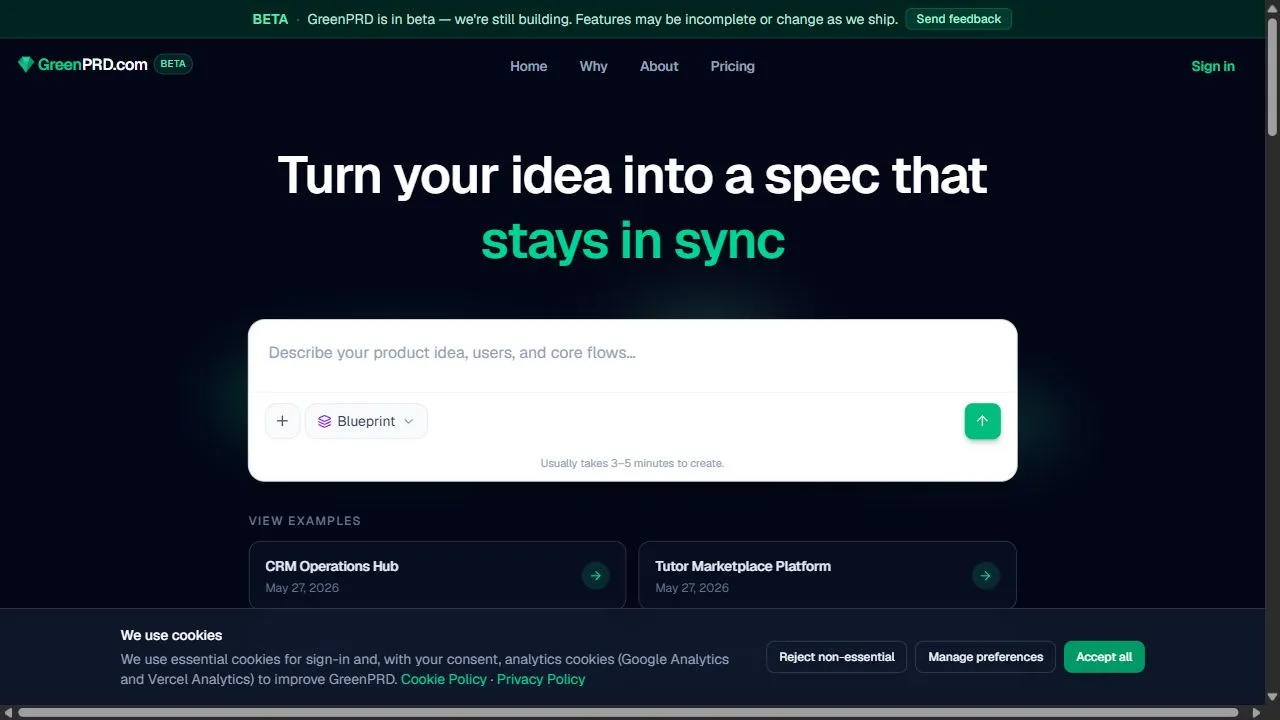
A product management tool that keeps documentation, graphs, and requirements in sync as your project evolves.

FusionOS
FusionOS is an innovative AI workflow automation platform that empowers users to build, deploy, and manage autonomous AI agents for a wide range of tasks.
Quick Verdict & Takeaway
Head-to-head summary recommendation
Both GreenPRD and FusionOS provide high-performance solutions in the Agentic Ai ecosystem. Both platforms are top-rated in their respective categories.
Choose GreenPRD if:
You need a mixed tool optimized for AI Workflow Automation with TEXT input formats.
Choose FusionOS if:
You prefer a mixed platform geared towards AI Workflow Automation with TEXT output options.
Specification & Feature Matrix
Direct technical comparison between GreenPRD and FusionOS
| Feature / Spec | GreenPRD | FusionOS |
|---|---|---|
| Pricing Model | MIXED | MIXED |
| Starting Price | $7.67/mo | $10/mo |
| Category | Agentic Ai | Agentic Ai |
| Subcategory | AI Workflow Automation | AI Workflow Automation |
| Supported Inputs | TEXT | TEXT |
| Generated Outputs | TEXT, OTHERS | TEXT |
| User Rating | ★ 4.0 / 5.0 (0) | ★ 4.0 / 5.0 (0) |
| Verified Status | Unverified | Unverified |
Interface & UI Showcase
Visual previews and interface screenshots
GreenPRD Interface
FusionOS Interface


Pros & Cons Comparison
GreenPRD Pros & Cons
Strengths
- Reduces documentation drift
- Keeps technical specs in sync with features
Limitations
- Requires team adoption to be fully effective
- Learning curve for the graphing system
FusionOS Pros & Cons
Real Community Feedback
Verified user reviews from GetAiTools community
GreenPRD Reviews0
No community reviews yet for GreenPRD.
FusionOS Reviews1
"Great for summarizing meeting minutes."
About GreenPRD
Opening Overview GreenPRD is a sophisticated AI-powered product management and documentation synchronization platform designed to help product managers, designers, and engineering teams maintain a living, breathing record of their product requirements. By leveraging artificial intelligence, Model Context Protocol (MCP), and intelligent visual graphing , the tool transforms raw, fragmented ideas into structured specifications that evolve in real-time alongside the actual codebase. It serves as a centralized intelligence hub, ensuring that the strategic intent of a product is never decoupled from its technical implementation. The platform specifically solves the pervasive problem of documentation decay, a common failure in agile development where Product Requirement Documents (PRDs) become obsolete the moment a developer makes a critical change in the code. By utilizing AI to bridge the gap between high-level requirements and technical output, GreenPRD eliminates the manual burden of updating static documents. It is built for cross-functional teams who require a single source of truth to minimize miscommunication, reduce technical debt, and accelerate the development lifecycle. For organizations struggling with "documentation drift," GreenPRD provides a dynamic environment where requirements are not just text files but interconnected data points. This allows stakeholders to visualize the dependencies between different features and understand how a change in one requirement ripples through the rest of the product architecture. By integrating AI-driven context management, the tool ensures that every team member—from the C-suite to the junior developer—is aligned with the most current version of the product truth. Key Features of GreenPRD Centralized product brain that aggregates requirements, design specs, and technical documentation. AI-driven transformation of raw brainstormed ideas into structured, professional PRDs. Integration of Model Context Protocol (MCP) to maintain deep context across the product lifecycle. Visual graphing tools that map dependencies between various product features and requirements. Automated synchronization mechanisms that keep technical specifications aligned with feature evolution. Intelligent context management to prevent information silos within cross-functional teams. Dynamic documentation updates that trigger when core requirements are modified. Structured output generation for engineering hand-offs and design briefs. Real-time mapping of strategic product goals to specific technical tasks. Version-controlled requirement tracking to monitor the evolution of a feature over time. Why People Use GreenPRD The primary motivation for adopting GreenPRD is the elimination of documentation drift. In traditional product management workflows, requirements are typically housed in static documents or wiki pages like Notion or Confluence. While these tools are excellent for storage, they are passive; they do not know when the code has changed, nor do they automatically update when a developer pivots a feature's implementation during a sprint. This leads to a dangerous gap where the documentation describes a product that no longer exists, causing confusion and costly rework. Teams turn to GreenPRD because it shifts documentation from a static chore to a dynamic asset. Instead of spending hours manually auditing documents to ensure they match the latest build, product managers can rely on the platform's ability to maintain context. The use of visual graphs allows users to see the "big picture" of their product architecture, making it significantly easier to identify potential bottlenecks or contradictory requirements before they reach the production stage. Furthermore, the tool addresses the scalability issues associated with complex software projects. As a product grows, the web of dependencies becomes too complex for any single human to track perfectly. GreenPRD leverages AI to handle this complexity, providing a scalable way to manage thousands of interrelated requirements without losing sight of the original product vision. This results in a massive reduction in the mental overhead required to manage a product, allowing teams to focus on innovation rather than administrative synchronization. Popular Use Cases Agile Software Development Teams: Used to ensure that user stories and technical specs remain in sync during rapid two-week sprint cycles, preventing the "documentation lag" that often occurs during mid-sprint pivots. Startup Founders: Employed to quickly translate a vision and a set of raw ideas into a structured roadmap and detailed PRDs that can be handed off to early-stage engineering hires. Enterprise Product Owners: Utilized to manage complex dependencies across multiple product modules, ensuring that a change in the core API requirements is reflected across all dependent feature documents. Technical Architects: Used to create visual maps of product requirements that align closely with the system architecture, providing a clear bridge between business logic and technical execution. UX/UI Design Teams: Integrated into the workflow to ensure that design specifications are based on the most current requirements, reducing the number of design revisions caused by outdated briefs. Compliance and Audit-Heavy Industries: Used to maintain a rigorous and traceable history of requirement changes, ensuring that the final product matches the documented specifications for regulatory purposes. Benefits of GreenPRD Elimination of Documentation Decay: Ensures that specifications evolve in tandem with the product, removing the risk of relying on outdated information. Increased Engineering Velocity: Reduces the time developers spend asking for clarification on requirements, as the documentation is consistently accurate and structured. Reduced Technical Debt: Prevents the accumulation of architectural errors that stem from misaligned requirements and poorly communicated pivots. Enhanced Cross-Functional Alignment: Creates a unified language and visual map that designers, developers, and managers all use, minimizing friction during hand-offs. Faster Onboarding: Allows new team members to quickly grasp the entire product ecosystem by exploring the visual graphs and interconnected documentation. Improved Strategic Clarity: By mapping raw ideas to structured requirements, the tool helps stakeholders visualize the path from a conceptual goal to a tangible feature. Higher Quality Output: Increases the precision of the final product by ensuring that no requirement is overlooked or misinterpreted during the development process. Operational Efficiency: Automates the tedious process of updating related documents, freeing product managers to focus on strategy and user research.
About FusionOS
FusionOS is an innovative AI workflow automation platform that empowers users to build, deploy, and manage autonomous AI agents for a wide range of tasks. It addresses the challenge of integrating multiple AI tools and automating complex processes, ultimately streamlining operations and boosting productivity. FusionOS leverages large language models (LLMs) , artificial intelligence , and a visual workflow builder to enable users to create sophisticated AI-driven solutions without requiring extensive coding knowledge. This platform is designed for businesses, developers, and individuals seeking to harness the power of AI automation and agentic AI to solve real-world problems. Key Features of FusionOS Visual workflow builder for designing AI agent logic. Integration with a diverse range of AI models and tools. Customizable AI agents tailored to specific tasks. Real-time monitoring and analytics of agent performance. Secure data handling and privacy controls. Collaboration features for team-based agent development. API access for seamless integration with existing systems. Support for multiple input and output formats. Version control for managing workflow iterations. Automated task execution and scheduling. Built-in error handling and retry mechanisms. User-friendly interface for both technical and non-technical users. Ability to chain multiple AI tools together. Support for conditional logic and branching workflows. Comprehensive documentation and support resources. Why People Use FusionOS Individuals and organizations adopt FusionOS to overcome the limitations of manual processes and fragmented AI toolsets. Traditionally, automating complex tasks required significant coding effort and expertise in multiple AI technologies. FusionOS simplifies this process by providing a no-code/low-code environment where users can visually design and deploy AI agents. This approach dramatically reduces development time and costs, while also making AI automation accessible to a wider audience. The platform’s ability to orchestrate multiple AI tools into cohesive workflows unlocks new levels of efficiency and allows users to tackle problems that were previously too complex or time-consuming to address. By automating repetitive tasks and augmenting human capabilities, FusionOS empowers users to focus on higher-value activities and drive innovation. The platform’s focus on agentic AI allows for the creation of truly autonomous systems capable of handling tasks end-to-end, reducing the need for constant human intervention. Popular Use Cases Customer Support Automation: Building AI agents to handle common customer inquiries, resolve issues, and escalate complex cases to human agents. Sales Lead Qualification: Automating the process of identifying and qualifying potential sales leads based on predefined criteria. Content Creation: Generating articles, blog posts, social media updates, and other content formats using AI-powered writing tools. Data Extraction and Analysis: Automating the extraction of data from various sources and performing analysis to identify trends and insights. Market Research: Gathering and analyzing market data to identify opportunities and assess competitive landscapes. Social Media Management: Scheduling posts, monitoring brand mentions, and engaging with followers using AI-powered social media tools. E-commerce Product Description Generation: Automatically creating compelling product descriptions for online stores. Email Marketing Automation: Personalizing email campaigns and automating follow-up sequences based on user behavior. Financial Data Analysis: Automating the analysis of financial reports and identifying potential risks and opportunities. Legal Document Review: Assisting legal professionals with the review and analysis of legal documents. HR Recruitment: Automating the screening of resumes and scheduling interviews with qualified candidates. Personal Productivity: Building AI agents to manage tasks, schedule appointments, and automate daily routines. Research Assistance: Automating literature reviews and data collection for research projects. Code Generation and Review: Assisting developers with code generation, debugging, and code review. Translation Services: Automating the translation of text between multiple languages. Benefits of FusionOS Increased Efficiency: Automate repetitive tasks and streamline workflows, freeing up valuable time and resources. Reduced Costs: Lower development and operational costs by leveraging a no-code/low-code platform and automating manual processes. Improved Accuracy: Minimize errors and ensure consistency by automating tasks with AI-powered agents. Enhanced Scalability: Easily scale AI-driven solutions to meet changing business needs without requiring significant infrastructure investments. Faster Time to Market: Accelerate the development and deployment of AI applications with a visual workflow builder and pre-built integrations. Greater Flexibility: Customize AI agents to address specific business challenges and adapt to evolving requirements. Empowered Innovation: Unlock new possibilities for innovation by harnessing the power of AI automation and agentic AI . Simplified AI Integration: Seamlessly integrate multiple AI tools and technologies into cohesive workflows. Enhanced Collaboration: Facilitate team-based agent development with collaboration features and version control. Data-Driven Insights: Gain valuable insights into agent performance with real-time monitoring and analytics. Reduced Technical Debt: Minimize the need for custom coding and reduce the risk of technical debt. Increased Productivity: Empower employees to focus on higher-value activities by automating routine tasks. Improved Decision-Making: Leverage AI-powered insights to make more informed and data-driven decisions. Competitive Advantage: Gain a competitive edge by leveraging the power of AI workflow automation to optimize operations and deliver superior customer experiences. Accessibility to AI: Democratize access to AI technology, enabling users without extensive coding experience to build and deploy AI solutions.
More AI Competitors to Compare

MyClaw.Host
Agentic Ai

Kolena AI for Insurance
Agentic Ai
Comet
Agentic Ai
Kimi K2
Agentic Ai
Maskara.ai
Agentic Ai

Minimax Claw
Agentic Ai
Frequently Asked Questions
Most questions answered in under 30 seconds — but if you still have one, write to us at contactgetaitool@gmail.com and we reply within a few hours.
Which is better in 2026, GreenPRD or FusionOS?
How does the pricing compare between GreenPRD and FusionOS?
Can I use GreenPRD and FusionOS for free?
What input and output formats do GreenPRD and FusionOS support?
What are the key advantages of GreenPRD?
What are the key advantages of FusionOS?
What are top alternative competitors to GreenPRD and FusionOS?
Ready to Choose Your AI Tool?
Try both platforms or explore thousands of other curated artificial intelligence tools on GetAiTools.
Tags & Core Competencies
Specific tags and feature capabilities