GreenPRD
GreenPRD
Ai Tool Screenshots & Usage
Overview
Opening Overview
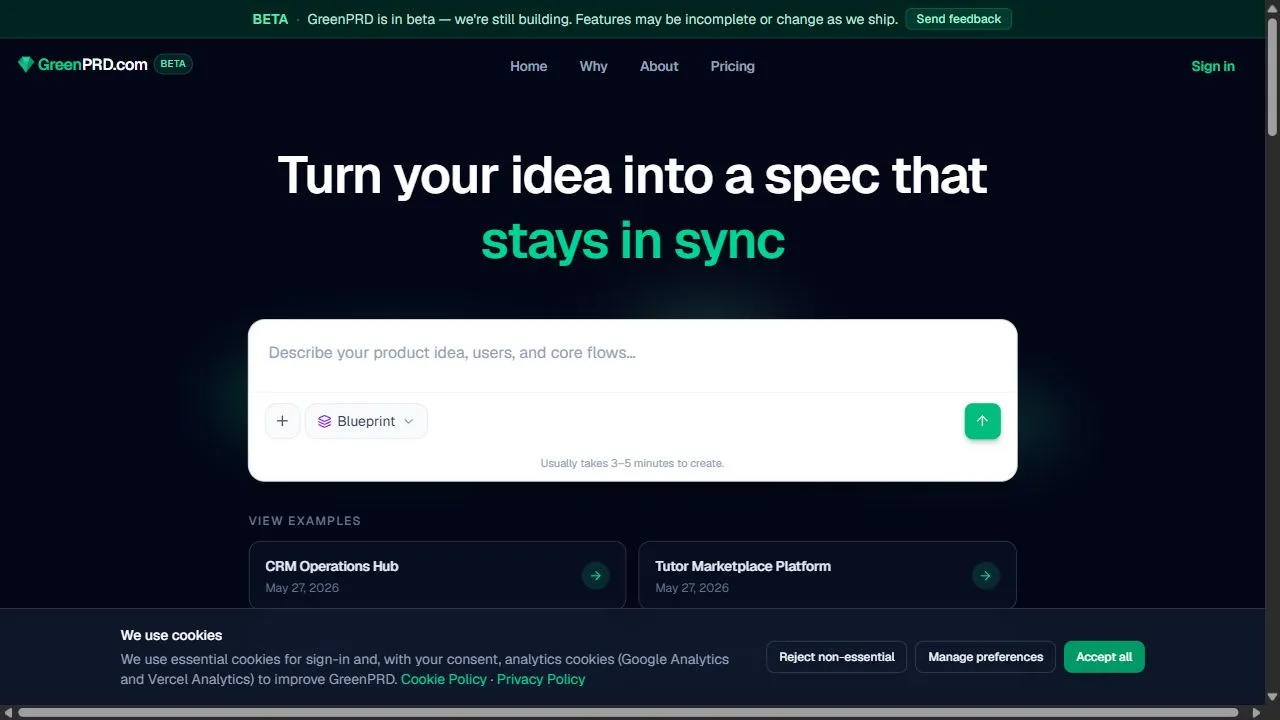
GreenPRD is a sophisticated AI-powered product management and documentation synchronization platform designed to help product managers, designers, and engineering teams maintain a living, breathing record of their product requirements. By leveraging artificial intelligence, Model Context Protocol (MCP), and intelligent visual graphing, the tool transforms raw, fragmented ideas into structured specifications that evolve in real-time alongside the actual codebase. It serves as a centralized intelligence hub, ensuring that the strategic intent of a product is never decoupled from its technical implementation.
The platform specifically solves the pervasive problem of documentation decay, a common failure in agile development where Product Requirement Documents (PRDs) become obsolete the moment a developer makes a critical change in the code. By utilizing AI to bridge the gap between high-level requirements and technical output, GreenPRD eliminates the manual burden of updating static documents. It is built for cross-functional teams who require a single source of truth to minimize miscommunication, reduce technical debt, and accelerate the development lifecycle.
For organizations struggling with "documentation drift," GreenPRD provides a dynamic environment where requirements are not just text files but interconnected data points. This allows stakeholders to visualize the dependencies between different features and understand how a change in one requirement ripples through the rest of the product architecture. By integrating AI-driven context management, the tool ensures that every team member—from the C-suite to the junior developer—is aligned with the most current version of the product truth.
Key Features of GreenPRD
- Centralized product brain that aggregates requirements, design specs, and technical documentation.
- AI-driven transformation of raw brainstormed ideas into structured, professional PRDs.
- Integration of Model Context Protocol (MCP) to maintain deep context across the product lifecycle.
- Visual graphing tools that map dependencies between various product features and requirements.
- Automated synchronization mechanisms that keep technical specifications aligned with feature evolution.
- Intelligent context management to prevent information silos within cross-functional teams.
- Dynamic documentation updates that trigger when core requirements are modified.
- Structured output generation for engineering hand-offs and design briefs.
- Real-time mapping of strategic product goals to specific technical tasks.
- Version-controlled requirement tracking to monitor the evolution of a feature over time.
Why People Use GreenPRD
The primary motivation for adopting GreenPRD is the elimination of documentation drift. In traditional product management workflows, requirements are typically housed in static documents or wiki pages like Notion or Confluence. While these tools are excellent for storage, they are passive; they do not know when the code has changed, nor do they automatically update when a developer pivots a feature's implementation during a sprint. This leads to a dangerous gap where the documentation describes a product that no longer exists, causing confusion and costly rework.
Teams turn to GreenPRD because it shifts documentation from a static chore to a dynamic asset. Instead of spending hours manually auditing documents to ensure they match the latest build, product managers can rely on the platform's ability to maintain context. The use of visual graphs allows users to see the "big picture" of their product architecture, making it significantly easier to identify potential bottlenecks or contradictory requirements before they reach the production stage.
Furthermore, the tool addresses the scalability issues associated with complex software projects. As a product grows, the web of dependencies becomes too complex for any single human to track perfectly. GreenPRD leverages AI to handle this complexity, providing a scalable way to manage thousands of interrelated requirements without losing sight of the original product vision. This results in a massive reduction in the mental overhead required to manage a product, allowing teams to focus on innovation rather than administrative synchronization.
Popular Use Cases
- Agile Software Development Teams: Used to ensure that user stories and technical specs remain in sync during rapid two-week sprint cycles, preventing the "documentation lag" that often occurs during mid-sprint pivots.
- Startup Founders: Employed to quickly translate a vision and a set of raw ideas into a structured roadmap and detailed PRDs that can be handed off to early-stage engineering hires.
- Enterprise Product Owners: Utilized to manage complex dependencies across multiple product modules, ensuring that a change in the core API requirements is reflected across all dependent feature documents.
- Technical Architects: Used to create visual maps of product requirements that align closely with the system architecture, providing a clear bridge between business logic and technical execution.
- UX/UI Design Teams: Integrated into the workflow to ensure that design specifications are based on the most current requirements, reducing the number of design revisions caused by outdated briefs.
- Compliance and Audit-Heavy Industries: Used to maintain a rigorous and traceable history of requirement changes, ensuring that the final product matches the documented specifications for regulatory purposes.
Benefits of GreenPRD
- Elimination of Documentation Decay: Ensures that specifications evolve in tandem with the product, removing the risk of relying on outdated information.
- Increased Engineering Velocity: Reduces the time developers spend asking for clarification on requirements, as the documentation is consistently accurate and structured.
- Reduced Technical Debt: Prevents the accumulation of architectural errors that stem from misaligned requirements and poorly communicated pivots.
- Enhanced Cross-Functional Alignment: Creates a unified language and visual map that designers, developers, and managers all use, minimizing friction during hand-offs.
- Faster Onboarding: Allows new team members to quickly grasp the entire product ecosystem by exploring the visual graphs and interconnected documentation.
- Improved Strategic Clarity: By mapping raw ideas to structured requirements, the tool helps stakeholders visualize the path from a conceptual goal to a tangible feature.
- Higher Quality Output: Increases the precision of the final product by ensuring that no requirement is overlooked or misinterpreted during the development process.
- Operational Efficiency: Automates the tedious process of updating related documents, freeing product managers to focus on strategy and user research.
A product management tool that keeps documentation, graphs, and requirements in sync as your project evolves.
Key use cases and capabilities
Page Insights
Pros & Cons
Pros
- Reduces documentation drift
- Keeps technical specs in sync with features
Cons
- Requires team adoption to be fully effective
- Learning curve for the graphing system
Frequently Asked Questions (FAQ)
How does GreenPRD stay in sync with my code?
It uses integrated tooling and context management to ensure documentation updates whenever key requirements change.
Is there a free trial or tier?
Yes, GreenPRD offers a free tier for individual users or small projects.
Related AIs
Featured


Compare with Alternatives
All VS
GetAi
@getai
Professional AI Workflow Automation tools for creators.
Pricing Details
More Related AIs
View All
WorqHat AI
WorqHat AI is an innovative AI workflow automation platform designed to empower users to build, d

WorqHat AI is an innovative AI workflow automation platform designed to empower users to build, deploy, and manage autonomous AI agents for a wide range of business tasks. It addresses the challenge of automating complex, multi-step processes that traditionally require significant manual effort a

Kortical
Opening Overview Kortical is a powerful AI-powered AutoML platform designed to help businesses a

Opening Overview Kortical is a powerful AI-powered AutoML platform designed to help businesses accelerate the development and deployment of machine learning models by leveraging artificial intelligence, automation, and intelligent workflows . The platform addresses the critical gap between pos
.png)
Victoria AI
Victoria AI is an innovative AI agent platform enabling users to build, deploy, and manage autono

Victoria AI is an innovative AI agent platform enabling users to build, deploy, and manage autonomous AI workflows for a variety of business applications. It addresses the challenge of automating complex, multi-step processes that traditionally require significant manual effort and specialized te
FlowPost
FlowPost is an AI-powered workflow automation platform designed to help users automate complex ta

 Yovilla Shulezhko5.0 stars
Mnemom
Mnemom is a sophisticated AI trust and verification platform designed to provide cryptographic pr

Mnemom is a sophisticated AI trust and verification platform designed to provide cryptographic proof and rigorous risk assessment for autonomous AI agents. By addressing the inherent "black box" nature of large language models and agentic workflows, the platform enables organizations to verify th
Epsilla
Epsilla is a powerful AI-powered vertical agent-as-a-service designed to help businesses and deve

Epsilla is a powerful AI-powered vertical agent-as-a-service designed to help businesses and developers build specialized LLM agents by leveraging artificial intelligence, automation, and private data integration . By bridging the gap between general-purpose large language models and proprieta

ClawDaddy
Opening Overview ClawDaddy is a specialized AI-powered deployment platform designed to help users

Opening Overview ClawDaddy is a specialized AI-powered deployment platform designed to help users deploy and manage AI agents by leveraging managed OpenClaw hosting and an intuitive Telegram-based interface . The platform solves the primary challenge of technical friction associated with AI im
Agentleader
Agentleader is an AI-powered lead generation platform designed to help businesses identify and c

 Luukas Saarela5.0 stars
Vagent
Vagent is an innovative AI agent voice chat platform that enables users to interact with their AI

 Jean Robin2.0 stars
BaseAI
BaseAI is an open-source framework for building autonomous AI agents, enabling developers to create

 Mehar Kumar5.0 stars
Agentforce
Agentforce is an AI agent platform that enables organizations to design, build, and deploy custom

 Etienne Denys3.0 stars
Maskara.ai
Maskara.ai is an innovative AI debate platform that enables users to orchestrate discussions betw

 Dimitri Fontai5.0 stars
Flowpoint
Flowpoint is an AI-powered workflow automation platform that enables users to automate complex ta

 Malthe Nielsen2.0 stars
Docusplit AI
Opening Overview Docusplit AI is a sophisticated AI-powered document management solution designed

Opening Overview Docusplit AI is a sophisticated AI-powered document management solution designed to help users automate the splitting, sorting, and organization of digital files by leveraging artificial intelligence, OCR technology, and intelligent automation workflows . In many professional

Formably
Formably is an AI-powered form backend designed to help businesses transform unstructured form d

Formably is an AI-powered form backend designed to help businesses transform unstructured form data into actionable insights by leveraging artificial intelligence and automation . Formably addresses the common problem of managing and extracting value from form submissions, which often arrive a
Leadodo
Leadodo is an AI-powered sales intelligence platform designed to help businesses accelerate revenue

 Rai Ferreira4.0 stars