
Plasma AI
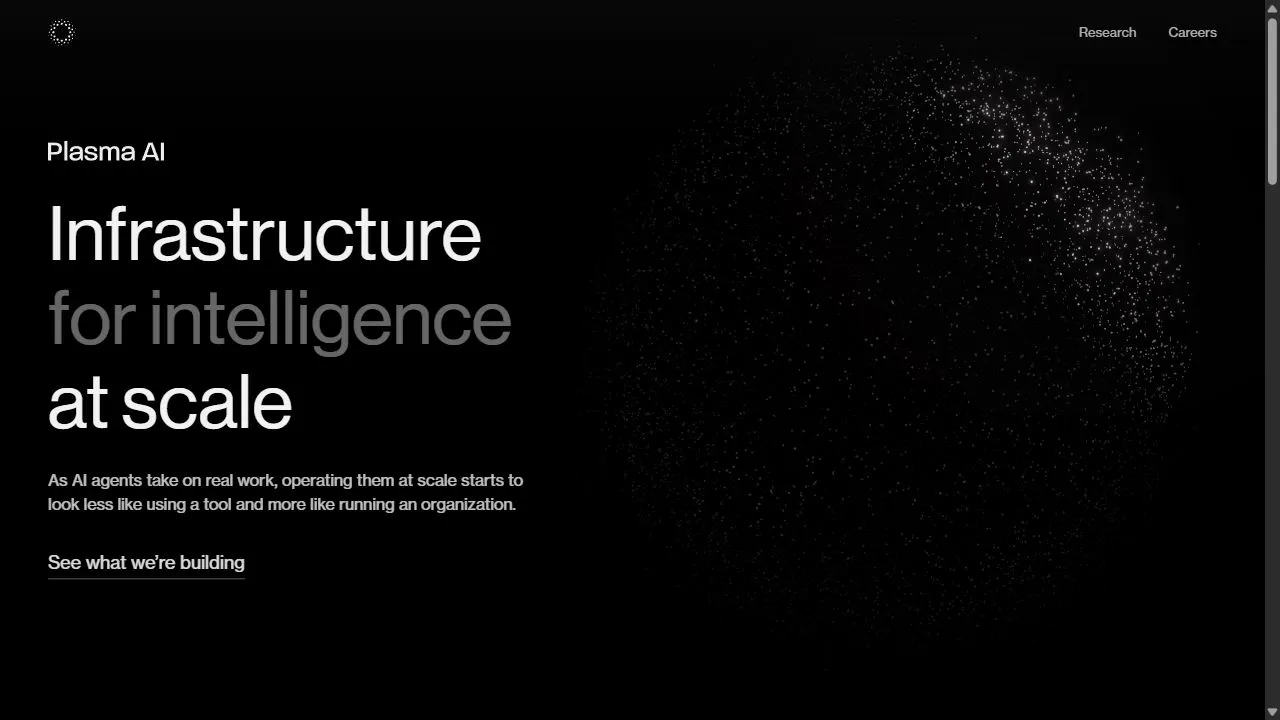
Plasma AI
Ai Tool Screenshots & Usage
Overview
Plasma AI is a comprehensive AI agent infrastructure layer designed to empower developers and engineering teams to build, deploy, and scale sophisticated autonomous agents by leveraging artificial intelligence, automation, and intelligent orchestration workflows. The platform addresses the critical challenge of infrastructure sprawl and the inherent complexity associated with maintaining reliable agentic architectures. By providing a standardized environment for data management and communication, Plasma AI allows organizations to move beyond simple prompt-based interactions toward fully autonomous systems capable of executing multi-step tasks with precision.
The tool is specifically engineered for software developers, data engineers, and enterprise AI teams who are struggling with the "plumbing" of AI development. Instead of spending countless hours configuring servers, managing state, or building custom communication protocols between different AI models, users can utilize Plasma AI as the foundational layer. This enables a strategic shift in focus, allowing teams to concentrate on the high-level behavior, intelligence, and specific logic of their agents while the platform handles the underlying stability and scalability required for production-grade deployments.
By integrating advanced orchestration capabilities, Plasma AI solves the problem of fragility in AI agent workflows. In traditional setups, as the number of agents or the complexity of their tasks increases, the system often becomes prone to failure or latency. Plasma AI mitigates these risks through a robust architectural design that ensures high availability and performant execution, making it an essential tool for those building enterprise-grade AI applications that require absolute reliability and the ability to handle high volumes of concurrent operations.
Key Features of Plasma AI
- Orchestration layer for coordinating complex multi-agent workflows and task delegation.
- Scalable API connectivity to integrate AI agents with external data sources and third-party software.
- Robust data management systems to handle agent memory, state persistence, and context windows.
- High-concurrency processing capabilities to ensure system responsiveness during peak operational loads.
- Modular component architecture allowing developers to swap or update agent behaviors without rebuilding the entire stack.
- Standardized communication protocols that facilitate seamless interaction between diverse AI agents.
- Infrastructure abstraction that removes the need for manual server configuration and environment maintenance.
- Enterprise-grade stability tools designed to prevent system crashes during complex autonomous executions.
- Flexible input and output handling supporting various text-based and structured data formats.
- Automated resource allocation to optimize the performance of AI agents based on real-time demand.
Why People Use Plasma AI
The primary motivation for adopting Plasma AI is the elimination of the technical debt associated with building AI agent infrastructure from scratch. In a manual development environment, engineers must build their own systems for tracking agent states, managing long-term memory, and ensuring that multiple agents can communicate without conflicting. This "infrastructure overhead" often consumes the majority of a development cycle, leaving very little time for the actual refinement of the AI's intelligence and utility. Plasma AI removes this barrier by providing a ready-made foundation, significantly accelerating the development lifecycle.
Furthermore, scalability is a recurring pain point for teams transitioning from a prototype or "Proof of Concept" (PoC) to a full-scale production environment. A system that works for one user often fails when scaled to thousands of concurrent users due to bottlenecks in data retrieval or orchestration failures. People use Plasma AI because it is built specifically for scale, offering the stability needed to support enterprise-level traffic without requiring a complete architectural overhaul.
Accuracy and reliability are also driving factors. Autonomous agents can often enter "infinite loops" or fail unexpectedly when they encounter an edge case in their workflow. By using a dedicated orchestration layer, developers can implement more rigorous controls and monitoring over how agents behave, ensuring that the final output is consistent and the process is transparent. This transition from fragile, custom-coded scripts to a professional infrastructure layer ensures that AI deployments are sustainable and maintainable over the long term.
Popular Use Cases
- Enterprise Customer Service Ecosystems: Deploying a network of specialized agents—one for billing, one for technical support, and one for account management—all coordinated through a single orchestration layer to provide seamless user experiences.
- Autonomous Market Research: Building agents that can independently browse the web, extract data from multiple sources, synthesize findings into a report, and update a central database without human intervention.
- Automated Software Development Lifecycles: Creating agents that can monitor code repositories, identify bugs, suggest fixes, and coordinate with testing agents to ensure code quality before deployment.
- Financial Analysis and Reporting: Scaling agents that monitor real-time market fluctuations, analyze quarterly earnings reports, and generate predictive insights for portfolio managers.
- Complex Content Supply Chains: Managing a pipeline of AI agents where one agent generates a content strategy, another drafts the copy, and a third optimizes the text for SEO and compliance.
- Internal Operational Automation: Developing agents that interface with corporate ERP and CRM systems to automate procurement workflows, employee onboarding, or inventory management.
Benefits of Plasma AI
- Increased Developer Velocity: By abstracting the infrastructure, developers can deploy functional AI agents in a fraction of the time it would take to build the supporting backend manually.
- Enhanced System Reliability: The platform reduces the likelihood of system failures and "hallucination loops" by providing a structured environment for agent orchestration.
- Seamless Scalability: Organizations can grow their AI capabilities from a few simple bots to a massive network of autonomous agents without experiencing performance degradation.
- Reduced Operational Overhead: The shift away from manual infrastructure maintenance lowers the cost of ownership and reduces the need for large DevOps teams to manage AI environments.
- Improved Architectural Flexibility: The modular nature of the platform allows teams to iterate quickly, updating specific agent behaviors or integrating new LLMs without disrupting the entire system.
- Higher Quality Outputs: With better state management and data orchestration, AI agents can maintain better context and produce more accurate, relevant results for the end user.
- Lower Barrier to Entry: Companies without massive internal infrastructure teams can now build enterprise-grade AI agent systems that were previously only possible for the largest tech giants.
Build and scale sophisticated AI agents with Plasma AI's robust infrastructure and orchestration layer.
Key use cases and capabilities
Page Insights
Pros & Cons
Pros
- Highly scalable
- Developer-centric architecture
- Reduces infrastructure maintenance
Frequently Asked Questions (FAQ)
Who is this for?
Plasma AI is designed for software developers and data engineers building autonomous agents.
Related AIs
Featured


Compare with Alternatives
All VS
GetAi
@getai
Professional AI Workflow Automation tools for creators.
Pricing Details
More Related AIs
View All
WorqHat AI
WorqHat AI is an innovative AI workflow automation platform designed to empower users to build, d

WorqHat AI is an innovative AI workflow automation platform designed to empower users to build, deploy, and manage autonomous AI agents for a wide range of business tasks. It addresses the challenge of automating complex, multi-step processes that traditionally require significant manual effort a

Kortical
Opening Overview Kortical is a powerful AI-powered AutoML platform designed to help businesses a

Opening Overview Kortical is a powerful AI-powered AutoML platform designed to help businesses accelerate the development and deployment of machine learning models by leveraging artificial intelligence, automation, and intelligent workflows . The platform addresses the critical gap between pos
.png)
Victoria AI
Victoria AI is an innovative AI agent platform enabling users to build, deploy, and manage autono

Victoria AI is an innovative AI agent platform enabling users to build, deploy, and manage autonomous AI workflows for a variety of business applications. It addresses the challenge of automating complex, multi-step processes that traditionally require significant manual effort and specialized te

FlowPost
FlowPost is an AI-powered workflow automation platform designed to help users automate complex ta

 Yovilla Shulezhko5.0 stars
Mnemom
Mnemom is a sophisticated AI trust and verification platform designed to provide cryptographic pr

Mnemom is a sophisticated AI trust and verification platform designed to provide cryptographic proof and rigorous risk assessment for autonomous AI agents. By addressing the inherent "black box" nature of large language models and agentic workflows, the platform enables organizations to verify th
Epsilla
Epsilla is a powerful AI-powered vertical agent-as-a-service designed to help businesses and deve

Epsilla is a powerful AI-powered vertical agent-as-a-service designed to help businesses and developers build specialized LLM agents by leveraging artificial intelligence, automation, and private data integration . By bridging the gap between general-purpose large language models and proprieta

ClawDaddy
Opening Overview ClawDaddy is a specialized AI-powered deployment platform designed to help users

Opening Overview ClawDaddy is a specialized AI-powered deployment platform designed to help users deploy and manage AI agents by leveraging managed OpenClaw hosting and an intuitive Telegram-based interface . The platform solves the primary challenge of technical friction associated with AI im

Agentleader
Agentleader is an AI-powered lead generation platform designed to help businesses identify and c

 Luukas Saarela5.0 stars
Vagent
Vagent is an innovative AI agent voice chat platform that enables users to interact with their AI

 Jean Robin2.0 stars
BaseAI
BaseAI is an open-source framework for building autonomous AI agents, enabling developers to create

 Mehar Kumar5.0 stars
Agentforce
Agentforce is an AI agent platform that enables organizations to design, build, and deploy custom

 Etienne Denys3.0 stars
Maskara.ai
Maskara.ai is an innovative AI debate platform that enables users to orchestrate discussions betw

 Dimitri Fontai5.0 stars
Flowpoint
Flowpoint is an AI-powered workflow automation platform that enables users to automate complex ta

 Malthe Nielsen2.0 stars
Docusplit AI
Opening Overview Docusplit AI is a sophisticated AI-powered document management solution designed

Opening Overview Docusplit AI is a sophisticated AI-powered document management solution designed to help users automate the splitting, sorting, and organization of digital files by leveraging artificial intelligence, OCR technology, and intelligent automation workflows . In many professional

Formably
Formably is an AI-powered form backend designed to help businesses transform unstructured form d

Formably is an AI-powered form backend designed to help businesses transform unstructured form data into actionable insights by leveraging artificial intelligence and automation . Formably addresses the common problem of managing and extracting value from form submissions, which often arrive a

Leadodo
Leadodo is an AI-powered sales intelligence platform designed to help businesses accelerate revenue

 Rai Ferreira4.0 stars