
Yaw Terminal
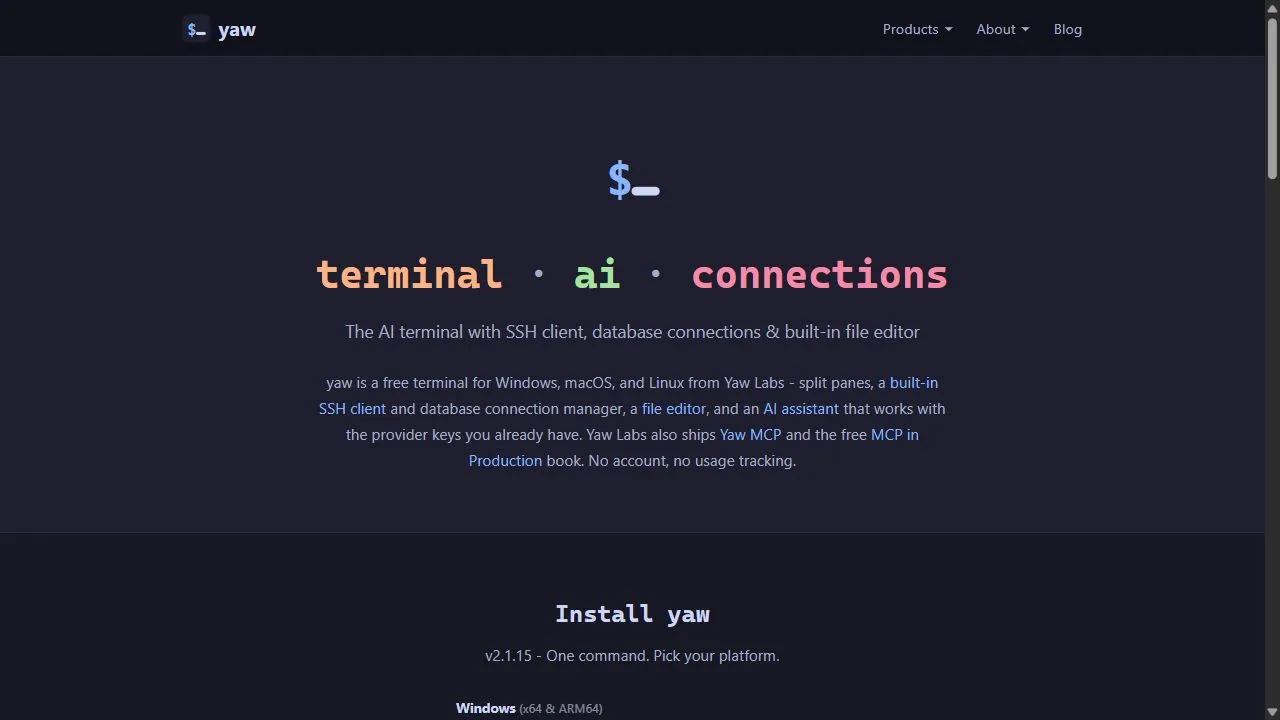
Yaw Terminal
Ai Tool Screenshots & Usage
Overview
Yaw Terminal is a powerful AI-native terminal interface designed to help developers bridge the gap between Large Language Models (LLMs) and local development environments by leveraging artificial intelligence, automation, and the Model Context Protocol (MCP). By integrating AI directly into the command-line experience, it solves the persistent problem of context switching, where developers must manually copy and paste code snippets and error logs between a chat interface and their terminal.
The tool utilizes AI to transform the traditional static terminal into an intelligent agent capable of understanding the local environment. Through the implementation of the Model Context Protocol, Yaw Terminal allows LLMs to securely access local tools, read files, and execute commands with a level of context that was previously unavailable in standard AI chat applications. This creates a seamless loop where the AI does not just suggest code but can actively participate in the management of repositories and the execution of complex automation tasks.
Designed primarily for software engineers, DevOps professionals, and AI researchers, Yaw Terminal serves as a comprehensive ecosystem for modern infrastructure patterns. Beyond its functional capabilities as a shell, it provides integrated educational resources, such as the "MCP in Production" guide, ensuring that users can effectively scale their AI-driven workflows from simple prompts to production-ready automation.
Key Features of Yaw Terminal
- Native support for the Model Context Protocol (MCP) to connect LLMs with local data sources.
- AI-driven command execution and script generation within the terminal environment.
- Integrated repository management allowing for AI-assisted version control workflows.
- Local development environment bridging to reduce manual data entry between AI and shell.
- Advanced automation capabilities for repetitive system administration tasks.
- Native AI interface optimized for developer productivity and low-latency interaction.
- Access to comprehensive documentation and guides for implementing MCP in production settings.
- Support for diverse input types to facilitate complex prompt engineering for system tasks.
- Intelligent context awareness that allows the AI to understand the current directory and file structure.
- Seamless integration with various LLM providers through standardized protocols.
Why People Use Yaw Terminal
The primary motivation for adopting Yaw Terminal is the elimination of the "context gap" that exists in traditional AI-assisted development. In a standard workflow, a developer asks an AI for a solution, receives a code block, and then manually implements it in the terminal, only to copy the resulting error back into the AI for debugging. Yaw Terminal removes these manual steps by allowing the AI to interact directly with the environment, significantly reducing the time spent on repetitive manual tasks.
Developers shift to this tool because traditional terminals are passive; they only execute exactly what is typed. Yaw Terminal introduces an active layer of intelligence that can suggest optimizations, automate the setup of environments, and manage dependencies without the user needing to remember every specific flag or syntax variation. This transition from a passive tool to an AI-native interface leads to a dramatic increase in accuracy and a reduction in human error during complex deployments.
Furthermore, the scalability offered by the Model Context Protocol (MCP) is a major draw. As developers build more complex systems, the ability to provide an AI with a standardized way to access tools and data becomes critical. Yaw Terminal provides the necessary infrastructure to implement these patterns, making it an essential tool for those looking to move beyond basic AI chatting and toward full-scale AI agentic workflows in their local development stacks.
Popular Use Cases
- Automated Codebase Refactoring: Developers use the tool to scan local directories and apply consistent refactoring patterns across multiple files using AI agents that understand the project structure.
- Infrastructure as Code (IaC) Management: DevOps engineers utilize the terminal to generate, test, and deploy Terraform or Kubernetes configurations with real-time AI validation against the local state.
- Rapid Debugging and Log Analysis: System administrators use Yaw Terminal to pipe complex error logs directly into the AI interface for immediate root-cause analysis and suggested remediation commands.
- CI/CD Pipeline Orchestration: Engineering teams use the AI-native interface to automate the triggering and monitoring of deployment pipelines, allowing the AI to interpret failure messages and suggest fixes.
- MCP Standard Implementation: AI researchers and software architects use the tool as a reference implementation to learn how to build and deploy their own MCP-compliant tools and servers.
- Local Environment Bootstrapping: New developers on a project use the AI interface to automate the installation of dependencies and configuration of environment variables based on the project's README and file structure.
Benefits of Yaw Terminal
- Increased Development Velocity: By removing the need to switch between a browser and a terminal, developers can complete tasks faster and maintain a state of deep work.
- Reduced Cognitive Load: Users no longer need to memorize exhaustive CLI documentation, as the AI handles the syntax and command construction based on the user's intent.
- Enhanced Accuracy: Direct integration with the local environment means the AI provides solutions based on the actual state of the code, rather than general assumptions.
- Streamlined AI Integration: The adoption of the Model Context Protocol simplifies the process of giving LLMs access to specific local tools and data without compromising security.
- Improved Onboarding: The inclusion of production-grade educational resources helps developers quickly master modern AI-native infrastructure patterns.
- Higher Productivity in Automation: The ability to turn natural language descriptions into executable terminal workflows allows for the rapid creation of custom automation scripts.
- Seamless Workflow Synergy: The unification of the shell and the AI creates a cohesive environment where the tool understands the "what" and the "how" of the developer's goals.
Yaw Terminal is an AI-powered developer tool and terminal that supports MCP protocols for enhanced productivity.
Key use cases and capabilities
Page Insights
Pros & Cons
Pros
- Completely free
- Supports MCP integration
Frequently Asked Questions (FAQ)
What is MCP?
MCP stands for Model Context Protocol, which Yaw integrates to bridge AI models with your development environment.
Related AIs
Featured

Compare with Alternatives
All VS
GetAi
@getai
Professional Coding Tutor tools for creators.
Pricing Details
More Related AIs
View AllNitro
Nitro is a high-performance AI inference engine designed to provide a fast, lightweight, and open

Nitro is a high-performance AI inference engine designed to provide a fast, lightweight, and open-source alternative to traditional cloud-based artificial intelligence interfaces. By shifting the computational burden from remote servers to local hardware, it enables users to execute complex large

CodingFleet
CodingFleet is a professional AI-powered Python code generator designed to help developers, data

 Julius Martinez3.0 stars
Anycode AI
Anycode AI is a comprehensive AI-powered engineering stability platform designed to help developm

Anycode AI is a comprehensive AI-powered engineering stability platform designed to help development teams put security, stability, and scalability on autopilot by leveraging artificial intelligence, automated codebase analysis, and intelligent monitoring workflows . By integrating directly into

Bob by IBM
Bob by IBM is a sophisticated AI-powered software development partner designed to ensure high-lev

Bob by IBM is a sophisticated AI-powered software development partner designed to ensure high-level code quality throughout the entire engineering lifecycle. By leveraging advanced artificial intelligence and automated analysis , Bob assists developers in maintaining rigorous coding standards, i

CodeAnt AI
Opening Overview CodeAnt AI is a powerful AI-powered code health platform designed to help users

Opening Overview CodeAnt AI is a powerful AI-powered code health platform designed to help users maintain high-quality software standards by leveraging artificial intelligence, automation, and intelligent code analysis . By integrating directly into the development workflow, it addresses the c

Windsurf
Opening Overview Windsurf is an advanced AI-powered Integrated Development Environment (IDE) desi

Opening Overview Windsurf is an advanced AI-powered Integrated Development Environment (IDE) designed to help software developers maintain their cognitive flow state by leveraging artificial intelligence, autonomous agents, and deep context-aware workflows . Unlike traditional code editors that

OrchestrAI
OrchestrAI is an AI-powered code review and static analysis platform designed to help software de

OrchestrAI is an AI-powered code review and static analysis platform designed to help software development teams improve code quality, security, and compliance throughout the software development lifecycle. OrchestrAI addresses the critical challenge of ensuring code reliability and security in

Redlight Greenlight for Claude Code
Redlight Greenlight for Claude Code is a macOS utility designed to manage and approve permission re

Redlight Greenlight for Claude Code is a macOS utility designed to manage and approve permission requests generated by Claude Code, enhancing security and control for developers utilizing AI-powered coding assistance. This tool addresses the challenge of securely integrating AI coding tools like Cl
Interview Solver
Interview Solver is an AI-powered live coding interview assistant designed to help developers ex

Interview Solver is an AI-powered live coding interview assistant designed to help developers excel in technical interviews by providing real-time coding support and guidance. Interview Solver addresses the challenges developers face during the high-pressure environment of coding interviews. It
Pillar | App Copilot
Pillar | App Copilot is a powerful open-source AI copilot designed to help developers and softwar

Pillar | App Copilot is a powerful open-source AI copilot designed to help developers and software architects transform natural language user requests into executable actions within an application by leveraging artificial intelligence, automation, and intelligent mapping workflows . By bridgin

Playrun
Playrun is a powerful AI-powered automated testing platform designed to help developers identify

Playrun is a powerful AI-powered automated testing platform designed to help developers identify and resolve software bugs by leveraging artificial intelligence, automation, and intelligent workflows . By shifting the testing process to the left in the development lifecycle, the tool ensures t

Corgea
Opening Overview Corgea is a powerful AI-powered application security platform designed to help u

Opening Overview Corgea is a powerful AI-powered application security platform designed to help users identify and automatically remediate vulnerabilities in their code by leveraging artificial intelligence, automation, and intelligent workflows . In a landscape where cyber threats evolve with

Explain by Whybug
Explain by Whybug is a specialized AI-powered debugging assistant designed to help software devel

Explain by Whybug is a specialized AI-powered debugging assistant designed to help software developers resolve code errors more efficiently by translating cryptic error logs into actionable insights. The tool addresses the universal challenge of encountering complex stack traces and runtime error

LLaMA
LLaMA is a powerful AI-powered collection of Large Language Models (LLMs) designed to help users

LLaMA is a powerful AI-powered collection of Large Language Models (LLMs) designed to help users develop, customize, and deploy state-of-the-art artificial intelligence by leveraging open-source architecture, advanced neural networks, and intelligent linguistic workflows . Developed by Meta, t
CodeRabbit
CodeRabbit is an AI-powered code review tool that automates the identification of bugs, security

CodeRabbit is an AI-powered code review tool that automates the identification of bugs, security vulnerabilities, and potential improvements within software code, directly integrated into pull requests. CodeRabbit addresses the challenges of traditional, manual code review processes, which are of

The Coder
The Coder is an intelligent AI coding assistant that helps developers write, debug, and understa

The Coder is an intelligent AI coding assistant that helps developers write, debug, and understand code more efficiently. It addresses the challenges of complex codebases, time-consuming debugging, and the steep learning curve associated with new programming languages. The Coder utilizes natur


