Google takes Dreambeans to India in bid to bring AI-generated personal stories to the masses
The application is now available in India for users aged 18 and above on Android and iOS,

Google is expanding its artificial intelligence ambitions in India with the international launch of Dreambeans, an experimental AI-powered application designed to transform users' everyday digital activities into personalized visual stories.
Developed by Google Labs, Dreambeans takes a different approach to artificial intelligence. Instead of waiting for users to enter prompts or ask questions, the application proactively generates personalized collections of stories using information from Google services that users choose to connect.

The application is now available in India for users aged 18 and above on Android and iOS, making India its first international market outside the United States.
With support for 14 languages, including Hindi, Bengali, Tamil, Telugu, Marathi, Punjabi, and English, Google is attempting to make personalized AI experiences accessible to a much broader audience.
The launch represents another step in Google's strategy to make artificial intelligence a more integrated part of everyday digital experiences rather than limiting it to traditional chatbots and search assistants.
However, Dreambeans also raises important questions about personal data, privacy, AI-generated memories, and how much access users should give an AI application to their digital lives.
What Is Google Dreambeans?
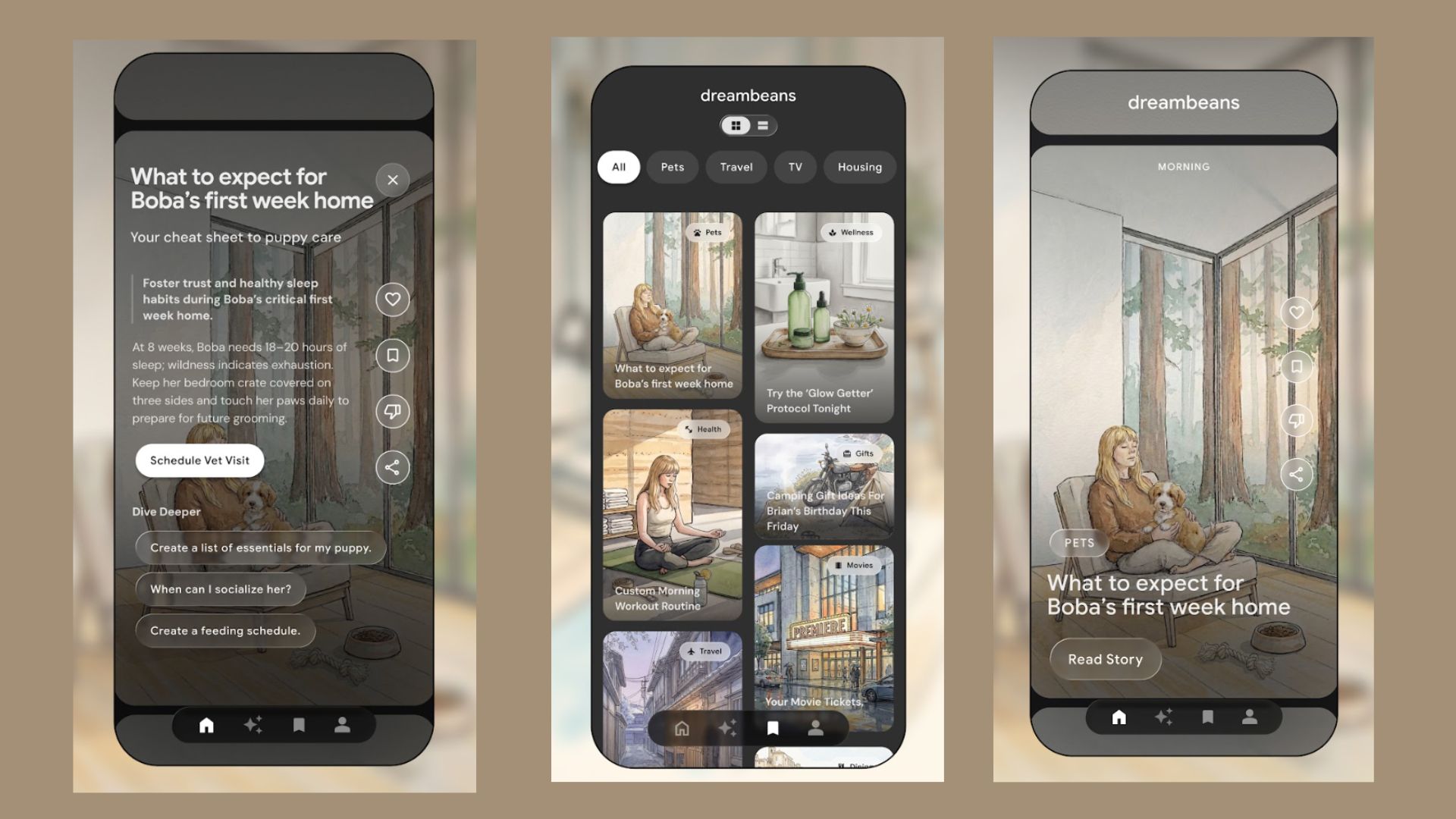
Dreambeans is an experimental application from Google Labs that uses artificial intelligence to create personalized daily collections of stories based on users' interests, activities, and information available through connected Google services.
Unlike traditional AI assistants such as Gemini or ChatGPT, Dreambeans is not primarily designed to answer questions or generate content in response to detailed prompts.
Instead, it works proactively.
After users connect their preferred Google services, Dreambeans analyzes relevant information and generates personalized story recommendations that may include:
- Places users might enjoy visiting.
- Upcoming events and important reminders.
- Personalized travel suggestions.
- New hobbies and creative activities.
- Entertainment recommendations.
- Health, fitness, and lifestyle inspiration.
- Topics related to users' interests.
- Suggestions based on recent digital activities.
Each story is presented through an illustrated visual experience, making information easier to explore and understand.
Google's broader goal is to reduce endless scrolling and help people discover information that is genuinely relevant to their lives.
The company describes the experience as a collection of daily stories designed to connect users with things that matter to them.
Why Google Is Bringing Dreambeans to India
India has become one of the most important markets for global technology companies, particularly as smartphone adoption, internet usage, and interest in artificial intelligence continue to expand.
Google selected India as Dreambeans' first international destination because of strong interest from Indian users and the widespread adoption of its services.
According to Google product manager Gozde Oznur, India has particularly strong overlap among users of Gemini, Gmail, and Google Photos.
This matters because Dreambeans depends on information from connected Google applications to create meaningful personalized experiences.
For example:
- Gmail may contain information about travel bookings and upcoming activities.
- Google Calendar can provide information about scheduled events.
- Google Photos can help personalize visual stories.
- YouTube activity can offer insights into entertainment interests.
- Google Search activity can help identify subjects users frequently explore.
- Gemini interactions can provide additional context about interests.
By combining these sources, Google hopes to create a more personalized AI experience.
India also provides an opportunity to test whether this type of proactive AI application can attract users across different languages, cultures, and lifestyles.
How Dreambeans Works With Google's AI Technology
Dreambeans uses Google's Personal Intelligence technology to understand relevant information from connected services and create personalized content.
The application was introduced in June 2026 and initially focused on generating static AI illustrations.
Google has also incorporated its image-generation technology, including Nano Banana 2, into the experience.
The process generally involves three stages.
1. Connecting Google Services
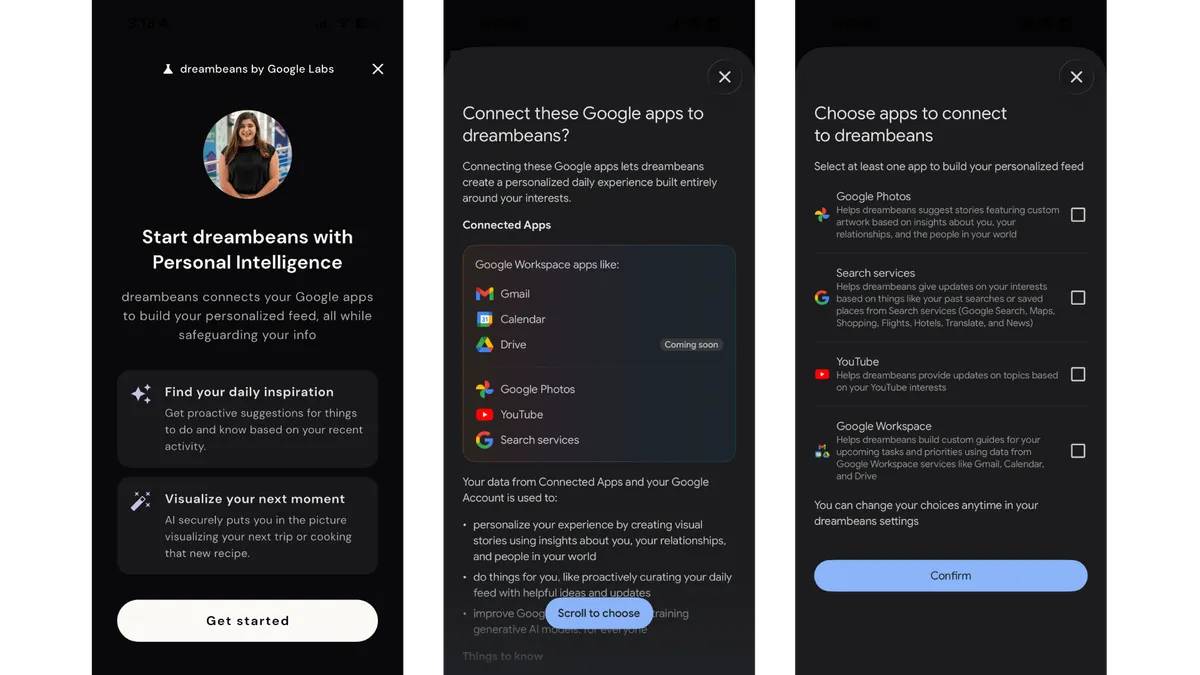
Users first choose which Google applications they want to connect.
Supported services include:
- Gmail
- Google Calendar
- Google Photos
- Google Search
- YouTube
- Gemini
Users do not have to connect every service. They can choose which information sources they want Dreambeans to use.
2. Understanding Personal Interests
Google's Personal Intelligence technology uses information from connected services to identify relevant interests, activities, and potential recommendations.
For example, if someone frequently watches travel videos, searches for destinations, and has upcoming travel plans in Calendar, Dreambeans may generate a story related to exploring a particular destination.
Similarly, someone interested in fitness could receive personalized suggestions connected to their interests.
3. Generating Personalized Stories
After analyzing relevant context, the application creates illustrated stories.
Users can:
- Open individual stories.
- Explore additional information.
- Bookmark interesting recommendations.
- Share stories with others.
- Provide feedback about generated content.
The experience is designed to feel more like a personalized digital magazine than a conventional AI chatbot.
Dreambeans Introduces AI-Generated Visual Stories
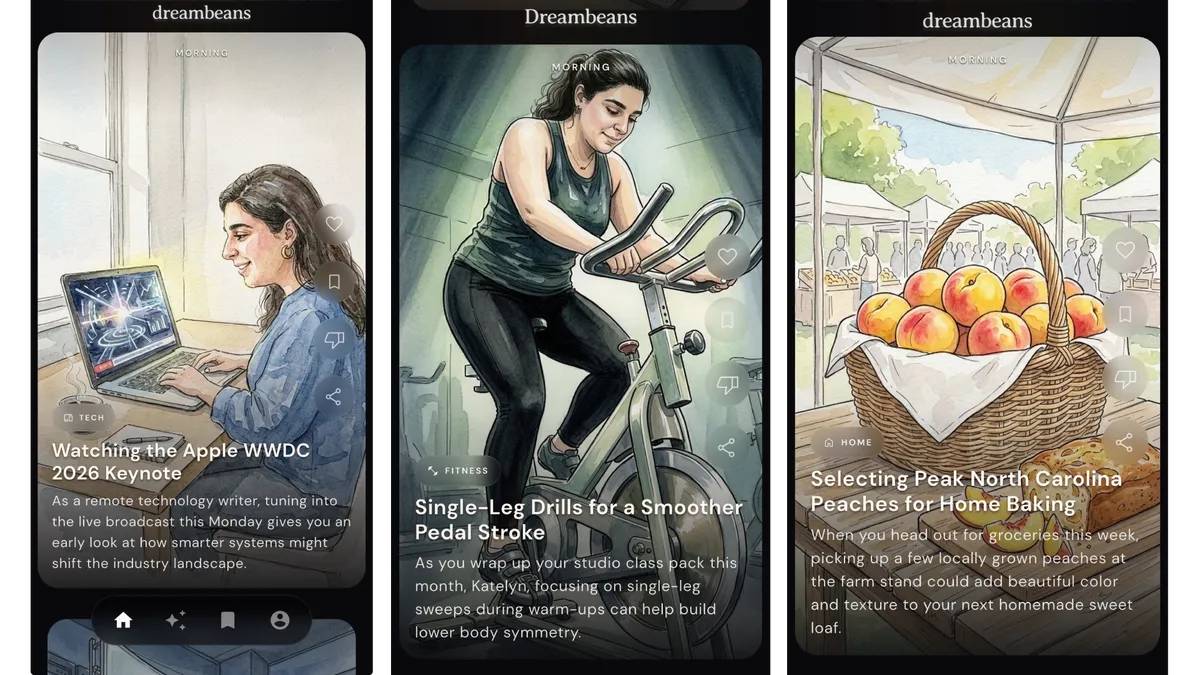
One of the most interesting aspects of Dreambeans is its visual storytelling approach.
Rather than presenting users with ordinary text-based recommendations, the application creates illustrated experiences around different subjects.
These illustrations help transform personal information into something more engaging.
For example, a user interested in astronomy might receive an illustrated story about an upcoming meteor shower.
Someone interested in cooking might receive suggestions for recipes and creative food experiments.
A person planning a trip could discover destinations and activities connected to their interests.
The application also allows users to explore individual stories instead of simply scrolling through an endless feed.
This approach reflects a growing trend in consumer AI products: moving beyond text generation toward personalized multimedia experiences.
Google's Veo Adds Animation Capabilities
Google has also introduced a feature that uses its Veo video-generation model to animate images in selected stories.
This makes the experience more dynamic than the original static illustrations.
Instead of displaying only AI-generated artwork, selected stories can include animated visual elements.
The integration demonstrates how Google is bringing together multiple AI technologies within a single consumer application.
Combining personalization, image generation, and video generation could eventually make Dreambeans a more interactive storytelling platform.
However, the animation feature is currently limited to selected stories rather than being available universally.
India Gets Support for 14 Languages
One of the most important parts of the India launch is language accessibility.
Dreambeans supports 14 languages:
- English
- Hindi
- Bengali
- Telugu
- Marathi
- Tamil
- Urdu
- Gujarati
- Kannada
- Malayalam
- Odia
- Punjabi
- Assamese
- Nepali
This multilingual support is particularly important in India, where millions of internet users communicate in regional languages rather than English.
Google wants Dreambeans to become accessible to people who may not regularly use English-language AI applications.
However, there is one important limitation.
Users can currently select only one language at a time for their generated stories.
Although Dreambeans can access information from connected Google services in multiple languages, it cannot currently generate stories that naturally combine different languages.
This could become a limitation in India, where many people regularly mix Hindi and English in everyday conversations, a communication style commonly known as Hinglish.
For example, someone might use Hindi in messages, English in professional emails, and a mixture of both languages when searching online.
An AI application that cannot naturally understand and reproduce this multilingual behavior may feel less personalized to some users.
Improving mixed-language generation could therefore become an important area for future development.
Privacy Concerns: How Much Personal Data Does Dreambeans Need?
While Dreambeans introduces an interesting approach to AI personalization, its reliance on personal Google account information raises significant privacy questions.
The application can connect to services that contain highly personal information, including:
- Private emails.
- Personal photographs.
- Travel information.
- Calendar appointments.
- Search activity.
- Entertainment preferences.
- Personal conversations with Gemini.
For some users, sharing this information with an AI application may be uncomfortable.
The concern is not simply whether AI can generate useful recommendations. It is also about how much personal information is necessary to provide those recommendations.
Google has outlined several controls intended to give users greater control over their information.
Users Can Choose Connected Services
Users can decide which Google services they want to connect to Dreambeans.
They can also disconnect individual services whenever they want.
This means users do not have to provide access to every supported application.
Users Can Delete Their Dreambeans Data
Google says users can delete their Dreambeans data directly within the application.
The company also stated that information deleted from underlying connected services is removed from Dreambeans' personalization system.
Users Can Exclude Certain Topics
Dreambeans allows users to communicate preferences about subjects they do not want to see.
For example, someone who does not want business-related information appearing in their personal stories can ask the application to avoid those subjects.
Google says the application will attempt to adjust its recommendations accordingly.
Stories Are Private
Dreambeans is currently designed for personal Gmail accounts rather than enterprise accounts.
Google says generated stories are visible only to the account holder.
These controls are important, but users should still review the permissions they grant before connecting sensitive accounts.
The Emotional Risks of AI-Generated Personal Stories
Another interesting concern involves the emotional impact of personalized AI recommendations.
Because Dreambeans analyzes information connected to users' personal lives, it may occasionally generate stories involving sensitive memories or people.
For example, the application could surface content involving someone who has passed away.
While such recommendations may be meaningful for some users, they could also create uncomfortable or upsetting experiences.
Google product manager Gozde Oznur acknowledged this possibility and explained that users can ask Dreambeans to stop showing particular subjects.
The company compares these controls to features in Google Photos that allow users to limit which memories appear.
This highlights an important challenge for personalized AI systems.
An application can understand a person's interests and history without necessarily understanding how that person feels about every memory.
AI personalization therefore needs more than accurate recommendations. It also requires sensitivity, user control, and the ability to respect personal boundaries.
How Dreambeans Compares With ChatGPT, Gemini, and Other AI Apps
Dreambeans enters a competitive AI application market dominated by general-purpose assistants and increasingly personalized digital experiences.
However, its approach is different.
| Platform | Primary Purpose |
|---|---|
| Google Dreambeans | Personalized daily visual stories |
| Google Gemini | General-purpose AI assistant |
| ChatGPT | AI conversations, research, writing, and productivity |
| Claude | AI assistant for reasoning and knowledge work |
| Meta AI | AI assistance and social experiences |
The most important difference is that Dreambeans does not depend on users continuously asking questions.
Instead, it proactively creates collections of content based on their connected digital activities.
This gives Google an opportunity to explore a different category of consumer AI applications.
Rather than competing directly with every chatbot, Dreambeans is experimenting with how AI can become a personalized discovery and recommendation layer.
Early Adoption: Can Dreambeans Become a Mainstream AI App?
Dreambeans' expansion into India comes with an interesting early adoption picture.
According to Sensor Tower estimates shared with TechCrunch, the application recorded nearly 55,000 downloads in the United States between its June launch and October 2026.
Approximately 63% of those downloads came in September, when Google expanded access to all eligible U.S. users aged 18 and above.
However, downloads subsequently declined by approximately 84% month over month in October, reaching around 5,500.
During its first 30 days of broader U.S. availability, Dreambeans recorded an estimated 29,000 downloads.
For comparison, Sensor Tower estimated:
- Meta's Muse: 7.4 million downloads.
- ChatGPT: 2.8 million downloads.
- Grok: 362,000 downloads.
- Claude: 155,000 downloads.
These comparisons need context because Dreambeans is a specialized storytelling application, while the others are broader AI assistants.
Nevertheless, the numbers suggest that Google still has work to do to turn Dreambeans into a widely adopted consumer product.
India could become an important market for testing whether localized language support and personalized recommendations can improve adoption.
What Google Wants to Build Next
Google is not necessarily positioning Dreambeans as a simple AI storytelling application.
The company is exploring ways to make the experience more actionable.
Currently, users can discover recommendations, explore stories, bookmark information, and share content.
The next step could involve helping users act on those recommendations.
For example:
- Turning travel inspiration into actual trip planning.
- Helping users discover local activities.
- Connecting recommendations with useful services.
- Making event discovery more convenient.
- Helping users explore new interests and hobbies.
Google has discussed exploring these possibilities, although it has not announced a detailed timeline for such capabilities.
If successfully developed, Dreambeans could evolve from a personalized story generator into a broader AI-powered personal discovery assistant.
What This Means for India's AI Ecosystem
Google's decision to launch Dreambeans in India is significant beyond the application itself.
India is becoming an increasingly important destination for AI product launches, experimentation, and localization.
Several factors make the country attractive for consumer AI companies:
- A large smartphone user base.
- Growing interest in generative AI.
- Strong adoption of Google's digital services.
- Demand for regional-language technology.
- A rapidly expanding startup ecosystem.
The Dreambeans launch also demonstrates that the next generation of AI applications may not necessarily look like traditional chatbots.
Companies are experimenting with AI-powered interfaces that can understand personal context, create visual experiences, and proactively recommend useful information.
For Indian developers and startups, this creates opportunities in areas such as personalized AI assistants, regional-language applications, recommendation systems, and intelligent content discovery.
However, the success of these applications will depend heavily on trust, transparency, and responsible handling of personal information.
Final Thoughts
Google's expansion of Dreambeans into India represents an interesting experiment in the future of personalized artificial intelligence.
Instead of requiring users to search for information or repeatedly enter prompts, the application attempts to understand their interests and proactively create meaningful daily stories.
Its integration with Gmail, Calendar, Google Photos, Search, YouTube, and Gemini gives it access to a broad range of personal context, while support for 14 languages makes the experience more accessible to India's diverse population.
However, privacy concerns, multilingual limitations, emotional sensitivity, and early adoption challenges remain important obstacles.
The bigger question is whether users will feel comfortable allowing AI to turn information from their everyday digital lives into personalized stories.
If Google gets the balance right, Dreambeans could help establish a new category of consumer AI applications: personalized AI experiences that do not simply answer questions but actively help people discover what matters to them.
For now, Dreambeans remains an experimental Google Labs product, and its expansion into India will provide an important test of whether this vision can reach mainstream audiences.
Frequently Asked Questions (FAQ)
1. What is Google Dreambeans?
Google Dreambeans is an experimental AI application developed by Google Labs that creates personalized daily collections of illustrated stories using information from Google services selected by users.
2. Is Google Dreambeans available in India?
Yes. Google expanded Dreambeans to India on November 3, 2026. It is available on Android and iOS for users aged 18 and above.
3. Which Google services can Dreambeans connect to?
Dreambeans supports Gmail, Google Calendar, Google Photos, Google Search, YouTube, and Gemini for personalized experiences.
4. Does Dreambeans generate AI images?
Yes. Dreambeans creates illustrated visual stories using Google's AI image-generation technology. Selected stories can also feature animation powered by Google's Veo video-generation model.
5. Which languages does Google Dreambeans support?
Dreambeans supports 14 languages, including English, Hindi, Bengali, Tamil, Telugu, Marathi, Urdu, Gujarati, Kannada, Malayalam, Odia, Punjabi, Assamese, and Nepali.
6. Is Google Dreambeans free?
Google has announced the India expansion for eligible users aged 18 and above. The application is available through Android and iOS. Users should check the current app listing and eligibility requirements for availability details.
7. Does Dreambeans access personal Gmail information?
Dreambeans can use information from Gmail and other Google services that users choose to connect. Users can control connected services and disconnect them.
8. Can users delete their personal data from Dreambeans?
Yes. Google says users can delete their Dreambeans data within the application. The company also says information deleted from connected services is removed from its personalization system.
9. Is Dreambeans similar to Google Gemini?
Not exactly. Gemini is a general-purpose AI assistant that responds to user prompts, while Dreambeans proactively generates personalized daily story collections based on connected personal information.
10. Can Dreambeans generate stories in Hinglish?
Currently, users can select only one language at a time. Although the app can use information from connected services in multiple languages, it cannot yet generate stories that naturally combine languages such as Hindi and English.
11. Who can use Google Dreambeans?
The India launch is available to users aged 18 and above with personal Google accounts.
12. What makes Dreambeans different from traditional AI applications?
Its proactive approach is the biggest difference. Instead of waiting for questions, it uses connected personal context to generate daily stories, recommendations, and discoveries.
13. Can Dreambeans create upsetting personal memories?
It may occasionally surface sensitive memories or stories involving people from a user's past. Google provides controls that allow users to ask the application to avoid certain subjects.
14. Will Google expand Dreambeans with more features?
Google is exploring ways to make Dreambeans more actionable, potentially helping users move from personalized recommendations to taking practical steps based on those suggestions. No specific timeline has been announced.
Sources and Further Reading:
- Google Official Announcement: https://blog.google/intl/en-in/products/dreambeans-is-now-available-to-everyone-in-india/
- Google Labs: https://labs.google/dreambeans
- TechCrunch: https://techcrunch.com/2026/11/02/google-takes-dreambeans-to-india-in-bid-to-bring-ai-generated-personal-stories-to-the-masses/
- Gadgets 360: https://www.gadgets360.com/apps/news/google-dreambeans-app-india-launch-ai-powered-personalised-stories-features-12274407